falseFY20250000022701YesYesNoNoP3MP3YP18M0.330.070.500.070.070.0050.500.020.020.0050.070.020.0050.50.0050.0050.0050.0050.0050000022701sune:NeedhamSalesAgreementMember2025-11-042025-11-040000022701sune:AtFirstClosingMembersune:PriorToReverseStockSplitsMembersune:April2025ReverseStockSplitMember2025-02-272025-02-270000022701sune:AtFirstClosingMembersune:February2025OfferingMember2025-02-272025-02-270000022701sune:PriorToReverseStockSplitsMembersune:April2025ReverseStockSplitMember2025-01-012025-12-310000022701sune:PriorToReverseStockSplitsMembersune:April2025ReverseStockSplitMember2024-01-012024-12-310000022701us-gaap:CommonStockMember2024-01-012024-12-3100000227012025-04-212025-04-210000022701sune:April2025ReverseStockSplitMember2025-04-092025-04-090000022701srt:MinimumMembersune:April2025ReverseStockSplitMember2025-04-032025-04-030000022701srt:MaximumMembersune:April2025ReverseStockSplitMember2025-04-032025-04-030000022701sune:April2025ReverseStockSplitMember2025-01-012025-12-3100000227012024-10-172024-10-170000022701sune:October2024ReverseStockSplitMember2024-10-012024-10-010000022701srt:MinimumMembersune:October2024ReverseStockSplitMember2024-07-192024-07-190000022701srt:MaximumMembersune:October2024ReverseStockSplitMember2024-07-192024-07-1900000227012024-06-122024-06-120000022701sune:June2024ReverseStockSplitMember2024-05-282024-05-280000022701srt:MinimumMembersune:June2024ReverseStockSplitMember2024-01-032024-01-030000022701srt:MaximumMembersune:June2024ReverseStockSplitMember2024-01-032024-01-030000022701us-gaap:SeriesDPreferredStockMemberus-gaap:PreferredStockMember2025-12-310000022701us-gaap:SeriesCPreferredStockMemberus-gaap:PreferredStockMember2025-12-310000022701us-gaap:SeriesBPreferredStockMemberus-gaap:PreferredStockMember2025-12-310000022701us-gaap:ConvertiblePreferredStockMemberus-gaap:PreferredStockMember2025-12-310000022701us-gaap:RetainedEarningsMember2025-12-310000022701us-gaap:AdditionalPaidInCapitalMember2025-12-310000022701srt:ScenarioPreviouslyReportedMemberus-gaap:AdditionalPaidInCapitalMember2024-12-310000022701srt:RestatementAdjustmentMemberus-gaap:AdditionalPaidInCapitalMember2024-12-310000022701us-gaap:RetainedEarningsMember2024-12-310000022701us-gaap:AdditionalPaidInCapitalMember2024-12-310000022701srt:ScenarioPreviouslyReportedMemberus-gaap:AdditionalPaidInCapitalMember2023-12-310000022701srt:RestatementAdjustmentMemberus-gaap:AdditionalPaidInCapitalMember2023-12-310000022701us-gaap:RetainedEarningsMember2023-12-310000022701us-gaap:AdditionalPaidInCapitalMember2023-12-310000022701us-gaap:RedeemableConvertiblePreferredStockMemberus-gaap:PreferredStockMember2025-12-310000022701us-gaap:CommonStockMember2025-12-310000022701us-gaap:SeriesDPreferredStockMemberus-gaap:PreferredStockMember2024-12-310000022701us-gaap:SeriesCPreferredStockMemberus-gaap:PreferredStockMember2024-12-310000022701us-gaap:SeriesBPreferredStockMemberus-gaap:PreferredStockMember2024-12-310000022701us-gaap:RedeemableConvertiblePreferredStockMemberus-gaap:PreferredStockMember2024-12-310000022701us-gaap:ConvertiblePreferredStockMemberus-gaap:PreferredStockMember2024-12-310000022701srt:ScenarioPreviouslyReportedMemberus-gaap:CommonStockMember2024-12-310000022701srt:RestatementAdjustmentMemberus-gaap:CommonStockMember2024-12-310000022701us-gaap:CommonStockMember2024-12-310000022701us-gaap:SeriesDPreferredStockMemberus-gaap:PreferredStockMember2023-12-310000022701us-gaap:SeriesCPreferredStockMemberus-gaap:PreferredStockMember2023-12-310000022701us-gaap:SeriesBPreferredStockMemberus-gaap:PreferredStockMember2023-12-310000022701us-gaap:RedeemableConvertiblePreferredStockMemberus-gaap:PreferredStockMember2023-12-310000022701us-gaap:ConvertiblePreferredStockMemberus-gaap:PreferredStockMember2023-12-310000022701srt:ScenarioPreviouslyReportedMemberus-gaap:CommonStockMember2023-12-310000022701srt:RestatementAdjustmentMemberus-gaap:CommonStockMember2023-12-310000022701us-gaap:CommonStockMember2023-12-310000022701sune:EquityIncentivePlan1Member2025-01-012025-12-310000022701us-gaap:EmployeeStockOptionMember2025-12-310000022701sune:DeferredStockAwardMember2025-12-310000022701us-gaap:EmployeeStockOptionMember2024-12-310000022701sune:DeferredStockAwardMember2024-12-310000022701us-gaap:EmployeeStockMember2025-12-310000022701sune:EquityIncentivePlan1Membersune:PriorToReverseStockSplitsMember2025-12-310000022701us-gaap:RestrictedStockUnitsRSUMembersune:EquityIncentivePlan1Member2025-01-012025-12-310000022701us-gaap:RestrictedStockUnitsRSUMembersune:EquityIncentivePlan1Member2025-12-310000022701sune:EquityIncentivePlan1Member2025-12-310000022701us-gaap:RestrictedStockUnitsRSUMembersune:EquityIncentivePlan1Member2024-12-310000022701us-gaap:RestrictedStockUnitsRSUMembersune:EquityIncentivePlan1Member2023-12-310000022701us-gaap:RestrictedStockUnitsRSUMembersune:EquityIncentivePlan1Member2024-01-012024-12-310000022701us-gaap:RestrictedStockUnitsRSUMemberus-gaap:ShareBasedCompensationAwardTrancheOneMember2025-01-012025-12-310000022701sune:NonEmployeeDirectorsMemberus-gaap:RestrictedStockUnitsRSUMember2025-01-012025-12-310000022701sune:MinnesotaOfficeLandlordMember2024-09-300000022701sune:PriorToReverseStockSplitsMembersune:PreFundedWarrantsMembersune:February2025OfferingMember2025-02-270000022701sune:PriorToReverseStockSplitsMembersune:February2025OfferingMember2025-02-270000022701sune:PreFundedWarrantsMembersune:February2025OfferingMember2025-02-270000022701us-gaap:ServiceMembersune:SunationNYMember2025-01-012025-12-310000022701us-gaap:ServiceMembersune:HawaiiEnergyConnectionMember2025-01-012025-12-310000022701sune:SunationNYMemberus-gaap:TransferredOverTimeMember2025-01-012025-12-310000022701sune:SunationNYMemberus-gaap:TransferredAtPointInTimeMember2025-01-012025-12-310000022701sune:ResidentialContractsMembersune:SunationNYMember2025-01-012025-12-310000022701sune:ResidentialContractsMembersune:HawaiiEnergyConnectionMember2025-01-012025-12-310000022701sune:HawaiiEnergyConnectionMemberus-gaap:TransferredOverTimeMember2025-01-012025-12-310000022701sune:HawaiiEnergyConnectionMemberus-gaap:TransferredAtPointInTimeMember2025-01-012025-12-310000022701sune:CommercialContractsMembersune:SunationNYMember2025-01-012025-12-310000022701sune:CommercialContractsMembersune:HawaiiEnergyConnectionMember2025-01-012025-12-310000022701us-gaap:ServiceMembersune:SunationNYMember2024-01-012024-12-310000022701us-gaap:ServiceMembersune:HawaiiEnergyConnectionMember2024-01-012024-12-310000022701sune:SunationNYMemberus-gaap:TransferredOverTimeMember2024-01-012024-12-310000022701sune:SunationNYMemberus-gaap:TransferredAtPointInTimeMember2024-01-012024-12-310000022701sune:ResidentialContractsMembersune:SunationNYMember2024-01-012024-12-310000022701sune:ResidentialContractsMembersune:HawaiiEnergyConnectionMember2024-01-012024-12-310000022701sune:HawaiiEnergyConnectionMemberus-gaap:TransferredOverTimeMember2024-01-012024-12-310000022701sune:HawaiiEnergyConnectionMemberus-gaap:TransferredAtPointInTimeMember2024-01-012024-12-310000022701sune:CommercialContractsMembersune:SunationNYMember2024-01-012024-12-310000022701sune:CommercialContractsMembersune:HawaiiEnergyConnectionMember2024-01-012024-12-310000022701us-gaap:SubsequentEventMember2026-01-302026-01-300000022701sune:SUNationAcquisitionMembersune:LongTermPromissoryNoteMemberus-gaap:SubsequentEventMember2026-01-302026-01-300000022701sune:TermLoanFromHerculesCapitalInc.Member2023-05-312023-05-310000022701srt:MinimumMemberus-gaap:MachineryAndEquipmentMember2025-12-310000022701srt:MinimumMemberus-gaap:LeaseholdImprovementsMember2025-12-310000022701srt:MinimumMemberus-gaap:FurnitureAndFixturesMember2025-12-310000022701srt:MaximumMemberus-gaap:MachineryAndEquipmentMember2025-12-310000022701srt:MaximumMemberus-gaap:LeaseholdImprovementsMember2025-12-310000022701srt:MaximumMemberus-gaap:FurnitureAndFixturesMember2025-12-310000022701us-gaap:MachineryAndEquipmentMember2025-12-310000022701us-gaap:LeaseholdImprovementsMember2025-12-310000022701us-gaap:FurnitureAndFixturesMember2025-12-310000022701us-gaap:MachineryAndEquipmentMember2024-12-310000022701us-gaap:LeaseholdImprovementsMember2024-12-310000022701us-gaap:FurnitureAndFixturesMember2024-12-310000022701us-gaap:RevolvingCreditFacilityMembersune:MbbEnergyBridgeLoanMemberus-gaap:SubsequentEventMember2026-01-012026-01-310000022701us-gaap:RevolvingCreditFacilityMembersune:MbbEnergyBridgeLoanMember2025-01-012025-12-310000022701sune:AtSecondClosingMembersune:February2025OfferingMember2025-04-072025-04-070000022701sune:AtFirstClosingMembersune:February2025OfferingMember2025-04-072025-04-070000022701sune:February2025OfferingMember2025-04-072025-04-070000022701sune:AtmOfferingMember2025-01-012025-12-310000022701sune:PurchaseSharesMember2024-02-052024-02-050000022701sune:AtmOfferingMember2024-01-012024-12-310000022701us-gaap:SeriesBPreferredStockMember2024-05-130000022701us-gaap:SeriesDPreferredStockMember2025-12-310000022701us-gaap:SeriesCPreferredStockMember2025-12-310000022701us-gaap:SeriesBPreferredStockMember2025-12-310000022701us-gaap:ConvertiblePreferredStockMember2025-12-310000022701us-gaap:SeriesDPreferredStockMember2024-12-310000022701us-gaap:SeriesBPreferredStockMember2024-12-310000022701us-gaap:ConvertiblePreferredStockMember2024-12-310000022701us-gaap:SeriesCPreferredStockMember2024-12-310000022701us-gaap:SeriesCPreferredStockMember2024-09-090000022701sune:IssuanceOfFirstAmendedConduitNoteMemberus-gaap:SeriesCPreferredStockMember2024-01-012024-12-310000022701us-gaap:ForeignCountryMember2025-12-310000022701us-gaap:SubsequentEventMember2026-01-300000022701us-gaap:FairValueInputsLevel3Membersune:ContingentValueRightsMember2025-12-310000022701us-gaap:FairValueInputsLevel3Memberus-gaap:FairValueMeasurementsRecurringMembersune:DerivativeLiabilityMember2024-12-310000022701us-gaap:FairValueInputsLevel3Memberus-gaap:FairValueMeasurementsRecurringMembersune:ContingentValueRightsMember2024-12-310000022701us-gaap:FairValueInputsLevel2Memberus-gaap:FairValueMeasurementsRecurringMembersune:ContingentConsiderationMember2024-12-310000022701us-gaap:FairValueMeasurementsRecurringMembersune:DerivativeLiabilityMember2024-12-310000022701us-gaap:FairValueMeasurementsRecurringMembersune:ContingentValueRightsMember2024-12-310000022701us-gaap:FairValueMeasurementsRecurringMembersune:ContingentConsiderationMember2024-12-310000022701us-gaap:FairValueInputsLevel3Membersune:ContingentValueRightsMember2024-12-310000022701us-gaap:RetainedEarningsMember2025-01-012025-12-310000022701sune:SUNationAcquisitionMembersune:LongTermPromissoryNoteMember2025-12-310000022701sune:SUNationAcquisitionMembersune:LongTermPromissoryNoteMember2024-12-310000022701sune:SecondConduitAdvanceMember2025-02-280000022701sune:MbbEnergyBridgeLoanMember2025-02-280000022701sune:SecondConduitAdvanceMember2024-12-310000022701sune:TermLoanFromHerculesCapitalInc.Member2023-05-300000022701sune:MbbEnergyLlcMember2025-01-012025-12-310000022701us-gaap:RevolvingCreditFacilityMembersune:MbbEnergyLlcMember2025-12-310000022701sune:PipeInvestmentMember2025-01-012025-12-310000022701srt:MinimumMember2025-12-310000022701srt:MaximumMember2025-12-310000022701sune:SUNationAcquisitionMember2025-03-132025-03-130000022701sune:SUNationAcquisitionMembersune:PromissoryNoteMember2025-01-012025-12-310000022701sune:SUNationAcquisitionMembersune:EquipmentLoansMember2025-01-012025-12-310000022701sune:SUNationAcquisitionMembersune:PromissoryNoteMember2024-01-012024-12-310000022701sune:SUNationAcquisitionMembersune:EquipmentLoansMember2024-01-012024-12-310000022701sune:DecathlonFixedLoanMember2024-01-012024-12-310000022701us-gaap:StateAndLocalTaxJurisdictionOtherMember2025-01-012025-12-310000022701us-gaap:NewYorkStateDivisionOfTaxationAndFinanceMember2025-01-012025-12-310000022701us-gaap:CaliforniaFranchiseTaxBoardMember2025-01-012025-12-310000022701sune:MassachusettsDepartmentOfRevenueMember2025-01-012025-12-310000022701srt:ScenarioPreviouslyReportedMember2024-01-012024-12-310000022701srt:RestatementAdjustmentMember2024-01-012024-12-310000022701sune:SunationNYMember2023-12-310000022701sune:HawaiiEnergyConnectionMember2023-12-310000022701sune:FloridaOfficeMember2025-01-012025-12-310000022701sune:MinnesotaOfficeLandlordMember2024-01-012024-12-310000022701srt:WeightedAverageMember2025-12-310000022701srt:MinimumMembersune:TradenamesAndTrademarksMember2024-12-310000022701srt:MaximumMembersune:TradenamesAndTrademarksMember2024-12-310000022701sune:TradenamesAndTrademarksMember2025-12-310000022701sune:TradenamesAndTrademarksMember2024-12-310000022701us-gaap:FairValueInputsLevel1Memberus-gaap:FairValueMeasurementsRecurringMember2025-12-310000022701us-gaap:FairValueMeasurementsRecurringMember2025-12-310000022701us-gaap:FairValueInputsLevel3Memberus-gaap:FairValueMeasurementsRecurringMember2024-12-310000022701us-gaap:FairValueInputsLevel2Memberus-gaap:FairValueMeasurementsRecurringMember2024-12-310000022701us-gaap:FairValueInputsLevel3Membersune:ContingentForwardContractMember2025-12-310000022701sune:DerivativeLiabilityMember2024-12-310000022701sune:ContingentValueRightsMember2024-12-310000022701sune:ContingentValueRightsMember2023-12-310000022701sune:ContingentConsiderationMember2023-12-310000022701sune:ContingentValueRightsMember2025-01-012025-12-310000022701sune:ContingentValueRightsMember2024-01-012024-12-310000022701sune:DerivativeLiabilityMember2024-01-012024-12-310000022701sune:DerivativeLiabilityMember2025-01-012025-12-310000022701sune:StateOfHawaiiTaxJurisdictionMember2025-01-012025-12-310000022701sune:StateOfHawaiiTaxJurisdictionMember2024-01-012024-12-310000022701us-gaap:RestrictedStockUnitsRSUMember2025-12-310000022701us-gaap:RestrictedStockUnitsRSUMember2025-01-012025-12-310000022701sune:InitialConduitLoanMemberus-gaap:BridgeLoanMember2024-01-012024-12-310000022701sune:InitialConduitLoanMemberus-gaap:BridgeLoanMember2024-12-310000022701sune:MbbEnergyBridgeLoanMember2024-12-310000022701srt:MinimumMemberus-gaap:NewYorkStateDivisionOfTaxationAndFinanceMember2025-01-012025-12-310000022701sune:PipeInvestmentMemberus-gaap:FairValueInputsLevel3Member2025-12-310000022701sune:EmployeeSavingsPlanMember2025-01-012025-12-310000022701sune:EmployeeSavingsPlanMember2024-01-012024-12-310000022701us-gaap:StateAndLocalJurisdictionMember2025-12-310000022701us-gaap:DomesticCountryMember2025-12-310000022701sune:InitialConduitLoanMemberus-gaap:BridgeLoanMember2025-12-310000022701srt:MaximumMembersune:SUNationAcquisitionMembersune:ContingentNoteMember2025-04-1000000227012025-04-100000022701sune:SUNationAcquisitionMembersune:LongTermPromissoryNoteMember2024-11-092024-11-090000022701sune:TermLoanFromHerculesCapitalInc.Memberus-gaap:FairValueInputsLevel3Memberus-gaap:MeasurementInputDiscountRateMember2025-12-310000022701sune:SUNationAcquisitionMembersune:LongTermPromissoryNoteMemberus-gaap:MeasurementInputDiscountRateMember2022-11-090000022701sune:DecathlonFixedLoanMember2025-01-012025-12-310000022701srt:MinimumMembersune:SUNationAcquisitionMembersune:EquipmentLoansMember2025-12-310000022701srt:MaximumMembersune:SUNationAcquisitionMembersune:EquipmentLoansMember2025-12-310000022701sune:TermLoanFromHerculesCapitalInc.Member2025-12-310000022701sune:MbbEnergyLlcMember2025-04-140000022701sune:SUNationAcquisitionMembersune:ContingentNoteMember2025-04-100000022701sune:TermLoanFromHerculesCapitalInc.Member2023-05-310000022701sune:ThereafterUntilPaidInFullMembersune:SUNationAcquisitionMembersune:LongTermPromissoryNoteMember2022-11-090000022701sune:FirstAnniversaryMembersune:SUNationAcquisitionMembersune:ShortTermLimitedRecourseSecuredPromissoryNoteMember2022-11-090000022701sune:DecathlonFixedLoanMember2025-12-310000022701sune:DecathlonFixedLoanMemberus-gaap:BridgeLoanMember2024-07-220000022701sune:TermLoanFromHerculesCapitalInc.Memberus-gaap:FairValueInputsLevel3Member2025-12-310000022701sune:SUNationAcquisitionMembersune:LongTermPromissoryNoteMember2025-04-100000022701sune:SUNationAcquisitionMembersune:LongTermPromissoryNoteMember2025-03-310000022701sune:SecondConduitAdvanceMember2024-09-230000022701sune:MbbEnergyBridgeLoanMember2024-08-160000022701sune:InitialConduitLoanMemberus-gaap:BridgeLoanMember2024-07-220000022701sune:MbbEnergyBridgeLoanMember2024-07-220000022701sune:DecathlonFixedLoanMember2023-06-010000022701sune:SecondConduitAdvanceMember2024-09-090000022701sune:SecondConduitAdvanceMember2024-06-120000022701sune:SUNationAcquisitionMembersune:PromissoryNoteMember2025-12-310000022701sune:SUNationAcquisitionMembersune:EquipmentLoansMember2025-12-310000022701sune:SUNationAcquisitionMembersune:PromissoryNoteMember2024-12-310000022701sune:SUNationAcquisitionMembersune:EquipmentLoansMember2024-12-310000022701sune:Top5SuppliersMemberus-gaap:AccountsPayableMemberus-gaap:SupplierConcentrationRiskMember2025-01-012025-12-310000022701sune:CustomersMemberus-gaap:SalesRevenueNetMemberus-gaap:CustomerConcentrationRiskMember2025-01-012025-12-310000022701sune:Top5SuppliersMemberus-gaap:AccountsPayableMemberus-gaap:SupplierConcentrationRiskMember2024-01-012024-12-310000022701sune:CustomersMemberus-gaap:SalesRevenueNetMemberus-gaap:CustomerConcentrationRiskMember2024-01-012024-12-310000022701sune:NeedhamSalesAgreementMember2025-08-180000022701sune:AtSecondClosingMembersune:February2025OfferingMember2025-02-270000022701sune:February2025OfferingMember2025-02-270000022701sune:AtmOfferingMember2024-10-210000022701sune:April2025ReverseStockSplitMember2025-12-310000022701sune:June2024ReverseStockSplitMember2024-06-060000022701sune:June2024ReverseStockSplitMember2024-01-030000022701sune:October2024ReverseStockSplitMember2025-12-310000022701sune:April2025ReverseStockSplitMember2025-04-030000022701sune:October2024ReverseStockSplitMember2024-10-170000022701sune:October2024ReverseStockSplitMember2024-07-190000022701sune:June2024ReverseStockSplitMember2024-06-120000022701sune:PurchaseSharesMember2024-12-310000022701sune:PurchaseSharesMember2024-02-050000022701sune:PriorToReverseStockSplitsMembersune:SeriesBwarrantsMembersune:February2025OfferingMember2025-02-270000022701sune:PriorToReverseStockSplitsMembersune:SeriesAwarrantsMembersune:February2025OfferingMember2025-02-270000022701sune:SeriesBwarrantsMembersune:February2025OfferingMember2025-02-270000022701sune:SeriesAwarrantsMembersune:February2025OfferingMember2025-02-270000022701us-gaap:FairValueInputsLevel1Memberus-gaap:FairValueMeasurementsRecurringMemberus-gaap:MoneyMarketFundsMember2025-12-310000022701us-gaap:FairValueMeasurementsRecurringMemberus-gaap:MoneyMarketFundsMember2025-12-310000022701us-gaap:FairValueInputsLevel1Memberus-gaap:FairValueMeasurementsRecurringMemberus-gaap:MoneyMarketFundsMember2024-12-310000022701us-gaap:FairValueMeasurementsRecurringMemberus-gaap:MoneyMarketFundsMember2024-12-310000022701us-gaap:FairValueInputsLevel1Memberus-gaap:FairValueMeasurementsRecurringMember2024-12-310000022701us-gaap:FairValueMeasurementsRecurringMember2024-12-310000022701sune:SUNationAcquisitionMember2024-12-310000022701sune:SUNationAcquisitionMembersune:LongTermPromissoryNoteMember2022-11-092022-11-090000022701us-gaap:CorporateAndOtherMember2025-12-310000022701sune:SunationNYMember2025-12-310000022701sune:HawaiiEnergyConnectionMember2025-12-310000022701us-gaap:CorporateAndOtherMember2024-12-310000022701sune:SunationNYMember2024-12-310000022701sune:HawaiiEnergyConnectionMember2024-12-310000022701us-gaap:EmployeeStockOptionMember2025-01-012025-12-310000022701us-gaap:EmployeeStockOptionMember2024-01-012024-12-3100000227012023-12-310000022701sune:WorkmanshipMember2025-01-012025-12-310000022701sune:SolarPanelsMember2025-01-012025-12-310000022701sune:InvertersMember2025-01-012025-12-310000022701sune:PriorToReverseStockSplitsMembersune:SeriesBwarrantsMembersune:February2025OfferingMember2025-04-072025-04-070000022701sune:PriorToReverseStockSplitsMembersune:SeriesAwarrantsMembersune:February2025OfferingMember2025-04-072025-04-070000022701sune:PriorToReverseStockSplitsMembersune:PreFundedWarrantsMembersune:February2025OfferingMember2025-04-072025-04-070000022701sune:SeriesBwarrantsMembersune:February2025OfferingMember2025-04-072025-04-070000022701sune:SeriesAwarrantsMembersune:February2025OfferingMember2025-04-072025-04-070000022701sune:PreFundedWarrantsMembersune:February2025OfferingMember2025-04-072025-04-070000022701sune:PriorToReverseStockSplitsMembersune:PreFundedWarrantsMembersune:February2025OfferingMember2025-03-312025-03-310000022701sune:PreFundedWarrantsMembersune:February2025OfferingMember2025-03-312025-03-310000022701sune:AtSecondClosingMembersune:PriorToReverseStockSplitsMembersune:PreFundedWarrantsMembersune:February2025OfferingMember2025-02-272025-02-270000022701sune:PriorToReverseStockSplitsMembersune:SeriesBwarrantsMembersune:February2025OfferingMember2025-02-272025-02-270000022701sune:PriorToReverseStockSplitsMembersune:SeriesAwarrantsMembersune:February2025OfferingMember2025-02-272025-02-270000022701sune:PriorToReverseStockSplitsMembersune:PreFundedWarrantsMembersune:February2025OfferingMember2025-02-272025-02-270000022701sune:AtSecondClosingMembersune:PreFundedWarrantsMembersune:February2025OfferingMember2025-02-272025-02-270000022701sune:SeriesBwarrantsMembersune:February2025OfferingMember2025-02-272025-02-270000022701sune:SeriesAwarrantsMembersune:February2025OfferingMember2025-02-272025-02-270000022701sune:PreFundedWarrantsMembersune:February2025OfferingMember2025-02-272025-02-270000022701sune:PriorToReverseStockSplitsMembersune:SeriesBwarrantsMember2025-06-300000022701sune:SeriesBwarrantsMember2025-06-300000022701sune:February2025OfferingMember2025-02-272025-02-270000022701sune:TermLoanFromHerculesCapitalInc.Member2025-03-032025-03-030000022701sune:DecathlonFixedLoanMember2025-03-032025-03-030000022701sune:OnOrBefore12MonthsAfterEffectiveDateMembersune:DecathlonFixedLoanMember2023-06-012023-06-010000022701sune:After36MonthsAfterEffectiveDateMembersune:DecathlonFixedLoanMember2023-06-012023-06-010000022701sune:After24MonthsAndOnOrBefore36MonthsAfterEffectiveDateMembersune:DecathlonFixedLoanMember2023-06-012023-06-010000022701sune:After12MonthsAndOnOrBefore24MonthsAfterEffectiveDateMembersune:DecathlonFixedLoanMember2023-06-012023-06-010000022701us-gaap:EmployeeStockMember2022-12-072022-12-070000022701sune:InitialConduitLoanMember2025-01-012025-12-310000022701us-gaap:RetainedEarningsMember2024-01-012024-12-310000022701sune:Lease2Member2025-01-012025-12-310000022701sune:SUNationAcquisitionMembersune:LongTermPromissoryNoteMember2025-06-012025-06-010000022701sune:SUNationAcquisitionMembersune:ContingentNoteMember2025-04-102025-04-100000022701sune:October2024ReverseStockSplitMember2025-01-012025-12-310000022701sune:June2024ReverseStockSplitMember2025-01-012025-12-3100000227012022-11-012022-11-3000000227012022-04-012022-04-3000000227012022-01-012022-12-310000022701sune:Lease1Member2025-01-012025-12-310000022701us-gaap:CommonStockMember2025-01-012025-12-310000022701sune:SunationNYMember2025-01-012025-12-310000022701sune:HawaiiEnergyConnectionMember2025-01-012025-12-310000022701sune:SunationNYMember2024-01-012024-12-310000022701sune:HawaiiEnergyConnectionMember2024-01-012024-12-310000022701sune:FloridaOfficeMember2025-07-012025-09-300000022701sune:MinnesotaOfficeLandlordMember2024-09-012024-09-300000022701sune:SecondConduitAdvanceMember2025-02-282025-02-280000022701sune:MbbEnergyBridgeLoanMember2025-02-282025-02-280000022701sune:DevelopedTechnologyMember2025-12-310000022701sune:DevelopedTechnologyMember2024-12-3100000227012024-07-012024-09-300000022701sune:PipeInvestmentMemberus-gaap:FairValueInputsLevel3Member2024-01-012024-03-310000022701sune:SeriesAwarrantsMember2025-06-262025-06-260000022701sune:SeriesBwarrantsMember2025-04-012025-06-300000022701sune:WarrantLiabilityMember2025-01-012025-12-310000022701sune:ContingentConsiderationMember2025-01-012025-12-310000022701sune:ContingentConsiderationMember2024-01-012024-12-310000022701sune:WarrantLiabilityMember2024-01-012024-12-310000022701us-gaap:SeriesCPreferredStockMember2024-09-092024-09-090000022701sune:InitialConduitLoanMember2024-01-012024-12-310000022701us-gaap:SeriesAPreferredStockMember2024-01-012024-03-3100000227012024-01-012024-03-310000022701us-gaap:RedeemableConvertiblePreferredStockMemberus-gaap:PreferredStockMember2024-01-012024-12-310000022701sune:InitialConduitLoanMember2024-07-222024-07-220000022701sune:InitialConduitLoanMemberus-gaap:BridgeLoanMember2025-01-012025-12-310000022701sune:SUNationAcquisitionMembersune:LongTermPromissoryNoteMember2024-01-012024-12-310000022701sune:SUNationAcquisitionMembersune:LongTermPromissoryNoteMember2023-01-012023-12-310000022701sune:SUNationAcquisitionMember2025-01-012025-12-310000022701sune:SecondConduitAdvanceMember2025-01-012025-12-310000022701sune:MbbEnergyBridgeLoanMember2025-01-012025-12-310000022701sune:TermLoanFromHerculesCapitalInc.Member2024-01-012024-12-310000022701sune:SecondConduitAdvanceMember2024-01-012024-12-310000022701sune:MbbEnergyBridgeLoanMember2024-01-012024-12-310000022701sune:February2025OfferingMember2025-01-012025-12-310000022701sune:TermLoanFromHerculesCapitalInc.Member2025-03-030000022701sune:DecathlonFixedLoanMember2025-03-030000022701sune:TermLoanFromHerculesCapitalInc.Member2024-12-310000022701sune:DecathlonFixedLoanMember2024-12-310000022701us-gaap:SeriesCPreferredStockMember2024-01-012024-12-310000022701us-gaap:SeriesCPreferredStockMemberus-gaap:PreferredStockMember2024-01-012024-12-310000022701us-gaap:ConvertiblePreferredStockMemberus-gaap:PreferredStockMember2024-01-012024-12-310000022701us-gaap:CommonStockMember2024-01-012024-12-310000022701us-gaap:AdditionalPaidInCapitalMember2024-01-012024-12-310000022701us-gaap:FairValueInputsLevel3Membersune:ContingentForwardContractMember2025-01-012025-12-310000022701us-gaap:CorporateAndOtherMember2025-01-012025-12-310000022701sune:SUNationAcquisitionMember2024-01-012024-12-310000022701sune:PipeInvestmentMember2024-01-012024-12-3100000227012025-04-060000022701us-gaap:CorporateAndOtherMember2024-01-012024-12-310000022701srt:MinimumMember2025-01-012025-12-310000022701srt:MaximumMember2025-01-012025-12-3100000227012024-02-290000022701us-gaap:SeriesDPreferredStockMemberus-gaap:PreferredStockMember2025-01-012025-12-310000022701us-gaap:AdditionalPaidInCapitalMember2025-01-012025-12-310000022701us-gaap:SeriesBPreferredStockMemberus-gaap:PreferredStockMember2024-01-012024-12-310000022701sune:SUNationAcquisitionMembersune:LongTermPromissoryNoteMember2022-11-0900000227012025-12-3100000227012024-12-310000022701sune:TermLoanFromHerculesCapitalInc.Member2025-01-012025-12-310000022701sune:October2024ReverseStockSplitMember2024-10-172024-10-170000022701sune:June2024ReverseStockSplitMember2024-06-122024-06-120000022701sune:InitialConduitLoanMemberus-gaap:BridgeLoanMember2024-07-222024-07-220000022701sune:MbbEnergyBridgeLoanMember2024-07-222024-07-220000022701sune:ScottMaskinMember2025-01-012025-12-310000022701sune:ScottMaskinMember2024-01-012024-12-310000022701sune:KyleUdsethMember2024-01-012024-12-310000022701sune:KyleUdsethMember2023-01-012023-12-3100000227012025-10-012025-12-3100000227012023-01-012023-12-310000022701ecd:ChngInFrValAsOfVstngDtOfPrrYrEqtyAwrdsVstdInCvrdYrMemberecd:PeoMembersune:ScottMaskinMember2025-01-012025-12-310000022701ecd:ChngInFrValOfOutsdngAndUnvstdEqtyAwrdsGrntdInPrrYrsMemberecd:NonPeoNeoMember2025-01-012025-12-310000022701ecd:ChngInFrValAsOfVstngDtOfPrrYrEqtyAwrdsVstdInCvrdYrMemberecd:NonPeoNeoMember2025-01-012025-12-310000022701ecd:FrValAsOfPrrYrEndOfEqtyAwrdsGrntdInPrrYrsFldVstngCondsDrngCvrdYrMemberecd:PeoMembersune:KyleUdsethMember2024-01-012024-12-310000022701ecd:ChngInFrValOfOutsdngAndUnvstdEqtyAwrdsGrntdInPrrYrsMemberecd:PeoMembersune:ScottMaskinMember2024-01-012024-12-310000022701ecd:ChngInFrValAsOfVstngDtOfPrrYrEqtyAwrdsVstdInCvrdYrMemberecd:PeoMembersune:ScottMaskinMember2024-01-012024-12-310000022701ecd:ChngInFrValAsOfVstngDtOfPrrYrEqtyAwrdsVstdInCvrdYrMemberecd:PeoMembersune:KyleUdsethMember2024-01-012024-12-310000022701ecd:FrValAsOfPrrYrEndOfEqtyAwrdsGrntdInPrrYrsFldVstngCondsDrngCvrdYrMemberecd:NonPeoNeoMember2024-01-012024-12-310000022701ecd:ChngInFrValOfOutsdngAndUnvstdEqtyAwrdsGrntdInPrrYrsMemberecd:NonPeoNeoMember2024-01-012024-12-310000022701ecd:ChngInFrValAsOfVstngDtOfPrrYrEqtyAwrdsVstdInCvrdYrMemberecd:NonPeoNeoMember2024-01-012024-12-310000022701ecd:YrEndFrValOfEqtyAwrdsGrntdInCvrdYrOutsdngAndUnvstdMemberecd:PeoMembersune:KyleUdsethMember2023-01-012023-12-310000022701ecd:EqtyAwrdsInSummryCompstnTblForAplblYrMemberecd:PeoMembersune:KyleUdsethMember2023-01-012023-12-310000022701ecd:ChngInFrValOfOutsdngAndUnvstdEqtyAwrdsGrntdInPrrYrsMemberecd:PeoMembersune:KyleUdsethMember2023-01-012023-12-310000022701ecd:ChngInFrValAsOfVstngDtOfPrrYrEqtyAwrdsVstdInCvrdYrMemberecd:PeoMembersune:KyleUdsethMember2023-01-012023-12-310000022701ecd:YrEndFrValOfEqtyAwrdsGrntdInCvrdYrOutsdngAndUnvstdMemberecd:NonPeoNeoMember2023-01-012023-12-310000022701ecd:EqtyAwrdsInSummryCompstnTblForAplblYrMemberecd:NonPeoNeoMember2023-01-012023-12-310000022701ecd:ChngInFrValOfOutsdngAndUnvstdEqtyAwrdsGrntdInPrrYrsMemberecd:NonPeoNeoMember2023-01-012023-12-310000022701ecd:ChngInFrValAsOfVstngDtOfPrrYrEqtyAwrdsVstdInCvrdYrMemberecd:NonPeoNeoMember2023-01-012023-12-3100000227012025-06-3000000227012026-03-1000000227012024-01-012024-12-3100000227012025-01-012025-12-31sune:segmentsune:itemxbrli:pureiso4217:USDxbrli:sharesiso4217:USDxbrli:shares
UNITED STATES
SECURITIES AND EXCHANGE COMMISSION
Washington, D.C. 20549
FORM 10-K
(Mark One)
x ANNUAL REPORT PURSUANT TO SECTION 13 OR 15(d) OF THE SECURITIES EXCHANGE ACT OF 1934
For the fiscal year ended December 31, 2025
| | |
| o | TRANSITION REPORT PURSUANT TO SECTION 13 OR 15(d) OF THE SECURITIES EXCHANGE ACT OF 1934 |
For the transition period from ______to _____
Commission File Number: 001-31588
SUNATION ENERGY, INC.
(Exact name of registrant as specified in its charter)
| | |
Delaware | | 41-0957999 |
(State or other jurisdiction | | (I.R.S. Employer |
of incorporation or organization) | | Identification No.) |
171 Remington Boulevard, Ronkonkoma, NY 11779
(Address of principal executive offices and zip code)
Registrant’s telephone number, including area code: (952) 996-1674
Securities registered pursuant to Section 12(b) of the Act:
| | |
Title of each class | Trading Symbol | Name of each exchange on which registered |
Common Stock, $.05 par value | SUNE | Nasdaq Stock Market |
Securities registered pursuant to Section 12(g) of the Act: None
Indicate by check mark if the registrant is a well-known seasoned issuer, as defined in Rule 405 of the Securities Act.
YES ¨ NO x
Indicate by check mark if the registrant is not required to file reports pursuant to Section 13 or 15(d) of the Act. YES ¨ NO x
Indicate by check mark whether the registrant (1) has filed all reports required to be filed by Section 13 or Section 15(d) of the Securities Exchange Act of 1934 during the preceding 12 months (or for such shorter period that the registrant was required to file such reports), and (2) has been subject to such filing requirements for the past 90 days. YES x NO ¨
Indicate by check mark whether the registrant has submitted electronically every Interactive Data File required to be submitted pursuant to Rule 405 of Regulation S-T during the preceding 12 months (or for such shorter period that the registrant was required to submit such files). YES x NO ¨
Indicate by check mark whether the registrant is a large accelerated filer, an accelerated filer, a non-accelerated filer, a smaller reporting company, or an emerging growth company. See the definitions of “ large accelerated filer,” “accelerated filer,” “smaller reporting company” and “emerging growth company” in Rule 12b-2 of the Exchange Act.
Large Accelerated Filer ¨ Accelerated Filer ¨ Non-Accelerated Filer x
Smaller Reporting Company x Emerging Growth Company ¨
If an emerging growth company, indicate by check mark if the registrant has elected not to use the extended transition period for complying with any new or revised financial accounting standards provided pursuant to Section 13(a) of the Exchange Act. ¨
Indicate by check mark whether the registrant has filed a report on and attestation to its management’s assessment of the effectiveness of its internal control over financial reporting under Section 404(b) of the Sarbanes-Oxley Act (15 U.S.C. 7262(b)) by the registered public accounting firm that prepared or issued its audit report. ¨
If securities are registered pursuant to Section 12(b) of the Act, indicate by check mark whether the financial statements of the registrant included in the filing reflect the correction of an error to previously issued financial statements. ☐
Indicate by check mark whether any of those error corrections are restatements that required a recovery analysis of incentive-based compensation received by any of the registrant's executive officers during the relevant recovery pursuant to §240.10D-1(b). ☐
Indicate by check mark whether the registrant is a shell company (as defined in Rule 12b-2 of the Act). YES ¨ NO x
The aggregate market value of the voting and non-voting common equity held by non-affiliates of the Registrant was approximately $9,666,000 based upon the closing sale price of the Company’s common stock on the Nasdaq Capital Market on June 30, 2025.
As of March 10, 2026 there were outstanding 3,406,616 shares of the Registrant’s common stock.
RISK FACTOR SUMMARY
Below is a summary of the material risks to our business, operations and the investment in our common stock. Additional discussion of the risks summarized in this risk factor summary, and other risks that we face, can be found below under Part I, Item 1A. “Risk Factors” and should be carefully considered, together with other information in this Annual Report on Form 10-K in its entirety before making investment decisions regarding our common stock.
Risks Related to the Company’s Common Stock
Our shares will be subject to potential delisting if we do not maintain the listing requirements of the Nasdaq Capital Market; new and additional proposed Nasdaq listing rules create more stringent listing compliance and risk for more delistings.
Shareholders may be diluted if additional capital stock is issued to raise capital, including to finance acquisitions, repay debt or in connection with strategic transactions.
Future sales of Company shares or securities exercisable for shares could cause the Company’s stock price to decline.
Our management concluded that our disclosure controls and procedures and our internal control over financial reporting were not effective as of December 31, 2025 and 2024 due to material weaknesses in internal control over financial reporting. If we are unable to remediate these material weaknesses and maintain an effective system of disclosure controls and procedures and internal control over financial reporting, we may not be able to accurately report our financial results in a timely manner, which may adversely affect investor confidence in us and materially and adversely affect our business and financial results.
The price of the Company’s common stock and trading volume may be volatile and may negatively impact shareholders’ value of their investment.
The Company may issue additional common stock resulting in significant existing stock ownership dilution.
Anti-Takeover Effects of Delaware Law, the Certificate of Incorporation and the Bylaws may discourage or prevent a change in control, even if beneficial to our shareholders and could cause our stock price to decline.
The Company’s board of directors is authorized to issue and designate shares of preferred stock without further shareholder approval.
Risks Relating to the Company’s Business
The Company’s continued success and viability depends on the continued origination of solar installation agreements.
If the Company fails to manage its operations and growth effectively, it may be unable to execute its business plan, maintain high levels of customer service or adequately address competitive challenges.
The Company needs to raise additional capital to fund its operations and other obligations, which funding may not be available on favorable terms or at all and may lead to substantial dilution to the Company’s existing shareholders. Further, there is substantial doubt about the Company’s ability to continue as a going concern, which conditions may adversely affect the Company’s stock price and its ability to raise capital.
The Company depends on a limited number of suppliers of solar energy system components and technologies to adequately meet demand for its solar energy systems.
Increases in the cost of the Company’s solar energy systems due to tariffs and other trade restrictions imposed by the U.S. and foreign governments could have a material adverse effect on its business, financial condition and results of operations.
The Company’s operating results and its ability to grow or viably continue may fluctuate from quarter to quarter and year to year, which could make its future performance difficult to predict and could cause its operating results for a particular period to fall below expectations.
The Company may be required to record an impairment charge on our goodwill in the future.
We may not realize the anticipated benefits of past or future investments, strategic transactions, or acquisitions, and integration of these acquisitions may disrupt our business and our management.
We periodically receive proposals to consider expansion, diversification and other forms of strategic transactions, and any such transactions that we may consider or consummate in the future could have negative consequences.
Even if we successfully consummate a strategic transaction, we may fail to realize all of the anticipated benefits of the transaction, those benefits may take longer to realize than expected, or we may encounter integration difficulties.
If the Company is unable to make net profitable acquisitions, successful joint ventures, mergers, or other diversification strategies on economically acceptable terms, its future growth would be limited, and any acquisitions it may make could reduce, rather than increase, its cash flows.
Product liability and property damage claims against the Company or accidents could result in adverse publicity and potentially significant monetary damages.
Changes in our business strategy or restructuring of our businesses may increase our costs or otherwise affect our businesses.
We may not fully realize the anticipated benefits from our restructuring or diversification efforts.
We need to obtain substantial additional financing arrangements to provide working capital, expansion and growth capital. If financing is not available to us on acceptable terms when needed, our ability to continue to fund our operations and grow our business would be materially adversely impacted.
Federal tax policy impacts the competitiveness of our service offerings to customers and our market.
The customer value proposition for home solar, storage, and home electrification products is influenced by a number of factors, including, but not limited to, the retail price of electricity, the valuation of electricity not consumed on site and exported to the grid, the rate design mechanisms of customers’ utility bills, various policies related to the permitting and interconnection costs of our products to homes and the grid, the availability of incentives for solar, batteries, and other electrification products, and other policies which allow aggregations of our systems to provide the grid value. Significant changes to any of these factors may impact the competitiveness of our service offerings to customers.
The Company will not be able to insure against all potential risks and it may become subject to higher insurance premiums.
Damage to the Company’s brand and reputation or change or loss of use of its brand could harm its business and results of operations.
The loss of one or more members of the Company’s senior management or key employees may adversely affect its ability to implement its strategy.
The Company’s inability to protect its intellectual property could adversely affect its business. The Company may also be subject to intellectual property rights claims by third parties, which are extremely costly to defend, could require it to pay significant damages and could limit its ability to use certain technologies.
The Company may be subject to interruptions or failures in its information technology systems.
The Company’s information technology systems may be exposed to various cybersecurity risks and other disruptions that could impair its ability to operate, adversely affect its business, and damage its brand and reputation.
A failure to hire and retain a sufficient number of key employees, such as installers and electricians, would constrain our growth and our ability to timely complete projects.
Our business is concentrated in certain markets, putting us at risk of region-specific disruptions.
Litigation brought by third parties claiming breach of contract, contractual defaults or other claims for may be costly and time consuming.
Risks Related to the Solar Industry
Changes in current laws or regulations or the imposition of new laws or regulations, or new interpretations thereof, in the solar energy sector, by federal or state agencies in the United States could impair our ability to compete and could materially harm our business, financial condition and results of operations.
If sufficient additional demand for residential solar energy systems does not develop or takes longer to develop than the Company anticipates, its ability to originate solar installation agreements may decrease.
The Company’s business prospects are dependent in part on a continuing decline in the cost of solar energy system components and the Company’s business may be adversely affected to the extent the cost of these components stabilize or increase in the future, whether through international supply disruptions, conflicts, trade wars, new tariffs or otherwise.
The Company faces competition from centralized electric utilities, retail electric providers, independent power producers and renewable energy companies.
Developments in technology or improvements in distributed solar energy generation and related technologies or components may have a materially adverse effect on demand for the Company’s offerings.
A material reduction in the retail price of electricity charged by electric utilities or other retail electricity providers could harm the Company’s business, financial condition and results of operations.
Terrorist or cyberattacks, which are increasing, against centralized utilities could adversely affect the Company’s business.
Climate change may have long-term impacts on the Company’s business, industry, and the global economy.
Risks Related to Regulations
Increases in the cost of the Company’s solar energy systems due to tariffs imposed by the U.S. and foreign governments could have a material adverse effect on its business, financial condition and results of operations.
The Company is not currently regulated as an electric public utility under applicable law, but may be subject to regulation as an electric utility in the future.
Electric utility policies and regulations, including those affecting electric rates, may present regulatory and economic barriers to the purchase and use of solar energy systems that may significantly reduce demand for the Company’s solar energy systems and adversely impact its ability to originate new solar installation agreements.
The Company relies on net metering and related policies to sell solar systems to its customers in most of its current markets, and changes to policies governing net metering may significantly reduce demand for electricity from residential solar energy systems and thus for the Company’s installation services.
A customer’s decision to procure installation services from the Company depends in part on the availability of rebates, tax credits and other financial incentives. The expiration, elimination or reduction of these rebates, credits or incentives or its ability to monetize them could adversely impact its business.
Technical and regulatory limitations regarding the interconnection of solar energy systems to the electrical grid may significantly delay interconnections and customer in-service dates, harming the Company’s growth rate and customer satisfaction.
Compliance with occupational safety and health requirements and best practices can be costly, and noncompliance with such requirements may result in potentially significant monetary penalties, operational delays and adverse publicity.
Our business is subject to consumer protection laws. Such laws and regulatory enforcement policies and priorities are subject to change, which may negatively impact our business.
PART I
ITEM 1. BUSINESS
OVERVIEW
SUNation Energy, Inc. (herein referred to as “SUNation Energy,” “SUNE,” “our,” “we” or the “Company”) is focused on growing leading local and regional solar, storage, and energy services companies nationwide. The SUNation Energy vision is the provision of exemplary client service while powering the energy transition through grass-root, community-centric growth of solar electricity paired with battery storage. Our portfolio of brands (SUNation, Hawaii Energy Connection, E-Gear) provide homeowners and businesses of all sizes with an end-to-end product offering spanning solar, battery storage, and grid services. SUNation Energy, Inc.’s markets are New York and Hawaii, and the company operates proudly within two U.S. states.
Our primary customers are residential homeowners. We also provide solar energy systems to commercial owners and other municipal customers.
Corporate History
SUNation Energy is a Delaware corporation originally organized in 1969 that operates directly and through its subsidiaries located in the United States (“U.S.”).
SUNation Energy’s vision is to power the energy transition through grass-roots growth of solar electricity paired with battery storage. The Company is a domestic operator and consolidator of residential solar, battery storage, and grid services solutions. Our strategy is focused on acquiring, integrating, and growing leading local and regional solar, storage, and energy services companies nationwide.
Our current business units, Hawaii Energy Connection, LLC (“HEC”), and New York-based subsidiaries, the SUNation entities (collectively, “SUNation NY”) are engaged in the design, installation, and maintenance of solar energy systems across residential, commercial, and municipal sectors. Our team specializes in providing tailored solar solutions that meet the specific energy needs of each client, ensuring both efficiency and sustainability. In addition to our core solar services, we also offer energy storage systems to optimize energy use and increase reliability. Our New York business unit further integrates a broader range of services, including residential roofing solutions, to ensure seamless solar installations and long-term durability. Additionally, we provide community solar services that allow groups of individuals, businesses, or organizations to share the benefits of a single solar array, making renewable energy accessible to more people in the community.
Our Strategy
Our strategy is designed to provide customers with sustainable energy security by leveraging our people, technology, and processes to deliver solutions that improve the performance, increase the reliability, and reduce the cost of energy. Key elements of our strategy include:
Capitalizing on the opportunity for industry and regional consolidation. Residential solar is a fragmented industry, with over 4,000 contractors nationwide. We believe the Tesla-SolarCity acquisition in 2016 and the Sunrun-Vivint merger in 2020 started an era of consolidation and the positive impact of scale-expansion. According to Wood Mackenzie, as of 2025 Q4, 75%+ of the residential solar market is served by a regional or local installer. We believe there is a tremendous opportunity for a consolidator to rapidly scale its business and become one of the most recognized brands in the industry through acquiring, integrating, and growing leading local and regional solar sales and installation companies.
Leverage and continue to lower our customer acquisition costs through referral programs. We already have what we believe are premier referral rates, with approximately 35% of installed jobs in 2025 coming from referrals or repeat customers. We believe that our existing HEC and SUNation NY portfolio companies form a foundation to drive improved referral performance across the network of companies we acquire, further increasing our referral rates and lowering our overall customer acquisition cost.
Continue to grow our operations to achieve economies of scale. Residential and Commercial solar is like many industries in that cost-of-goods-sold is a significant expense, and companies with greater scale can enjoy significantly lower costs throughout their equipment supply chain. As we grow both organically and through acquisitions, we expect to lower the costs of acquiring key input products such as modules, inverters, and electrical balance-of-systems components, which we anticipate should allow us to accelerate growth through lower pricing and enhanced profit margins. With scalable shared services (e.g., accounting, HR, policy, marketing, legal, IT), we believe our current approach of organic growth enhanced by acquisitions will drive profitability and cash generation. We are also able to help our customers access various options to finance their acquisition of a solar system through referrals to a variety of solar finance companies.
Explore potential opportunities outside of solar to become a one-stop shop for consumers’ home and energy needs. As we continue to grow our customer base, we may have new opportunities for incremental revenue generation by cross-selling
ancillary market products such as more energy storage and service contracts on orphaned systems (customers whose original solar contractor is no longer in business or have simply abandoned the local markets).
We believe that the following key strengths of our business position us to execute on our M&A roll-up strategy and to distinguish us from competitors.
Customer centric approach in market, leading to competitive customer acquisition costs. SUNation Energy seeks to put the customer above all else. Our installers complete offerings in-house as full-service installers to have total control of the customer experience. Our Company offers transparent, clear sales agreements and has invested in digital tools to support customers along the installation journey. Our installers are active in their local communities to build a trusted brand. These activities lead to satisfied customers, as demonstrated by a high average referral rate and favorable online reviews, helping to lower future customer acquisition costs.
A leading vendor for cutting-edge product offerings. We are a leading vendor for cutting-edge product offerings from Enphase, Tesla, FranklinWH, and other large solar product providers. As an experienced operator in the residential and commercial solar industries, we have built relationships with these large solar product providers. In 2026, we will be expanding this product offering to include the Generac full home ecosystem, which includes their new power electronics, whole home batteries, standby generators, and smart thermostat that control the entire system.
Seasoned and experienced management team. We have a strong leadership team, with deep experience in residential and commercial solar and M&A. Our chief executive officer grew our New York business into the third largest solar provider in one of the most dynamic markets in the country. Our chief operating officer and chief financial officer is a seasoned leader in the M&A, finance, technology and solar markets. We have over 100 years of solar industry experience at the management level.
Our Products and Services
The primary product we offer to customers is a photovoltaic solar energy system, which is almost always installed on the roof, although can at times be ground mounted. Solar panels, also called modules, generate direct-current electricity when they are struck by sunlight. This direct current (“DC”) is sent to an inverter, which converts the DC electricity into alternating-current (“AC”) electricity, which is the type of electricity that is needed to provide power to outlets and run home appliances and equipment The AC flows from the inverter to the home’s main electrical panel, where it is then used to supply the home, business, or institution’s current power needs. If there is a shortfall, the home draws the remainder needed from the traditional utility connection, often referred to as the “grid.” If the home system has excess production, the surplus is usually exported back to the grid. Residential solar systems typically provide cost savings to customers because the system’s roof-panels generate power from the sun instead of customer’s needing to purchase power from the utility. In addition, customers generally receive tax incentives and credits for the excess generation provided back to the utility.
Battery storage is an increasingly important piece of our offering. Lithium-ion batteries store excess solar generated electricity on the residential premises, as opposed to sending it back to the grid. This can generate economic benefits in markets with utility time-of-use (“TOU”) rates, whereby a homeowner is compensated at a low rate during the day for sending solar to the grid but would be charged a high rate in the evening for drawing electricity from the grid. In TOU markets, customers can store their excess power during the day and then utilize the stored power at night, thus saving money. An equally important benefit of pairing a battery with solar is that a battery will keep powering a customer’s home during a grid outage. A solar system alone will not continue providing a home with electricity if the grid is down as the utility company establishes automatic disconnects to ensure that no live current is sent back into the grid for safety reasons. When a battery is added, the system can automatically and nearly-instantaneously become a self-contained micro-grid during an outage. The home can continue utilizing the electricity generated by the panels, as well as electricity stored in the battery when the sun is not shining. In addition, the excess production from the panels during the day can be used to recharge a battery that was depleted overnight.
In the Hawaiian market we also offer energy management control devices on solar systems that are paired with batteries that help homeowners generate ongoing revenue streams by aggregating their batteries into a fleet, thus creating a “virtual power plant” and selling grid services to the utility. We have proprietary technology in this area, and strong relationships with regulators and utilities.
Residential Customers Agreements
The majority of SUNation Energy’s revenue (85% of 2025 consolidated revenue) comes from photovoltaic solar energy systems and batteries for residential homeowners. The size of our residential installations vary by location. In 2025, the average system size installed was 6.8 kilowatts for HEC customers in Hawaii and 127 kilowatts for SUNation NY’s regional customers on Long Island, New York.
Historically, most residential homeowners have chosen to own their home system rather than pursue a third-party ownership model. The Company believes that it has historically been best for customers to own their own systems, but recognizes that some customers do not want to own their systems.
For customers pursuing the home ownership model, these customers typically pursue loan financing, although a small proportion pay in cash. The Company assists customers in obtaining loan financing options through our relationships with diverse funding sources. Under these loan financing agreements, there is typically no down-payment or upfront cost to the homeowner. Customers will pay for this amount financed plus a finance charge through a monthly payment to a financing supplier.
Under the customer loan scenario, we receive cash payments from the loan company upon completion of various milestones during the installation process.
In addition to our residential offerings, the Company has a distinct roofing business within the New York market. This division offers vertically integrated roofing services alongside our solar and storage options. Thanks to this distinction, our roofing services allow for the diversification of our product offerings, offering our regional business the chance for additional revenue opportunities.
To showcase workmanship and the Company’s commitment to quality, the Company has worked alongside General Aniline & Film (“GAF”), a respected industry leader in the roofing field, to climb up their partnership ranks. Since launch, the Company has reached the upper echelon of GAF installer status tiers and is being recognized for its quality work in the field.
Commercial and Industrial Contracts
SUNation Energy, through its regional business entities, actively develops and installs photovoltaic (PV) arrays and other renewable energy solutions for commercial, industrial, and institutional facilities across both the New York and Hawaii markets. Projects span a wide range of property types—including office buildings, warehouses, schools, and non-profit organizations—and are tailored to meet customer needs through various system configurations, including rooftop installations, ground-mounted arrays, and solar carports.
The nature of the commercial business is highly complex, and has a significantly different timeline, permitting process, and labor standards as compared to solar development and deployment in the residential spaces. As a result of these complex nuances, the Company has a seasoned commercial leadership team that oversees a dedicated department whose sole focus is on operations, installation, project management and development of commercial, institutional, and industrial sites.
In addition to the development of commercial projects, the Company has worked with stakeholders in the private and public sectors to offer community solar, which distributes the benefits of renewable energy that is produced on larger sites to ratepayers who have opted in at a competitively-priced market rate, as well as shaping policy actions across the local, state, and federal governments that are favorable towards the mass adoption of green energy.
Service of Existing and Orphaned Systems
SUNation Energy, through its regional businesses, also offers service, repair and preventative maintenance of solar systems, batteries, and other related components. Within the industry, these service operations are a unique differentiator that sets the Company apart from its peers as most solar operators in the Company’s key markets do not seek to maintain and/or monitor the performance of existing systems for their customers and/or non-customers.
The Company actively services and repairs the systems of competitor systems, as is technically feasible based on component type, age, and staff qualifications and training. With over twenty years in business, the Company has found that as other solar providers have exited the market or have gone out of business, there has been ample consumer demand for these types of services, and these operations offer enhanced and diversified revenue opportunities.
Roofing
Roofing is a natural extension of SUNation Energy’s photovoltaic offerings. While the market within the northeast is competitive, SUNation Energy’s solar and service operations allow nearly unprecedented access to homeowners in need of roofing solutions. Over the years, the company has invested heavily in the hiring of talented roof installers, and deepening relationships with industry leaders in the roofing space such as GAF, the largest roofing and waterproofing manufacturer in North America. SUNation NY is currently a GAF Master Elite installer, and been recognized in GAF’s President’s Club awards.
Competition
In the solar installation market, we compete with companies that offer products like ours. Some of these companies have greater financial resources, operational experience, and technical capabilities than we do. When bidding for solar installation projects, however, our current experience suggests that there is no clear dominant or preferred competitor in the markets in which we compete. We do not believe that any competitor has more than 25% of market share in the regions in which we operate. We compete with other solar installers on pricing, service, warranty, and the ability to arrange financing. We also compete, on a cost basis, with traditional utilities that supply electricity to our potential customers and with companies that are not regulated like traditional utilities but that
have access to the traditional utility electricity transmission and distribution infrastructure pursuant to state and local pro-competitive and consumer choice policies. Our advantage over traditional utilities is that we offer customers the opportunity to create their own electricity and reduce dependency on the traditional electrical grid. We compete with these traditional utilities primarily based on price (cents per kilowatt hour), predictability of future prices, the backup power capabilities of our battery storage solution and the ease by which customers can switch to electricity generated by our solar energy systems.
We believe we are a strong competitor, but the marketplace is comprised of many companies. There are over 4,000 residential solar sales and installation companies in the U.S., and most residential solar sales are competitive with customers receiving quotes from multiple companies.
We also compete with (i) companies that are not regulated like traditional utilities but that have access to the traditional utility electricity transmission and distribution infrastructure pursuant to state and local pro-competitive and consumer choice policies and (ii) solar companies with business models that are like ours. Some customers might choose to subscribe to a community solar project or renewable subscriber program with these companies or their utilities, instead of installing a solar energy system on their home, which could affect our sales. Additionally, some utilities offer generation portfolios that are increasingly renewable in nature. We believe that we compete favorably with these companies based on our unique multi-channel approach and differentiated customer experience.
We also face competition from: purely sales organizations that acquire customers and then subcontract out the installation of solar energy systems; from those installation businesses that seek financing from external parties; from large construction companies and utilities; and from sophisticated electrical and roofing companies. Within the competitive New York market, SUNation NY ranked first among solar contractors in total installed solar energy in the region in 2025, as per publicly available utility interconnection data.
In addition, utility interconnection data shows that SUNation NY’s aggregate installed capacity on Long Island increased approximately 29% year over year in 2025, highlighting continued growth in system deployments and reinforcing the Company’s position within one of the most active solar markets in the Northeast.
Intellectual Property
We hold registered trademarks for, among others, “SUNation”, “SUNation Energy”, “Hawaii Energy Connection,” “SUNation Solar Systems, Inc.,” “Sungevity,” and “Horizon Solar Power.” These trademarks are important to our regional branding and growth strategy.
Government Regulation
We are not regulated as a public utility in the U.S. under applicable national, state, or other local regulatory regimes where we conduct business.
To install systems, we obtain interconnection permission from the applicable local primary electric utility. Depending on the size of the solar energy system and local law requirements, interconnection permission is provided by the local utility directly to us and/or our customers. In almost all cases, interconnection permissions are issued based on a standard process that has been pre-approved by the local public utility commission or other regulatory body with jurisdiction over net metering policies. As such, no additional regulatory approvals are required once interconnection permission is given.
Our operations are subject to stringent and complex federal, state, and local laws, including regulations governing the occupational health and safety of our employees and wage regulations. For example, we are subject to the requirements of the federal Occupational Safety and Health Act, as amended (“OSHA”), the U.S. Department of Transportation (“DOT”), and comparable state laws that protect and regulate employee health and safety. We endeavor to maintain compliance with applicable DOT, OSHA, and other comparable government regulations.
Government Incentives
Federal, state, and local government bodies provide incentives, including rebates, tax credits, and other financial incentives, to catalyze customer acceptance of solar energy as an alternative to utility-provided power.
Some of the most significant federal incentives have been sourced from the Inflation Reduction Act of 2022 (“IRA”). Among other provisions, the IRA extended the Investment Tax Credit (“ITC”) for homeowners. Qualifying homeowners who purchase a residential solar energy system and/or energy storage system can receive a 30% tax credit, returning a material portion of purchase price to homeowners. On July 4, 2025, the President signed H.R. 1, the “One Big Beautiful Bill Act,” or “OBBBA”, into law, which accelerates the phase-outs and terminations of various eligible tax credits enacted as part of the Inflation Reduction Act and places restrictions on continued receipt of tax credits by specified foreign entities and foreign influenced entities. The OBBBA terminates several consumer-facing tax credits, including the Residential Clean Energy Credit (Section 25D) and the Energy Efficient Home
Improvement Credit (Section 25C), effective at the end of 2025. The Section 25D credit previously allowed homeowners to claim a 30% credit for installing rooftop solar panels and related equipment. The OBBBA also has an accelerated phaseout of the Clean Electricity Investment Tax Credit (Section 48E) and the Clean Electricity Production Tax Credit (45Y). In this accelerated phase out, projects must begin construction by July 4, 2026, or be placed in service by December 31, 2027, to qualify for these credits.
At the state and local level, one of the key polices in place in many states that have enabled the growth of distributed solar is net metering. Net metering provides significant value to certain customers with solar energy systems for the electricity generated by their systems but not directly consumed on site. Net metering allows a customer to pay the local electric utility only for power usage net of excess production from the customer's solar energy system. Customers receive a credit for the energy an interconnected solar energy system generates in excess of that needed by the home or business, which is provided to the electrical grid.
More than half of the states, and many local jurisdictions, have established property tax incentives for renewable energy systems that include exemptions, exclusions, abatements, and credits. Approximately 30 states and the District of Columbia have adopted a renewable portfolio standard (and eight other states have some voluntary goal) that requires regulated utilities to procure a specified percentage of total electricity delivered in the state from eligible renewable energy sources, such as solar energy systems, by a specified date.
Human Capital
As of March 1, 2026, the Company employed 164 people. We consider our relations with our employees to be good. None of our employees are currently represented by a labor union.
The Company aims to attract and retain qualified personnel and provides wages and benefits that are competitive locally to reward employees for performance. The Company values innovation, inclusion and diversity, safety and engagement as they attract, develop, and retain the best talent.
The health and safety of our employees is a top priority of our leaders. We believe the Company has generally been successful implementing proactive measures to protect the health and safety of its employees while maintaining business continuity and high levels of service to our customers.
Available Information
The Company maintains a website at www.sunation.com/corporate. Our annual reports on Form 10-K, quarterly reports on Form 10-Q, current reports on Form 8-K, and other reports filed or furnished pursuant to Section 13(a) or 15(d) of the Exchange Act are available free of charge on our website as soon as reasonably practicable after these documents are filed electronically with the Securities and Exchange Commission (“SEC”). To obtain copies of these reports, go to www.ir.sunation.com and click on “Financial Info,” then click on “Financial Results” to view all of our current EDGAR reports.
The SEC also maintains a website that contains reports, proxy and information statements, and other information regarding issuers, like SUNation Energy, that file electronically with the SEC. The SEC’s website is www.sec.gov.
ITEM 1A. RISK FACTORS
Certain statements contained in this Annual Report on Form 10-K are “forward-looking” statements within the meaning of and in reliance on the Private Securities Litigation Reform Act of 1995, which provides a “safe harbor” for forward-looking statements. Actual events and results may differ materially from those expressed or forecasted in forward-looking statements due to a number of factors, including those factors discussed below.
Risks Related to the Company’s Common Stock
Our shares will be subject to potential delisting if we do not maintain the listing requirements of the Nasdaq Capital Market; new and additional proposed Nasdaq listing rules create more stringent listing compliance and risk for more delistings.
Our shares of common stock are listed on the Nasdaq Capital Market, or Nasdaq. Nasdaq has rules for continued listing, including, without limitation, minimum market capitalization and other requirements. Failure to maintain our listing, or de-listing from Nasdaq, would make it more difficult for shareholders to dispose of our common stock and more difficult to obtain accurate price quotations on our common stock. This could have an adverse effect on the price of our common stock. Our ability to issue additional securities for financing or other purposes, or otherwise to arrange for any financing we may need in the future, may also be materially and adversely affected if our common stock is not traded on a national securities exchange. In the past, from time to time, we have received certain notices from Nasdaq of non-compliance items.
For example, as previously reported, the Company had received respective Nasdaq non-compliance letters regarding: (i) a Minimum Bid Price Deficiency notice from the Listing Qualifications Department (the “Staff”) of The Nasdaq Stock Market notifying the Company that, for the 30 consecutive business day period immediately preceding April 11, 2025 deficiency letter, the Company’s common stock had not maintained a minimum closing bid price of $1.00 per share (the “Minimum Bid Price Requirement”) and, as a result, did not comply with Listing Rule 5550(a)(2); and (ii) the Staff’s additional delisting notice pursuant to its discretionary authority under Listing Rule 5101 based on public interest concerns related to the Company’s securities offering announced on February 27, 2025.
Following receipt of the April 2025 deficiency notice, the Company timely requested a hearing before the Nasdaq Hearing Panel. The hearing request automatically stayed any suspension or delisting action pending the outcome of the hearing. The Company appeared before the Nasdaq Hearing Panel on May 27, 2025 to address the above-noted compliance matters. As of the hearing date, the Company had been in Compliance with the Minimum Bid Price for not less than twenty-five (25) consecutive trading days, and has since maintained Minimum Bid Price compliance to date.
On June 10, 2025, the Company received the Nasdaq Hearing Panel’s decision in which it notified the Company that it did not find the Company to be in violation of Listing Rules 5100 and 5550(a)(2), the “Public Interest Concern” and “Bid Price Rule”, respectively. Accordingly, the June 10, 2025 letter further provided that the Company is deemed to be in full compliance with the applicable Nasdaq Listing Rules, and that the above-referenced matter was closed. While we are currently in compliance with Nasdaq’s listing rules, there is no guarantee that we may not become subject to future non-compliance or delisting notices, any of which could have a serious negative effect on our stock price, volatility, ability to remain listed, liquidity, among other similar adverse effects on our stock and shareholders.
Despite the Company’s current compliance with Nasdaq’s existing listing standards, the Nasdaq Stock Market has implemented and proposed additional new rules that require existing Nasdaq listed companies to comply with more stringent continued listing rules. For example, proposed Nasdaq rule changes significantly increase delisting risks by removing grace periods for compliance, targeting low-priced stocks, and raising market value requirements. Key changes include immediate suspension for falling below a $5 million market value of listed securities (MVLS) and for stocks trading at or below $0.10. Key risks include the elimination of cure periods: previously, companies had an initial automatic 180-day grace period to regain compliance with certain listing standards. The proposed changes allow for immediate suspension and delisting, particularly when a company's MVLS falls below $5 million for 10 consecutive trading days. Nasdaq is implementing accelerated delisting for stocks trading at or below $0.10 per share for ten consecutive trading days, ultimately targeting companies in severe financial distress. Additionally, Nasdaq has proposed limited appeal rights, including the ability to stay a delisting during an appeal process is being restricted, leaving companies with little to no time to fix deficiencies. Should we fall subject to any of these or other non-compliance matters, we could be delisted, resulting in a variety of serious negative consequences, including, but not limited to the loss of liquidity, and a significant decrease or total loss in shareholder value.
Shareholders may be diluted if additional capital stock is issued to raise capital, including to finance acquisitions, repay debt or in connection with strategic transactions.
We intend to seek to raise additional funds for our operations, to finance acquisitions, repay existing debt or to develop strategic relationships by issuing equity or convertible debt securities, which would reduce the percentage ownership of our existing stockholders. Our board of directors has the authority, without action or vote of the stockholders, to issue all or any part of our authorized but unissued shares of common or preferred stock. Following our recent shareholder approval, our amended and restated certificate of incorporation authorizes us to issue up to 1,000,000,000 shares of common stock and 3,000,000 shares of preferred stock. Future issuances of common or preferred stock would reduce your influence over matters on which stockholders vote and would be dilutive to earnings per share. In addition, any newly issued preferred stock could have rights, preferences and privileges senior to those of the common stock. Those rights, preferences and privileges could include, among other things, the establishment of dividends that must be paid prior to declaring or paying dividends or other distributions to holders of our common stock or providing for preferential liquidation rights. These rights, preferences and privileges could negatively affect the rights of holders of our common stock, and the right to convert such preferred stock into shares of our common stock at a rate or price that would have a dilutive effect on the outstanding shares of our common stock.
Future sales of Company shares or securities exercisable for shares could cause the Company’s stock price to decline.
If shareholders of the Company, sell, or indicate an intention to sell, substantial amounts of the Company’s common stock in the public market, the trading price of the common stock of the Company could decline. Dilution and potential dilution, the availability of a large number of shares for sale, and the possibility of additional issuances and sales of the Company’s common stock may negatively affect both the trading price and liquidity of the Company’s common stock.
Our management concluded that our disclosure controls and procedures and our internal control over financial reporting were not effective as of December 31, 2025 and 2024 due to material weaknesses in internal control over financial reporting. If we are unable to remediate these material weaknesses and maintain an effective system of disclosure controls and procedures and internal control over financial reporting, we may not be able to accurately report our financial results in a timely manner, which may adversely affect investor confidence in us and materially and adversely affect our business and financial results.
The process of designing and implementing and maintaining effective internal controls for newly acquired businesses has required and is expected to continue to require significant resources of the Company. We have concluded that we have material weaknesses in our internal controls due to our limited accounting and finance resources which resulted in inappropriate preparation, review and maintenance of documentation critical to the design and consistent execution of internal controls. Due to limited staffing,it can be challenging to properly prepare, review and maintain appropriate documentation critical to the process.
If the Company continues to have material weaknesses in our internal controls or is unable to establish or maintain appropriate internal financial controls and procedures, it could cause the Company to fail to meet its reporting obligations on a timely basis, result in material misstatements in its consolidated financial statements, and harm its operating results. In addition, the process for designing and implementing and maintaining an effective internal control environment for the Company may divert management’s attention from revenue generating or other important business activities.
If the Company fails to design and implement and maintain effective internal controls over financial reporting for newly acquired businesses in the required timeframe, it may be subject to sanctions or investigations by regulatory authorities, including the SEC and Nasdaq. Furthermore, if the Company is unable to conclude that its internal controls over financial reporting are effective, it could lose investor confidence in the accuracy and completeness of its financial reports, the market price of the Company’s securities could decline, and it could be subject to sanctions or investigations by regulatory authorities. Failure to implement or maintain effective internal control over financial reporting and disclosure controls and procedures required of public companies could also restrict the Company’s future access to the capital markets.
The price of the Company’s common stock and trading volume may be volatile and may negatively impact shareholders’ value of their investment.
The market price for the Company’s common stock has been highly volatile, and the market from time to time has experienced significant price and volume fluctuations that are unrelated to the operating performance of public companies. The trading volume and prices of the common stock have been volatile and may continue to be volatile and could fluctuate widely due to factors both within and beyond the Company’s control. During 2025 through March 1, 2026, the sale price of common stock ranged from $0.68 to $539 per share, and our daily trading volume ranged from 79 to approximately 69.6 million shares. This volatility may, in part, be the result of broad market and industry factors. Future fluctuations in the trading price or liquidity of the Company’s common stock may harm the value of the investment of the Company’s shareholders in the Company’s common stock.
Factors that may have a significant impact on the market price and marketability of the Company’s common stock include, among others:
public reaction to the Company’s press releases, announcements and filings with the SEC;
the Company’s operating and financial performance;
fluctuations in broader securities market prices and volumes, particularly among securities of technology and solar companies;
changes in market valuations of similar companies;
departures of key personnel;
commencement of or involvement in material litigation;
variations in the Company’s quarterly results of operations or those of other technology and solar companies;
changes in general economic conditions, financial markets or the technology and solar industries;
announcements by the Company or its competitors of significant acquisitions or other transactions;
changes in accounting standards, policies, guidance, interpretations or principles;
speculation in the press or investment community;
actions by the Company’s shareholders, particularly relating to the Company’s common stock;
the failure of securities analysts to cover the Company’s common stock or changes in their recommendations and estimates of its financial performance;
future sales of the Company’s common stock;
the delisting of the Company’s common stock or halting or suspension of trading in its common stock by the Nasdaq Stock Market;
economic and other external factors such as global conflicts, trade wars and the impacts of domestic and foreign tariffs on supplies, parts and other solar related materials and components; and
general market conditions.
The Company may issue additional common stock resulting in stock ownership dilution.
As of March 1, 2026, we had 3,406,616 shares of common stock outstanding. There are an additional 60 shares reserved for issuance upon the settlement of outstanding restricted stock units, 3 shares available for grant under the 2022 Equity Incentive Plan, and 2 shares available for issuance under the 2022 Employee Stock Purchase Plan.
Anti-Takeover Effects of Delaware Law, the Certificate of Incorporation and the Bylaws may discourage or prevent a change in control, even if beneficial to our shareholders and could cause our stock price to decline.
Certain provisions of Delaware law, our certificate of incorporation and our bylaws could make the acquisition of our company more difficult and could delay, defer or prevent a tender offer or other takeover attempt that a stockholder might consider to be in its best interest, including takeover attempts that might result in the payment of a premium to stockholders over the market price for their shares. These provisions also may promote the continuity of our management by making it more difficult for a person to remove or change the incumbent members of our board of directors.
The Company’s board of directors is authorized to issue and designate shares of preferred stock without shareholder approval.
The Company’s articles of incorporation authorize the board of directors, without the approval of the Company shareholders, to issue up to 3,000,000 shares of preferred stock, subject to limitations prescribed by applicable law, rules and regulations and the provisions of the articles of incorporation, as shares of preferred stock in series, to establish from time to time the number of shares to be included in each such series and to fix the designation, powers, preferences and rights of the shares of each such series and the qualifications, limitations or restrictions thereof. The powers, preferences and rights of these series of preferred stock may be senior to or on parity with our common stock, which may reduce its value.
Risks Relating to the Company’s Business
The Company’s continued success and viability depends on the continued origination of solar installation agreements.
The Company’s success and viability depends on the continued origination of solar installation agreements. The Company may be unable to originate additional solar installation agreements and related solar energy systems in the numbers or at the pace the Company currently expects for a variety of reasons, including, but not limited to, the following:
demand for solar energy systems failing to develop sufficiently or taking longer than expected to develop;
residential solar energy technology being unavailable at economically attractive prices as a result of factors outside of the Company’s control, including utility prices not rising as quickly as anticipated;
issues related to financing, construction, permitting, the environment, governmental approvals and the negotiation of solar installation agreements;
a reduction in government incentives or adverse changes in policy and laws for the development or use of solar energy, including net metering, SRECs and tax credits;
other government or regulatory actions that could adversely affect the Company’s business model;
supply chain issues considering most residential solar panels are manufactured outside the U.S.;
negative developments in public perception of the solar energy industry; and
competition from other solar companies following a business plan similar to the Company’s and other energy technologies, including the emergence of alternative renewable energy technologies.
If the challenges of originating solar installation agreements increase, the Company’s pool of available opportunities may be limited, which could have a material adverse effect on its business, financial condition, cash flows and results of operations.
If the Company fails to manage its operations and growth effectively, it may be unable to execute its business plan, maintain high levels of customer service or adequately address competitive challenges.
The Company continues to be focused on growing revenue in the future and it intends to continue its efforts to expand its business within existing and new markets. This growth may place a strain on the Company’s management, operational and financial infrastructure. The Company’s growth requires management to devote a significant amount of time and effort to maintain and expand its relationships with customers and third parties, attract new customers, arrange financing for its growth and manage its expansion into additional markets.
In addition, the Company’s current and planned operations, personnel, information technology and other systems and procedures might be inadequate to support future growth and may require it to make additional unanticipated investments in its infrastructure. The
Company’s success and ability to further scale its business will depend, in part, on its ability to manage these changes in a cost-effective and efficient manner.
If the Company cannot manage its operations and growth, it may be unable to meet its or others’ expectations regarding growth, opportunity and financial targets, take advantage of market opportunities, execute its business strategies or respond to competitive pressures. This could also result in declines in quality or customer satisfaction, increased costs, difficulties in introducing new offerings or other operational difficulties. Any failure to effectively manage the Company’s operations and growth could adversely impact its reputation, business, financial condition, cash flows and results of operations.
The Company needs to raise additional capital to fund its operations and repay its obligations, which funding may not be available on favorable terms or at all and may lead to substantial dilution to the Company’s existing shareholders. Further, there is substantial doubt about the Company’s ability to continue as a going concern, which conditions may adversely affect the Company’s stock price and its ability to raise capital.
Based on the Company’s current financial position and the Company’s forecasted future cash flows for twelve months beyond the date of issuance of these financial statements, substantial doubt exists around the Company’s ability to continue as a going concern for a reasonable period of time. As noted in Note 11, Equity, and Note 8, Commitments and Contingencies, the Company raised capital and satisfied certain outstanding debt obligations during 2025, however there remains uncertainty related to our future cash flows as it relies on the ability to generate enough cash flow from its operating segments to cover the Company’s corporate overhead costs. As a result, the Company requires additional funding and seeks to raise capital through sources that may include public or private equity offerings, debt financings and/or strategic alliances. However, additional funding may not be available on terms acceptable to the Company, or at all. If the Company is unable to raise additional funds, it would have a negative impact on the Company’s business, results of operations and financial condition.
Our ability to operate as a going concern is contingent upon successfully obtaining additional financing. Raising additional capital may be costly or difficult to obtain and could significantly dilute the Company’s shareholders’ ownership interests or inhibit the Company’s ability to achieve its business objectives. If the Company raises additional funds through public or private equity offerings or convertible debt or other exchangeable securities, the terms of these securities may include liquidation or other preferences that adversely affect the rights of the Company’s common shareholders. To the extent that the Company raises additional capital through the sale of common stock or securities convertible or exchangeable into common stock, the Company’s existing shareholders will be diluted. In addition, any debt financing may subject the Company to fixed payment obligations and covenants limiting or restricting its ability to take specific actions, such as incurring additional debt or making capital expenditures.
In addition, the fact that there is substantial doubt about the Company’s ability to continue as a going concern and that the Company is operating under these conditions may adversely affect the Company’s stock price and its ability to raise capital.
The Company depends on a limited number of suppliers of solar energy system components and technologies to adequately meet demand for its solar energy systems.
The Company purchases solar panels, inverters, energy storage systems and other system components and instruments from a limited number of suppliers, making it susceptible to quality issues, shortages and price changes. If one or more of the suppliers the Company relies upon to meet anticipated demand ceases or reduces production due to its financial condition, acquisition by a competitor or otherwise, is unable to increase production as industry demand increases or is otherwise unable to allocate sufficient production to it, it may be difficult to quickly identify alternative suppliers or to qualify alternative products on commercially reasonable terms and the Company’s ability to satisfy this demand may be adversely affected. There are a limited number of suppliers of solar energy system components, instruments and technologies. Any need to transition to a new supplier may result in additional costs and delays in originating solar installation agreements and deploying its related solar energy systems, which in turn may result in additional costs and delays in its acquisition of such solar installation agreements and related solar energy systems. These issues could have a material adverse effect on the Company’s business, financial condition and results of operations.
There have also been periods of industry-wide shortages of key components and instruments, including batteries and inverters, in times of rapid industry growth. The manufacturing infrastructure for some of these components has a long lead-time, requires significant capital investment and relies on the continued availability of key commodity materials, which could potentially result in an inability to meet demand for these components. The solar industry is currently experiencing rapid growth and, as a result, shortages of key components or instruments, including solar panels, may be more likely to occur, which in turn may result in price increases for such components. Even if industry-wide shortages do not occur, manufacturers and suppliers experiencing high demand or insufficient production capacity for key components may allocate these key components to customers other than the Company or its suppliers. The Company’s ability to originate solar installation agreements and related solar energy systems would be reduced as a result of the allocation of key components by manufacturers and suppliers.
The Company’s supply chain and operations could be subject to natural disasters and other events beyond its control, such as earthquakes, wildfires, flooding, hurricanes, tsunamis, typhoons, volcanic eruptions, droughts, tornadoes, power outages or other
natural disasters, the effects of climate change and related extreme weather, public health issues and pandemics, war, terrorism, government restrictions or limitations on trade, and geo-political unrest and uncertainties.
Increases in the cost of the Company’s solar energy systems due to tariffs and other trade restrictions imposed by the U.S. and foreign governments could have a material adverse effect on its business, financial condition and results of operations.
U.S. trade and tariff policy regarding solar energy equipment has experienced a high level of activity in recent years, under both the current and previous Administrations. Most recently, on July 1, 2025, the U.S. Commerce Department launched an investigation under Section 232 of the Trade Expansion Act of 1962 into imported polysilicon, a key component in solar panels. A decision is expected in 2026. If the investigation finds that imported polysilicon poses a national security threat to the United States, the Administration could impose new tariffs on those imports, potentially increasing the price of some of the equipment we procure.
In addition, on April 21, 2025, the U.S. Commerce Department issued final anti-dumping (“AD”) and countervailing duty (“CVD”) rates on crystalline solar cells and modules imported from Vietnam, Malaysia, Thailand and Cambodia. These countries have supplied the majority of imported solar cells and modules to the United States in recent years, and now face new country-wide final AD or CVD tariff rates ranging from 1.92% to 534.67%. The Commerce Department also imposed new tariffs on individual cell and module manufacturers in those countries. The imposition of tariffs generally has an inflationary effect on module prices for solar energy equipment installers, including us.
In addition, U.S. laws and regulations intended to prevent the importation of goods manufactured with forced labor have and could continue to affect our business operations and supply chain, including ongoing enforcement of the Uyghur Forced Labor Prevention Act (“UFLPA”) and the withhold release order (“WRO”) that U.S. Customs and Border Protection (“CBP”) issued on June 24, 2021, applicable to certain silica-based products manufactured in the Xinjiang Uyghur Autonomous Region of China. Intensive examinations, withhold release orders, and related governmental procedures have resulted in supply chain and operational delays throughout the industry, and we have implemented policies and procedures to maintain compliance and minimize delays. These and similar trade restrictions that may be imposed in the future could cause delivery and installation delays, and restrict the global supply of polysilicon and solar products. This could result in near-term demand for available energy systems despite higher costs, increased costs of polysilicon and the overall cost of energy systems, and equipment shortages, potentially reducing overall demand for and limiting the supply of our products and services.
In recent years, we have faced substantial trade policy volatility, marked by escalating tariffs and trade investigations that create substantial uncertainty in our supply chain and cost structure. In April 2025, the Administration implemented broad "reciprocal" tariffs, including a 10% baseline tariff on most imports. Following a 90-day pause to allow for bilateral negotiations, country-specific reciprocal tariffs took effect on August 7, 2025, with rates now ranging from 10% to 50% depending on the country of origin. Existing tariffs on steel, copper and aluminum were notably already increased to 50% for most countries, with specific exemptions for the UK. On February 20, 2026, the U.S. Supreme Court held that the International Emergency Economic Powers Act does not authorize the President to impose tariffs, invalidating some but not all of the recently imposed tariffs. The Trump Administration responded by announcing new tariffs pursuant to another statute, but significant uncertainty remains regarding the legality and effect of such tariffs. In response to such U.S. tariffs, some foreign governments have threatened or instituted retaliatory tariffs on certain U.S. goods and have indicated a willingness to impose additional tariffs on U.S. products, which could increase tensions and create greater uncertainty and instability in our business dealings and negatively affect our business operations. The legal standing of some reciprocal tariffs is currently under federal court review, though these rulings are stayed pending appeal, meaning the announced tariffs remain in effect.
The trade relationship with China has seen particularly aggressive and fluctuating tariff escalations. While final tariff rates have yet to be determined, other pre-existing U.S. tariffs on Chinese goods generally persist, can change more frequently than previously, and are additive. For example, the current U.S. presidential administration has announced a formal investigation process to consider new national security-based tariffs on imports of semiconductors and semiconductor manufacturing equipment, which are necessary components of our solar panels. The highly fluid situation with China is potentially subject to further changes as this 90-day pause period concludes and with the ongoing sector-specific investigations into polysilicon and semiconductors.
These developments compound existing trade measures, including the previously discussed AD/CVD tariffs on solar cells and modules and the 50% Section 232 tariffs on steel and aluminum. The cumulative effect impacts both our direct equipment procurement costs and the expenses faced by our U.S.-based component suppliers, whose manufacturing inputs are subject to these tariffs.
The unpredictable nature of these policy changes, including their scale, scope, and implementation timeline, creates significant challenges for cost forecasting and supply chain management. While we are actively collaborating with suppliers to establish alternative, less impacted supply chains, these transitions require substantial time for development and scaling. We cannot guarantee that these mitigation efforts will fully offset the adverse effects of these tariff increases on our business operations, financial condition, and results of operations
We cannot predict what actions may ultimately be taken with respect to tariffs or trade relations between the United States and other countries, which products may be subject to such actions, or what actions may be taken by other countries in retaliation. The tariffs described above, the adoption and expansion of trade restrictions, the occurrence of a trade war, or other governmental action related to tariffs, trade agreements or related policies have the potential to adversely impact our supply chain and access to equipment, and our costs and ability to economically serve certain markets. Any such cost increases or decreases in availability could slow our growth and cause our financial results and operational metrics to suffer. We cannot predict whether, and to what extent, U.S. trade policies will change in the future and cannot ensure that additional tariffs or other restrictive measures will not continue or increase.
The Company’s operating results and its ability to grow or viability continue may fluctuate from quarter to quarter and year to year, which could make its future performance difficult to predict and could cause its operating results for a particular period to fall below expectations.
The Company’s quarterly and annual operating results are difficult to predict and may fluctuate significantly in the future. In addition to the other risks described in this section, the following factors could cause the Company’s operating results to fluctuate:
expiration or initiation of any governmental rebates or incentives;
significant fluctuations in customer demand for the Company’s solar energy systems;
our ability to continue or to expand the Company’s operations and the amount and timing of expenditures related to this expansion;
announcements by the Company or its competitors of significant acquisitions;
strategic partnerships, joint ventures or capital-raising activities or commitments;
price of materials and supplies;
availability and cost of labor;
changes in the Company’s pricing policies or terms or those of its competitors, including centralized electric utilities;
actual or anticipated developments in the Company’s competitors’ businesses;
technology or the competitive landscape; and
natural disasters or other weather or meteorological conditions.
For these or other reasons, past performance should not be relied upon as indications of the Company’s future performance.
The Company may be required to record an impairment charge on our goodwill in the future.
We are required under generally accepted accounting principles to test goodwill for impairment at least annually or when events or changes in circumstances indicate that the carrying value may be impaired. Factors that can lead to impairment of goodwill include significant adverse changes in the business climate and actual or projected operating results, declines in the financial condition of our business and sustained decrease in our stock price. During the fourth quarter of fiscal 2024, we performed an interim quantitative assessment as of December 31, 2024 related to the recoverability of our goodwill for our two reporting units as a result of a material decline in our stock price and forecasted revenues and operating results. We concluded that the fair value of our HEC reporting unit did not exceed its carrying value as of December 31, 2024 and recorded an impairment of $3.1 million in our consolidated statements of operations, reducing our HEC goodwill balance to $6.7 million and our total goodwill balance to $17.4 million. We performed a quantitative analysis as of September 30, 2025 and October 1, 2025 and concluded that the fair values of the SUNation NY and HEC reporting units exceeded its carrying value and no impairment charge was necessary. We may be required to record additional impairment expense on our goodwill in the future.
For further information regarding the assessment please see Note 7, Goodwill and Intangible Assets, in this Annual Report on Form 10-K.
We may not realize the anticipated benefits of past or future investments, strategic transactions, or acquisitions, and integration of these acquisitions may disrupt our business and our management.
We have in the past and may in the future, acquire companies, projects, products, or technologies or enter into joint ventures or other strategic transactions.
We may not realize the anticipated benefits of past or future investments, strategic transactions, or acquisitions, and these transactions involve numerous risks that are not within our control. These risks include the following, among others:
Failure to satisfy the required conditions and otherwise complete a planned acquisition, joint venture or other strategic transaction on a timely basis or at all;
Legal or regulatory proceedings, if any, relating to a planned acquisition, joint venture or other strategic transaction and the outcome of such legal proceedings;
Difficulty in assimilating the operations, systems, and personnel of the acquired company;
Difficulty in effectively integrating the acquired technologies or products with our current products and technologies;
Difficulty in maintaining controls, procedures and policies during the transition and integration;
Disruption of our ongoing business and distraction of our management and employees from other opportunities and challenges due to integration issues;
Difficulty integrating the acquired company’s accounting, management information and other administrative systems;
Inability to retain key technical and managerial personnel of the acquired business;
Inability to retain key customers, vendors and other business partners of the acquired business;
Inability to achieve the financial and strategic goals for the acquired and combined businesses;
Incurring acquisition-related costs or amortization costs for acquired intangible assets that could impact our results of operations;
Significant post-acquisition investments which may lower the actual benefits realized through the acquisition;
Potential failure of the due diligence processes to identify significant issues with product quality, legal, and financial liabilities, among other things;
Moderating and anticipating the impacts of inherent or emerging seasonality in acquired customer agreements;
Potential inability to assert that internal controls over financial reporting are effective; and
Potential inability to obtain, or obtain in a timely manner, approvals from governmental authorities, which could delay or prevent such acquisitions.
Our failure to address these risks, or other problems encountered in connection with our past or future investments, strategic transactions, or acquisitions, could cause us to fail to realize the anticipated benefits of these acquisitions or investments, cause us to incur unanticipated liabilities, and harm our business generally. Future acquisitions could also result in dilutive issuances of our equity securities, the incurrence of debt, contingent liabilities, amortization expenses, incremental expenses or the write-off of goodwill, any of which could harm our financial condition or results of operations, and the trading price of our common stock could decline.
We periodically receive proposals to consider expansion, diversification and other forms of strategic transactions, and any such transactions that we may consider or consummate in the future could have negative consequences.
We have in the past and continue to receive inquiries related to a range of strategic transactions and strategic alternatives, ranging from offers to acquire assets to grow our existing business to expansions to diversify our business and more. Strategic alternatives, if consummated, could take the form of mergers, acquisitions, partnerships, joint ventures, licensing arrangements or other strategic transactions.
We expect to continue to devote time and resources to exploring legitimate strategic options that we believe will increase shareholder value. There can be no assurance that any of these proposals will result in a successful consummation, if pursued, or that they will be completed on attractive terms or at all. Additionally, there can be no assurances that any particular course of action, business arrangement or transaction, or series of transactions, will lead to increased shareholder value or that it will ultimately result in a successful expansion or diversified business.
The process of evaluating these strategic options may be very costly, including such as legal and accounting fees, expenses and other related charges that would otherwise be committed to operations. In addition, any strategic business combination or other transactions that we may consummate in the future could have a variety of negative consequences and we may implement a course of action or consummate a transaction that yields unexpected results that adversely affect our business and decreases the remaining cash available for use in our business.
Additionally, a number of the foregoing and other significant factors may be beyond our control, including, among other things, market conditions, industry trends, the interest of third parties in a potential transaction with us, obtaining shareholder approval and the availability of financing to third parties in a potential transaction with us on reasonable terms. Any failure of such potential transaction to achieve the anticipated results could significantly impair our ability to enter into any future strategic transactions and may significantly diminish or delay any future distributions to our shareholders.
If we are not successful in identifying a successful strategic alternative, expansion or diversification or if our plans are not executed in a timely fashion, this may cause reputational harm with our shareholders and the value of our common stock shares may be materially adversely impacted. In addition, speculation regarding any developments related to the review of strategic alternatives and/or perceived uncertainties related to the future of our business could cause our share price to fluctuate significantly or result in the total loss of your investment.
Even if we successfully consummate a strategic transaction, we may fail to realize all of the anticipated benefits of the transaction, those benefits may take longer to realize than expected, or we may encounter integration difficulties.
Our ability to realize the anticipated benefits of any potential expansion, diversification or business combination or any other result in this regard are highly uncertain. Any anticipated benefits will depend on a number of factors, including our ability to realize what is
believed to be higher value of targeted assets due to the ability to integrate with any future business partner and our ability to generate future shareholder value. Such process may also be disruptive to our business, and the expected benefits may not be achieved within the anticipated time frame, or at all. The failure to meet the challenges involved and to realize the anticipated benefits of any potential transaction could adversely affect our business and financial condition.
Any executed strategic transaction may not maximize or even enhance stockholder value, could result in total costs and expenses that are greater than expected, and could make it more difficult to attract and retain qualified personnel, each of which could have a material adverse effect on our business. In addition, a potential strategic alternative may require stockholder approval and stockholder approval may not be obtained (including if any significant or activist shareholder may not vote for such transaction or it/they may attempt to actively work against the approval of such strategic or other transaction) and, therefore, we may not successfully consummate the strategic alternative.
In addition, the market price of our common stock may reflect a market assumption that a strategic alternative will occur, and a failure to complete a strategic alternative could result in negative investor perceptions and could cause a decline in the market price of our common stock, which could adversely affect our ability to access the equity and financial markets, as well as our ability to explore and enter into different strategic alternatives.
If the Company is unable to make net profitable acquisitions, successful joint ventures, mergers, or other diversification strategies on economically acceptable terms, its future growth would be limited, and any acquisitions it may make could reduce, rather than increase, its cash flows.
The consummation and timing of any future acquisitions will depend upon, among other things, whether the Company is able to:
identify attractive acquisition candidates that are accretive and net profitable;
negotiate economically acceptable purchase agreements;
obtain any required governmental or third-party consents;
obtain financing for these acquisitions on economically acceptable terms which may be more difficult at times when the capital markets are less accessible; and
outbid any competing bidders.
Additionally, any acquisition, joint venture, or merger involves potential risks, including, among other things:
mistaken assumptions about assets, revenues and expenses of the acquired company, including synergies and potential growth;
an inability to successfully integrate the assets or businesses the Company acquires;
coordinating geographically disparate organizations, systems and facilities;
the assumption of unknown liabilities for which the Company is not indemnified or for which its indemnity is inadequate;
mistaken assumptions about the acquired company’s suppliers or other vendors;
the diversion of management’s and employees’ attention from other business concerns;
unforeseen difficulties operating in new geographic areas and business lines;
customer or key employee losses at the acquired business; and
poor quality assets or installation.
If the Company consummates future acquisitions, its capitalization, results of operations and future growth may change significantly and its shareholders may not have the opportunity to evaluate the economic, financial and other relevant information considered in deciding to engage in these future acquisitions.
Product liability and property damage claims against the Company or accidents could result in adverse publicity and potentially significant monetary damages.
It is possible that the Company’s solar energy systems could injure its customers or other third parties or its solar energy systems could cause property damage as a result of product malfunctions, defects, improper installation, fire or other causes. Any product liability claim that the Company faces could be expensive to defend and may divert management’s attention. The successful assertion of product liability claims against the Company could result in potentially significant monetary damages, potential increases in insurance expenses, penalties or fines, subject it to adverse publicity, damage its reputation and competitive position and adversely affect sales of solar energy systems. In addition, product liability claims, injuries, defects or other problems experienced by other companies in the residential solar industry could lead to unfavorable market conditions to the industry as a whole and may have an adverse effect on the Company’s ability to expand its portfolio of solar installation agreements, thus affecting its business, financial condition and results of operations.
Changes in our business strategy or restructuring of our businesses may increase our costs or otherwise affect our businesses.
We continually review our operations with a view toward reducing our cost structure, including, but not limited to, reducing our labor cost-to-revenue ratio, improving process and system efficiencies and increasing our revenues and operating margins. Despite these efforts, we have needed and may continue to need to adjust our business strategies to meet these changes, or we may otherwise find it necessary to restructure our operations or particular businesses or assets. When these changes or events occur, we may incur costs to change our business strategy and may need to write down the value of assets or sell certain assets. Additionally, we may seek to strategically roll up entities that we believe will be revenue accretive, and/or consider strategic transactions that may significantly alter our principal business focus or expand or diversify our business, in each case, such strategic transaction may result in a need to execute a financing, including potentially significant dilutive financings. Any of these events our costs may increase, and we may have significant charges or losses associated with the write-down or divestiture of assets and our business may be materially and adversely affected.
We may not fully realize the anticipated benefits from our restructuring or diversification efforts.
In regard to our realigned strategy and continued exploration of strategic alternatives, we may not achieve the expected benefits of such activities. Our ability to achieve the anticipated cost savings and other benefits from our restructuring, or other strategic diversification or expansion efforts within expected time frames is subject to many estimates and assumptions, and may vary materially based on factors such as market conditions and the effect of our efforts on our work force. These estimates and assumptions are subject to significant economic, competitive, capital structure and other uncertainties, some of which are beyond our control. There can be no assurance that we will fully realize the anticipated positive impacts to our operations, liquidity or future financial results from our current or future cost saving, or the potential benefits of any such expansions or business diversification efforts. If our estimates and assumptions are incorrect or if other unforeseen events occur, we may not achieve the cost savings, increased margins, diversification or expected revenues from such strategic alternative efforts, and our business and results of operations could be adversely affected.
We need to obtain substantial additional financing arrangements to provide working capital, expansion and growth capital. If financing is not available to us on acceptable terms when needed, our ability to continue to fund our operations and grow our business would be materially adversely impacted.
Distributed solar power is a capital-intensive business that relies heavily on the availability of debt and equity financing sources to fund solar energy system purchase, design, engineering and other capital and operational expenditures. Our future success depends in part on our ability to raise capital from third-party investors and commercial sources, such as banks and other lenders, on competitive terms to help finance the deployment of our solar energy systems. We seek to minimize our cost of capital in order to improve profitability and maintain the price competitiveness of the electricity produced by the payments for and the cost of our solar energy systems; however, as a result of the passage of the One Big Beautiful Bill Act, which was passed in congress and signed into law in July 2025, we will be required to seek new sources of revenue, funding and financing, the affects and results of which are too early to fully ascertain, adding additional complexity to our operating and finance costs, in addition to the loss of certain tax credits to our residential customers, the latter of which is not yet in effect, and therefore, not fully determinable, adding further uncertainty to certain of our operational costs. These changes could materially impact our finance costs, timing and ultimately our revenues and operations. We rely on access to capital, including through equity financing, convertible notes, revenue loans and other forms of debt facilities, asset-backed securities and loan-backed securities, to cover the costs related to bringing our solar energy systems in service.
To meet the capital and liquidity needs of our business, as well as any potential strategic acquisitions, expansions or business diversifications, we will need to obtain additional debt or equity financing from current and new investors. We have limited cash resources with which to operate our business and we may have difficulty in accessing financing on a timely basis or at all. The contract terms in certain of our existing investment and securities documents contain various conditions, penalty and liquidated damages clauses. If we are not able to satisfy such conditions due to events related to our business, a specific investment fund, developments in our industry, including tax or regulatory changes, or otherwise, and as a result, we are unable to draw on existing funding commitments or raise capital through equity, equity derivative or debt instruments, we could experience a material adverse effect on our business, liquidity, financial condition, results of operations and prospects. Any delays in accessing financing could have an adverse effect on our ability to pay our operational expenses, make capital expenditures, repay loans and fund other general corporate purposes. Further, our flexibility in planning for and reacting to changes in our business may be limited and our vulnerability to adverse changes in general economic, industry, regulatory and competitive conditions may be increased.
If any of our previous or current debt or equity investors decide not to invest in us in the future for any reason or decide to invest at levels inadequate to support our anticipated needs or materially change the terms under which they are willing to provide future financing, we will need to identify new investors and financial institutions to provide financing and negotiate new financing terms. In addition, our ability to obtain additional financing through the asset-backed securities market, loan-backed securities market or other secured debt markets is subject to our having sufficient assets eligible for securitization as well as our ability to obtain appropriate
credit ratings. If we are unable to raise additional capital in a timely manner, our ability to meet our capital needs and fund future growth and profitability may be limited.
Delays in obtaining financing could cause delays in expansion in existing markets or entering into new markets and hiring additional personnel, as well as with respect to any such potential business expansions, diversifications or acquisitions. Such financings could also result in significant dilution to our existing shareholders Any future delays in capital raising could similarly cause us to delay deployment of a substantial number of solar energy systems for which we have signed solar service agreements with customers, or to execute upon any potential acquisitions, expansions or business diversification efforts. Our future ability to obtain additional financing depends on banks’ and other financing sources’ continued confidence in our business model and the renewable energy industry as a whole. It could also be impacted by the liquidity needs of such financing sources themselves. We face intense competition from a variety of other companies, technologies and financing structures for such limited investment capital. If we are unable to continue to offer a competitive investment profile, we may lose access to these funds or they may only be available to us on terms less favorable than those received by our competitors. Any inability to secure financing could lead us to cancel planned installations, potential business diversification, expansions, impair our ability to accept new customers or increase our borrowing costs, any of which could have a material adverse effect on our business, financial condition and results of operations.
Federal tax policy impacts the competitiveness of our service offerings to customers and our market.
At the federal level, tax policy and associated regulations have a direct impact on our business. The most notable recent tax legislation affecting our business is the OBBBA that President Trump signed into law on July 4, 2025. The new law adjusts federal energy tax policies that we rely upon, including the Section 48E Clean Electricity Investment Credit and its associated “bonus” credits. For example, the law maintains the Section 48E credit for energy storage through 2033, it shortens the availability of the 48E credit for solar facilities to the end of 2027. The law also applies new “Foreign Entity of Concern” restrictions to the Section 48E credit, which could potentially deny tax credits to projects that use certain components or receive “material assistance” from FEOC entities, thereby potentially increasing costs and potentially reducing demand. The law ends the customer-claimed Section 25D Residential Clean Energy Credit starting in 2026. Changes in the law to the Section 45X Advanced Manufacturing Production Credit could also affect us indirectly, through our suppliers. The implementation of the law through the federal regulatory process could also directly and materially affect our business, revenues, residential installation viability, profitability, margins, among other negative serious implications. If our revenues decline significantly, we may be required to pause, suspend or significantly reduce our operations, lay-off employees and may become no longer be a viable going concern business. While it is too soon to definitively determine the long-term effects of the OBBBA on the solar industry, there are potential significant negative effects that may result therefrom to our business operations.
The customer value proposition for home solar, storage, and home electrification products is influenced by a number of factors, including, but not limited to, the retail price of electricity, the valuation of electricity not consumed on site and exported to the grid, the rate design mechanisms of customers’ utility bills, various policies related to the permitting and interconnection costs of our products to homes and the grid, the availability of incentives for solar, batteries, and other electrification products, and other policies which allow aggregations of our systems to provide the grid value. Significant changes to any of these factors may impact the competitiveness of our service offerings to customers.
The value proposition of our solar and storage offering, as well as our other related home electrification offerings, such as the electric vehicle charging station, is impacted by several factors outside of our control including, but are not limited to, the retail price of electricity, the valuation of electricity not consumed on site but exported to the grid, the rate design mechanisms of customers’ utility bills, various policies related to the permitting and interconnection costs of our products to homes and the grid, the availability of incentives for solar, batteries, and other electrification products, and other policies which allow aggregations of our systems to provide the grid value. For over two decades across the United States, utilities, their trade associations, fossil fuel interests, and some other stakeholders not aligned with a decentralized grid have been challenging many legislative and regulatory policies that enhance the customer value proposition of residential solar and storage. In connection with the value attributed to exported electricity, net metering (“NEM”) had traditionally been a main policy mechanism to measure and value exported electricity sent back to the grid in the markets within which we do business. That value has always varied depending on the retail price of power in a certain market, substantial differences in rate design per market, and NEM market specific differences, including billing details around how to carry over NEM credits, whether or not to cap the amount of net metered solar in a specific market, or how a specific market values the exported electricity. A substantial majority of the markets in which we operate have implemented various styles of NEM policies, allowing end customers to receive credits for the electricity not consumed on site and exported to the grid. Some states have moved away from the traditional retail NEM credit structure of paying the full retail rate for exported electricity, and instead, such states have chosen to value excess generation by customers’ solar systems in different ways. Hawaii transitioned from retail NEM in 2016 and developed programs that utilize values from rooftop solar paired with batteries to support grid needs. Additionally, some states like New Jersey and Maryland have established caps or thresholds that will trigger regulatory review of net metering policies in the coming years.
The Company will not be able to insure against all potential risks and it may become subject to higher insurance premiums.
The Company’s insurance policies do not cover all potential losses and coverage is not always available in the insurance market on commercially reasonable terms. Furthermore, the receipt of insurance proceeds may be delayed, requiring the Company to use cash or incur financing costs in the interim. To the extent the Company experiences covered losses under its insurance policies, the limit of its coverage for potential losses may be decreased or the insurance rates it has to pay increased. Furthermore, the losses insured through commercial insurance are subject to the credit risk of those insurance companies.
The Company may not be able to maintain or obtain insurance of the type and amount it desires at reasonable rates. The insurance coverage the Company does obtain may contain large deductibles or fail to cover certain risks or all potential losses. In addition, the Company’s insurance policies will be subject to annual review by its insurers and may not be renewed on similar or favorable terms, including coverage, deductibles or premiums, or at all. If a significant accident or event occurs for which the Company is not fully insured or it suffers losses due to one or more of its insurance carriers defaulting on their obligations or contesting their coverage obligations, it could have a material adverse effect on its business, financial condition and results of operations.
Damage to the Company’s brand and reputation or change or loss of use of its brand could harm its business and results of operations.
The Company depends significantly on its reputation for excellent customer service and brand name to attract new customers and grow its business. If the Company fails to continue to deliver within the planned timelines, if its offerings do not perform as anticipated or if it damages any of its customers’ properties or delays or cancels projects, its brand and reputation could be significantly impaired. Future technological improvements may allow the Company to offer lower prices or offer new technology to new customers; however, technical limitations in its current solar energy systems may prevent it from offering such lower prices or new technology to the Company’s existing customers. The inability of the Company’s current customers to benefit from technological improvements could cause its existing customers to lower the value they perceive the Company’s existing products offer and impair its brand and reputation.
In addition, given the sheer number of interactions the Company’s personnel has with customers and potential customers, it is inevitable that some customers’ and potential customers’ interactions with it will be perceived as less than satisfactory. If the Company cannot manage its hiring and training processes to avoid or minimize these issues to the extent possible, its reputation may be harmed and its ability to attract new customers would suffer.
The loss of one or more members of the Company’s senior management or key employees may adversely affect its ability to implement its strategy.
The Company depends on its experienced management team and the loss of one or more key executives could have a negative impact on its business. The Company may be unable to replace key members of its management team and key employees if it loses their services. Integrating new employees into the Company’s team could prove disruptive to the Company’s operations, require substantial resources and management attention and ultimately prove unsuccessful. An inability to attract and retain sufficient managerial personnel who have critical industry experience and relationships could limit or delay the Company’s strategic efforts, which could have a material adverse effect on its business, financial condition and results of operations.
The Company’s inability to protect its intellectual property could adversely affect its business. The Company may also be subject to intellectual property rights claims by third parties, which are extremely costly to defend, could require it to pay significant damages and could limit its ability to use certain technologies.
The Company’s success depends, at least in part, on its ability to protect its core technology and intellectual property. The Company relies on intellectual property laws, primarily a combination of copyright and trade secret laws in the U.S., as well as license agreements and other contractual provisions, to protect its proprietary technology and brand. The Company cannot be certain its agreements and other contractual provisions will not be breached, including a breach involving the use or disclosure of its trade secrets or know-how, or that adequate remedies will be available in the event of any breach. In addition, the Company’s trade secrets may otherwise become known or lose trade secret protection.
The Company cannot be certain its products and its business do not or will not violate the intellectual property rights of a third party. Third parties, including the Company’s competitors, may own patents or other intellectual property rights that cover aspects of the Company’s technology or business methods. These parties may claim the Company has misappropriated, misused, violated or infringed third-party intellectual property rights. Any claim that the Company has violated a third party’s intellectual property rights, whether with or without merit, could be time-consuming, expensive to settle or litigate and could divert its management’s attention and other resources, all of which could adversely affect its business, results of operations, financial condition and cash flows. If the Company does not successfully settle or defend an intellectual property claim, it could be liable for significant monetary damages and could be prohibited from continuing to use certain technology, business methods, content or brands. To avoid a prohibition, the Company could seek a license from third parties, which could require it to pay significant royalties, increasing its operating expenses.
If a license is not available at all or not available on commercially reasonable terms, the Company may be required to develop or license a non-violating alternative, either of which could adversely affect its business, results of operations, financial condition and cash flows.
The Company may be subject to interruptions or failures in its information technology systems.
The Company relies on information technology systems and infrastructure to support its business. Any of these systems may be susceptible to damage or interruption due to fire, floods, power loss, telecommunication failures, usage errors by employees, computer viruses, cyberattacks or other security breaches or similar events. A compromise of the Company’s information technology systems or those with which it interacts could harm its reputation and expose it to regulatory actions and claims from customers and other persons, any of which could adversely affect its business, financial condition, cash flows and results of operations. If the Company’s information systems are damaged, fail to work properly or otherwise become unavailable, it may incur substantial costs to repair or replace them and it may experience a loss of critical information, customer disruption and interruptions or delays in its ability to perform essential functions.
The Company’s information technology systems may be exposed to various cybersecurity risks and other disruptions that could impair its ability to operate, adversely affect its business, and damage its brand and reputation.
The Company relies extensively on its information technology systems and on third parties for services including its enterprise resource planning (“ERP”) system, banking, payroll, shipping, and e-mail systems to conduct business. The Company also collects, stores and transmits sensitive data, including proprietary business information and personally identifiable information of its customers, suppliers and employees.
The Company’s information technology systems and communication systems are vulnerable to cybersecurity risks such as computer viruses, hacking, malware, denial of service attacks, cyber terrorism, circumvention of security systems, malfeasance, breaches due to employee error, natural disasters, telecommunications failure, at its facilities or at third-party locations.
Complying with the varying cybersecurity and data privacy regulatory requirements could cause the Company to incur substantial costs or require it to change its business practices in a manner adverse to its business. Any failure, or perceived failure, by the Company to comply with any regulatory requirements or international privacy or consumer protection-related laws and regulations could result in proceedings or actions against it by governmental entities or others, subject it to significant penalties and negative publicity and adversely affect us. In addition, as noted above, the Company is subject to the possibility of security breaches, which themselves may result in a violation of these laws.
Any failure, breach or unauthorized access to the Company’s or third-party systems could result in the loss of confidential, sensitive or proprietary information, interruptions in its service or production or otherwise its ability to conduct business operations, and could result in potential reductions in revenue and profits, damage to its reputation or liability. Given that the Company receives, stores and uses personal information of its customers, including names, addresses, e-mail addresses, credit information, credit card and financial account information and other housing and energy use information, this risk is amplified. There can be no assurance that the Company’s protective measures will prevent or timely detect security breaches that could have a significant impact on its business, reputation, operating results and financial condition.
If a cyberattack or other security incident were to allow unauthorized access to or modification of the Company’s customers’ data or its own data, whether due to a failure with its systems or related systems operated by third parties, it could suffer damage to its brand and reputation. The costs the Company would incur to address and fix these incidents would increase its expenses. These types of security incidents could also lead to lawsuits, regulatory investigations and increased legal liability, including in some cases contractual costs related to customer notification and fraud monitoring. Further, as regulatory focus on privacy and data security issues continues to increase and worldwide laws and regulations concerning the protection of information become more complex, the potential risks and costs of compliance to the Company’s business will intensify.
A failure to hire and retain a sufficient number of key employees, such as installers and electricians, would constrain our growth and our ability to timely complete projects.
To support our growth, we need to hire, train, deploy, manage, and retain a substantial number of skilled employees, including but not limited to engineers, installers, and electricians. Competition for these roles is increasing. Shortages of skilled labor could significantly delay a project or otherwise increase our costs.
Our business is concentrated in certain markets, putting us at risk of region-specific disruptions.
The Company currently operates primarily in Hawaii and the New York (Long Island) region, and most of the Company’s revenue comes from these regions. Any disruptions to these specific states or regional areas may impact the Company’s operations and financial results.
Litigation brought by third parties claiming breach of contract, contractual defaults or other claims for may be costly and time consuming.
We may, from time to time, be involved in litigation and government proceedings, as well as contractual financial claims arising in the course of business, which may a material adverse impact on our financial position, results of operations or liquidity. These claims have in the past, and may in the future, arise from a wide variety of business practices and initiatives, including current or new product releases, third party products that we may be asked to install and which may prove defective or faulty, significant business transactions, securities offerings, convertible notes, warrants, loans, warranty or product claims, employment practices, real estate contracts and regulation, among other matters. Adverse outcomes in some or all of these claims may result in significant monetary damages or injunctive relief that could adversely affect our ability to conduct our business. Litigation, threatened litigation and other material claims are subject to inherent uncertainties and management’s view of these matters may change in the future. A material adverse impact in our consolidated financial statements could occur for the period in which the effect of an unfavorable outcome becomes probable and reasonably estimable.
If we become involved in material litigation or a significant number of litigations, we may incur substantial expense defending these claims and the proceedings may divert the attention of management, even if we prevail. An adverse outcome could have a material adverse impact on our business, including causing us to seek protection under the bankruptcy laws, forcing us to reduce or discontinue our operations entirely, subject us to significant liabilities, allow our competitors to market competitive products without a license from us, prohibit us from marketing our products or require us to seek licenses from third parties that may not be available on commercially reasonable terms, if at all. If a judgment is entered against us, and we are unable to satisfy the judgment, a plaintiff may attempt to levy on our assets. We may be forced to sell material assets to satisfy such judgment, which may, in turn, force us to reduce or discontinue our operations.
Risks Related to the Solar Industry
Changes in current laws or regulations or the imposition of new laws or regulations, or new interpretations thereof, in the solar energy sector, by federal or state agencies in the United States could impair our ability to compete and could materially harm our business, financial condition and results of operations.
There has been, and will continue to be, regulatory uncertainty in the clean energy sector generally and the solar energy sector in particular. Changes in current laws or regulations, or the imposition of new laws and regulations in the United States and around the world, could materially and adversely affect our business, financial condition and results of operations. In addition, any changes to the laws and implementing regulations affecting the clean energy sector may create delays in the introduction of new products, prevent our customers from deploying our products or, in some cases, require us to redesign our products.
On July 4, 2025, the One Big Beautiful Bill Act became law, which accelerates the phase-outs and terminations of various eligible tax credits enacted as part of the Inflation Reduction Act and places restrictions on continued receipt of tax credits by specified foreign entities and foreign influenced entities. The reduction, elimination or expiration of government incentives for, or regulations mandating the use of, as well as corporate commitments to the use of renewable energy and solar energy specifically could reduce demand for solar energy systems and harm our business, financial condition and results of operations.
If sufficient additional demand for residential solar energy systems does not develop or takes longer to develop than the Company anticipates, its ability to originate solar installation agreements may decrease.
The distributed residential solar energy market is at a relatively early stage of development in comparison to fossil fuel-based electricity generation. If additional demand for distributed residential solar energy systems fails to develop sufficiently, fails to maintain or grow from current levels (including as a result of the loss of federal tax credits in 2026) or takes longer to develop than the Company anticipates, it may materially negatively impact the Company’s business.
Many factors may affect the demand for solar energy systems, including, but not limited to, the following:
availability, substance and magnitude of solar support programs, including government targets;
subsidies, incentives, renewable portfolio standards and residential net metering rules;
the relative pricing of other conventional and non-renewable energy sources, such as natural gas, coal, oil and other fossil fuels, wind, utility-scale solar, nuclear, geothermal and biomass;
performance, reliability and availability of energy generated by solar energy systems compared to conventional and other non-solar renewable energy sources;
availability and performance of energy storage technology, the ability to implement this technology for use in conjunction with solar energy systems and the cost competitiveness this technology provides to customers as compared to costs for those customers that rely solely on the conventional electrical grid; and
general economic conditions, supply chain conditions and the level of interest rates.
The residential solar energy industry is constantly evolving, which makes it difficult to evaluate the Company’s prospects. The Company cannot be certain if historical growth rates reflect future opportunities or whether it will achieve the growth it anticipates. The failure of distributed residential solar energy to achieve, or its being significantly delayed in achieving, widespread adoption could have a material adverse effect on the Company’s business, financial condition and results of operations.
The Company’s business prospects are dependent in part on a continuing decline in the cost of solar energy system components and the Company’s business may be adversely affected to the extent the cost of these components stabilize or increase in the future, whether through international supply disruptions, conflicts, trade wars, new tariffs or otherwise.
The market for residential solar energy systems has benefitted from the declining cost of solar energy system components and to the extent these costs stabilize, decline at a slower rate or increase, the Company’s future growth rate may be negatively affected. The declining cost of solar energy system components and the raw materials necessary to manufacture them has been a key driver in the price of solar energy systems, the prices charged for electricity and customer adoption of solar energy. Solar energy system component and raw material prices may not continue to decline at the same rate as they have over the past several years or at all. In addition, growth in the solar industry and the resulting increase in demand for solar energy system components and the raw materials necessary to manufacture them may also put upward pressure on prices. An increase of solar energy system components and raw materials prices could slow the Company’s growth and cause its business and results of operations to suffer. Further, the cost of solar energy system components and raw materials has increased and could increase in the future due to tariff penalties, duties, the loss of or changes in economic governmental incentives or other factors.
The Company faces competition from centralized electric utilities, retail electric providers, independent power producers and renewable energy companies.
The solar energy and renewable energy industries are both highly competitive and continually evolving as participants strive to distinguish themselves within their markets and compete with large centralized electric utilities. The Company competes with these centralized electric utilities primarily based on price (cents per kWh). The Company may also compete based on other value-added benefits, such as reliability and carbon-friendly power. If the Company cannot offer compelling value to its customers based on these factors, its business may not grow.
Centralized electric utilities generally have substantially greater financial, technical, operational and other resources than the Company does. As a result, these competitors may be able to devote more resources to the promotion and sale of their products or services or respond more quickly to evolving industry standards and changes in market conditions than the Company can.
The Company also competes with retail electric providers and independent power producers that are not regulated like centralized electric utilities but that have access to the centralized utilities’ electricity transmission and distribution infrastructure pursuant to state, territorial and local pro-competition and consumer choice policies. These retail electric providers and independent power producers are able to offer customers electricity supply-only solutions that are competitive with the Company’s installation options on both price and usage of renewable energy technology while avoiding the physical installations that the Company’s business model requires. This may limit the Company’s ability to acquire new customers, particularly those who have an objection to putting solar panels on their roofs.
The Company also competes with solar companies with business models similar to its own, that market to similar potential customers. Some of these competitors specialize in the distributed residential solar energy market. Some of the Company’s competitors offer or may offer similar offerings and products as the Company. Many of the Company’s competitors also have significant brand name recognition and have extensive knowledge of its target markets.
The Company also competes with solar companies that offer community solar products and utility companies that provide renewable power purchase programs. Some customers might choose to subscribe to a community solar project or renewable subscriber programs instead of installing a solar energy system on their home, which could affect the Company’s sales. Additionally, some utility companies (and some utility-like entities, such as community choice aggregators in California) have generation portfolios that are increasingly renewable in nature. In California, for example, due to recent legislation, utility companies and community choice aggregators in that state are required to have generation portfolios comprised of 60% renewable energy by 2030 and state regulators are planning for utility companies and community choice aggregators to sell 100% greenhouse gas free electricity to retail customers by 2045. As utility companies offer increasingly renewable portfolios to retail customers, those customers might be less inclined to install a solar energy system at their home, which could adversely affect the Company’s growth.
The Company competes with companies that sell solar energy systems and services in the commercial, industrial and government markets, in addition to the residential market, in the U.S. and foreign markets. There is intense competition in the residential solar energy sector in the markets in which the Company operates. As new entrants continue to enter into these markets, the Company may be unable to grow or maintain its operations and it may be unable to compete with companies that earn revenue in both the residential market and non-residential markets. Further, because the Company provides services primarily to residential customers, the Company has a less diverse market presence and is more exposed to potential adverse changes in the residential market than its competitors that sell solar energy systems and services in the commercial, industrial, government and utility markets.
As the solar industry grows and evolves, the Company will also face new competitors and technologies who are not currently in the market. The Company’s industry is characterized by low technological barriers to entry and well-capitalized companies, including utilities and integrated energy companies, could choose to enter the market and compete with us. The Company’s failure to adapt to changing market conditions and to compete successfully with existing or new competitors will limit its growth and will have a material adverse effect on its business, financial condition and results of operations.
Developments in technology or improvements in distributed solar energy generation and related technologies or components may have a material adverse effect on demand for the Company’s offerings.
Significant developments in technology, such as advances in distributed solar power generation, energy storage solutions such as batteries, energy storage management systems, the widespread use or adoption of fuel cells for residential or commercial properties or improvements in other forms of distributed or centralized power production may materially and adversely affect demand for the Company’s offerings and otherwise affect its business. Future technological advancements may result in reduced prices to consumers or more efficient solar energy systems than those available today, either of which may result in current customer dissatisfaction. The Company may not be able to adopt these new technologies as quickly as its competitors or on a cost-effective basis.
A material reduction in the retail price of electricity charged by electric utilities or other retail electricity providers could harm the Company’s business, financial condition and results of operations.
Decreases in the retail price of electricity from electric utilities or from other retail electric providers, including other renewable energy sources such as larger-scale solar energy systems, could make the Company’s offerings less economically attractive. The price of electricity from utilities could decrease for any one or more reasons, including but not limited to:
the construction of a significant number of new power generation plants, whether generated by natural gas, nuclear power, coal or renewable energy;
the construction of additional electric transmission and distribution lines;
a reduction in the price of natural gas or other natural resources as a result of increased supply due to new drilling techniques or other technological developments;
a relaxation of associated regulatory standards or broader economic or policy developments;
less demand for electricity due to energy conservation technologies and public initiatives to reduce electricity consumption or to recessionary economic conditions; and
development of competing energy technologies that provide less expensive energy.
A reduction in electric utilities’ rates or changes to peak hour pricing policies or rate design (such as the adoption of a fixed or flat rate or adding fees to homeowners that have residential solar systems) could also make the Company’s offerings less competitive with the price of electricity from the electrical grid. If the cost of energy available from electric utilities or other providers were to decrease relative to solar energy generated from residential solar energy systems or if similar events affecting the economics of the Company’s offerings were to occur, it may have difficulty attracting new customers or existing customers may default or seek to terminate, cancel or otherwise avoid the obligations under their solar installation agreements. For example, large utilities in California have started transitioning customers to time-of-use rates and also have adopted a shift in the peak period for time-of-use rates to later in the day. Unless grandfathered under a different rate, residential customers with solar energy systems may be required to take service under time-of-use rates with the later peak period. Moving utility customers to time-of-use rates or the shift in the timing of peak rates for utility-generated electricity to include times of day when solar energy generation is less efficient or non-operable could also make the Company’s offerings less competitive. Time-of-use rates could also result in higher costs for the owners of solar energy systems whose electricity requirements are not fully met during peak periods.
Terrorist or cyberattacks against centralized utilities could adversely affect the Company’s business.
Assets owned by utilities such as substations and related infrastructure have been physically attacked in the past and will likely be attacked in the future. These facilities are often protected by limited security measures, such as perimeter fencing. Any such attacks may result in interruption to electricity flowing on the grid. Furthermore, cyberattacks, whether by individuals or nation states, against utility companies could severely disrupt their business operations and result in loss of service to customers, which would adversely affect the Company’s operations. For example, the May 2021 ransomware attack on the owners of the Colonial Pipeline system forced
a shutdown of its operations for multiple days, requiring significant capital outlays and concerns by customers and regulators of the reliability of the electricity provision. In the event the Company was plagued by similar cyberattacks, customers could choose other sources for electricity, which would adversely affect the Company’s operations. Increased cyberattacks generally may also materially increase the Company’s defense costs, which would adversely affect its profitability.
Climate change may have long-term impacts on the Company’s business, industry, and the global economy.
Climate change poses a systematic threat to the global economy. While the Company’s core business model seeks to mitigate climate change by accelerating the transition to renewable energy, there are also inherent climate-related risks to the Company’s business operations. For example, climate change is likely to increase the frequency and severity of weather events; climate change may make it more challenging to predict weather outcomes, impacting operational schedules; and climate change could lead to extreme events which disrupt relevant energy infrastructure assets such as transmission grids. These types of risks could harm the Company’s business, financial condition and results of operations.
Risks Related to Regulations
Increases in the cost of the Company’s solar energy systems due to tariffs imposed by the U.S. and foreign government could have a material adverse effect on its business, financial condition and results of operations.
China is a major producer of solar cells and other solar products. Certain solar cells, modules, laminates and panels from China are subject to various U.S. antidumping and countervailing duty rates, depending on the exporter supplying the product, imposed by the U.S. government as a result of determinations that the U.S. was materially injured as a result of such imports being sold at less than fair value and subsidized by the Chinese government. For example, then President Biden’s administration increased Section 301 tariffs on imports of wafers, polysilicon and certain tungsten products from China. As a result, solar wafers and polysilicon imports, critical components for solar energy development, now face a 50% tariff rate. Tungsten products, such as bars and sheets, will be subject to a 25% tariff rate. The tariff increases took effect on January 1, 2025. If alternative sources are not available on competitive terms in the future, the Company may seek to purchase these products from manufacturers in China. In addition, tariffs on solar cells, modules and inverters in China may put upward pressure on prices of these products in other jurisdictions from which the Company currently purchases equipment, which could reduce its ability to offer competitive pricing to potential customers.
The Company cannot predict what, if any, additional actions the U.S. may adopt with respect to tariffs or other trade regulations or what actions may be taken by other countries in retaliation for such measures. If additional measures are imposed or other negotiated outcomes occur, the Company’s ability to purchase these products on competitive terms or to access specialized technologies from other countries could be further limited, which could adversely affect its business, financial condition and results of operations.
The Company is not currently regulated as an electric public utility under applicable law, but may be subject to regulation as an electric utility in the future.
The Company currently is not regulated as an electric public utility in the U.S. under applicable national, state or other local regulatory regimes where it conducts business, and is not currently subject to the various federal, state and local standards, restrictions and regulatory requirements applicable to centralized public utilities. Any federal, state or local law or regulations that cause the Company to be treated as an electric utility or to otherwise be subject to a similar regulatory regime of commission-approved operating tariffs, rate limitations and related mandatory provisions, could place significant restrictions on its ability to operate its business and execute its business plan by prohibiting, restricting or otherwise regulating its sale of electricity. If the Company were subject to the same state or federal regulatory authorities as centralized electric utilities in the U.S. and its territories or if new regulatory bodies were established to oversee its business in the U.S. and its territories or in foreign markets it enters, its operating costs would materially increase or it might have to change its business in ways that could have a material adverse effect on its business, financial condition and results of operations.
Electric utility policies and regulations, including those affecting electric rates, may present regulatory and economic barriers to the purchase and use of solar energy systems that may significantly reduce demand for the Company’s solar energy systems and adversely impact its ability to originate new solar installation agreements.
Federal, state and local government regulations and policies concerning the electric utility industry, utility rates and rate structures and internal policies and regulations promulgated by electric utilities, heavily influence the market for electricity generation products and services. These regulations and policies often relate to electricity pricing. Policies and regulations that promote renewable energy and distributed energy generation have been challenged by centralized electric utilities and questioned by those in government and others arguing for less governmental spending and involvement in the energy market. To the extent these views are reflected in government policies and regulations, the changes in such policies and regulations could adversely affect the Company’s business, financial condition and results of operations. Furthermore, any effort to overturn federal and state laws, regulations or policies that support solar energy generation or that remove costs or other limitations on other types of energy generation that compete with solar energy projects could materially and adversely affect the Company’s business.
The Company relies on net metering and related policies to sell solar systems to its customers in most of its current markets, and changes to policies governing net metering may significantly reduce demand for electricity from residential solar energy systems and thus for the Company’s installation services.
Net metering is one of several key policies that have enabled the growth of distributed generation solar energy systems in the U.S., providing significant value to customers for electricity generated by their residential solar energy systems, but not directly consumed on-site. Net metering allows a homeowner to pay his or her local electric utility for power usage net of production from the solar energy system or other distributed generation source. Homeowners receive a credit for the energy an interconnected solar energy system generates in excess of that needed by the home to offset energy purchases from the centralized utility made at times when the solar energy system is not generating sufficient energy to meet the customer’s demand. In many markets, this credit is equal to the residential retail rate for electricity and in other markets, such as Hawaii, where the rate is less than the retail rate and may be set, for example, as a percentage of the retail rate or based upon a valuation of the excess electricity. In some states and utility territories, customers are also reimbursed by the centralized electric utility for net excess generation on a periodic basis.
Net metering programs have been subject to legislative and regulatory scrutiny in certain states and territories. These jurisdictions, by statute, regulation, administrative order or a combination thereof, have recently adopted or are considering new restrictions and additional changes to net metering programs either on a state-wide basis or within specific utility territories. Many of these measures were introduced and supported by centralized electric utilities. These measures vary by jurisdiction and may include a reduction in the rates or value of the credits customers are paid or receive for the power they deliver back to the electrical grid, caps or limits on the aggregate installed capacity of generation in a state or utility territory eligible for net metering, expiration dates for and phasing out of net metering programs, replacement of net metering programs with alternative programs that may provide less compensation and limits on the capacity size of individual distributed generation systems that can qualify for net metering. Net metering and related policies concerning distributed generation also received attention from federal legislators and regulators.
If net metering caps in certain jurisdictions are met, if the value of the credit that customers receive for net metering is significantly reduced, if net metering is discontinued or replaced by a different regime that values solar energy at a lower rate or if other limits or restrictions on net metering are imposed, the Company’s current and future customers may be unable to recognize the same level of cost savings associated with net metering. The absence of favorable net metering policies or of net metering entirely, or the imposition of new charges that only or disproportionately impact customers that use net metering would likely significantly limit customer demand for distributed residential solar energy systems and thus for the Company’s installation services.
A customer’s decision to procure installation services from the Company depends in part on the availability of rebates, tax credits and other financial incentives. The expiration, elimination or reduction of these rebates, credits or incentives or its ability to monetize them could adversely impact its business.
The Company’s business depends in part on current government policies that promote and support solar energy and enhance the economic viability of distributed residential solar. U.S. federal, state and local governments established various incentives and financial mechanisms to reduce the cost of solar energy and to accelerate the adoption of solar energy. These incentives come in various forms, including rebates, tax credits and other financial incentives such as payments for renewable energy credits associated with renewable energy generation, exclusion of solar energy systems from property tax assessments or other taxes and system performance payments. However, these programs may expire on a particular date, end when the allocated funding is exhausted or be reduced or terminated as solar energy adoption rates increase.
A loss or reduction in such incentives could decrease the attractiveness of new solar energy systems to customers, which could adversely impact the Company’s business.
Applicable authorities may adjust or decrease incentives from time to time or include provisions for minimum domestic content requirements or other requirements to qualify for these incentives. Reductions in, eliminations or expirations of or additional application requirements for governmental incentives could adversely impact results of operations and ability to compete in the Company’s industry by increasing the cost of solar energy systems.
Technical and regulatory limitations regarding the interconnection of solar energy systems to the electrical grid may significantly delay interconnections and customer in-service dates, harming the Company’s growth rate and customer satisfaction.
Technical and regulatory limitations regarding the interconnection of solar energy systems to the electrical grid may curb or slow the Company’s growth in key markets. Utilities throughout the country follow different rules and regulations regarding interconnection and regulators or utilities have or could cap or limit the amount of solar energy that can be interconnected to the grid. The Company’s solar energy systems generally do not provide power to homeowners until they are interconnected to the grid.
With regard to interconnection limits, the Federal Energy Regulatory Commission, (“FERC”), in promulgating the first form of small generator interconnection procedures, recommended limiting customer-sited intermittent generation resources, such as the Company’s solar energy systems, to a certain percentage of peak load on a given electrical feeder circuit. Similar limits have been adopted by many states as a de facto standard and could constrain the Company’s ability to market to customers in certain geographic areas where the concentration of solar installations exceeds this limit.
Furthermore, in certain areas, the Company benefits from policies that allow for expedited or simplified procedures related to connecting solar energy systems to the electrical grid. The Company also is required to obtain interconnection permission for each solar energy system from the local utility. In many states and territories, by statute, regulations or administrative order, there are standardized procedures for interconnecting distributed residential solar energy systems to the electric utility’s local distribution system. However, approval from the local utility could be delayed as a result of a backlog of requests for interconnection or the local utility could seek to limit the number of customer interconnections or the amount of solar energy on the grid. In some states, certain utilities such as municipal utilities or electric cooperatives are exempt from certain interconnection requirements. If expedited or simplified interconnection procedures are changed or cease to be available, if interconnection approvals from the local utility are delayed or if the local utility seeks to limit interconnections, this could decrease the attractiveness of new solar energy systems to distributed residential solar power companies, including the Company, and the attractiveness of solar energy systems to customers. Delays in interconnections could also harm the Company’s growth rate and customer satisfaction scores.
As adoption of solar distributed generation rises, along with the increased operation of utility-scale solar generation (such as in key markets including California), the amount of solar energy being contributed to the electrical grid may surpass the capacity anticipated to be needed to meet aggregate demand. Some centralized public utilities claim in less than five years, solar generation resources may reach a level capable of producing an over-generation situation, which may require some existing solar generation resources to be curtailed to maintain operation of the electrical grid. In the event such an over-generation situation were to occur, it could also result in a prohibition on the addition of new solar generation resources. The adverse effects of such a curtailment or prohibition without compensation could adversely impact the Company’s business, results of operations, and future growth.
Compliance with occupational safety and health requirements and best practices can be costly, and noncompliance with such requirements may result in potentially significant monetary penalties, operational delays and adverse publicity.
The installation of solar energy systems requires individuals hired by the Company or third-party contractors, potentially including the Company’s employees, to work at heights with complicated and potentially dangerous electrical systems. The evaluation and modification of buildings as part of the installation process requires these individuals to work in locations that may contain potentially dangerous levels of asbestos, lead, mold or other materials known or believed to be hazardous to human health. There is substantial risk of serious injury or death if proper safety procedures are not followed. The Company’s operations are subject to regulation under OSHA, DOT regulations and equivalent state and local laws. Changes to OSHA or DOT requirements, or stricter interpretation or enforcement of existing laws or regulations, could result in increased costs. If the Company fails to comply with applicable OSHA or DOT regulations, even if no work-related serious injury or death occurs, it may be subject to civil or criminal enforcement and be required to pay substantial penalties, incur significant capital expenditures or suspend or limit operations. Individuals hired by or on behalf of the Company may have workplace accidents and receive citations from OSHA regulators for alleged safety violations, resulting in fines. Any such accidents, citations, violations, injuries or failure to comply with industry best practices may subject the Company to adverse publicity, damage its reputation and competitive position and adversely affect its business.
Our business is subject to consumer protection laws. Such laws and regulatory enforcement policies and priorities are subject to change, which may negatively impact our business.
We must comply with various international, federal, state, and local regulatory regimes, including those applicable to consumer credit transactions, leases, and marketing activities. These laws and regulations are subject to change and modification by statute, administrative rules and orders, and judicial interpretation. As a result of infrequent or sparse interpretations, ambiguities in these laws and regulations may create uncertainty with respect to what type of conduct is permitted or restricted under such laws and regulations. Regulators, such as the Federal Trade Commission and the Consumer Financial Protection Board, as well as state attorney generals and agencies, also can initiate inquiries into market participants, which can lead to investigations and, ultimately, enforcement actions. As a result, we are subject to a constantly evolving consumer protection and consumer finance regulatory environment that is difficult to predict and may affect our business.
The laws to which we may be subject to include federal and state laws that prohibit unfair, deceptive or abusive business acts or practices (such as the Federal Trade Commission Act and the Dodd-Frank Act), regulate lease and loan disclosures and terms and conditions (such as the Truth-in-Lending Act and the Consumer Leasing Act), and provide additional protections for certain customers in the military (such as the Servicemembers Civil Relief Act). Our business is or may also be subject to federal and state laws that regulate consumer credit report information, data privacy, debt collection, electronic fund transfers, service contracts, home improvement contracting and marketing activities (such as telemarketing, door-to-door sales, and e-mails).
While we have developed policies and procedures designed to assist in compliance with these laws and regulations, no assurance is given that our compliance policies and procedures will be effective. Failure to comply with these laws and with regulatory requirements applicable to our business could subject us to damages, revocation of licenses, class action lawsuits, administrative enforcement actions, civil and criminal liability, settlements, limits on offering certain products and services, changes in business practices, increased compliance costs, indemnification obligations to our capital providers, loan repurchase obligations and reputational damage that may harm our business, results of operations and financial condition.
ITEM 1B. UNRESOLVED STAFF COMMENTS
None.
ITEM 1C. CYBERSECURITY
The Company has an information security program designed to identify, mitigate, respond to and manage reasonably foreseeable cybersecurity risks and threats. The program is overseen by the Chief Financial Officer. The CFO in conjunction with senior management conducts periodic reviews of cybersecurity control, policies, and procedures to ensure relevance and effectiveness for the Company’s needs and operating environment. The CFO has previously led IT programs in his past work experiences and is able to apply those experiences to the Company. The audit and finance committee of the board has discussions with management on an annual basis about the Company’s risk assessment and risk management policies, particularly in the areas of financial reporting, internal controls, and compliance with legal and regulatory requirements.
One aspect of the Company’s information security program is focused on vendor selection. The Company evaluates all third-party vendors and service providers for their cybersecurity features and compliance with security requirements. Selected vendors, for example, must employ a variety of security measures to protect against unauthorized access, data breaches, and data loss. The Company remains committed to maintaining the highest standards of data security and ensuring the integrity and confidentiality of our data.
Our business strategy, results of operations and financial condition have not been materially affected by risks from cybersecurity threats, including as a result of previously identified cybersecurity incidents, but we cannot provide assurance that they will not be materially affected in the future by such risks or any future material incidents. For more information on our cybersecurity related risks, see Item 1A, “Risk Factors,” of this Annual Report on Form 10-K.
ITEM 2. PROPERTIES
The following is a summary of the Company’s leased property:
The Company leases 10,000 square feet of office and warehouse space in Aiea, Hawaii.
SUNation NY leases 20,000 square feet of office and warehouse space in Ronkonkoma, New York.
The Company believes these facilities will be adequate to accommodate its needs for the foreseeable future.
ITEM 3. LEGAL PROCEEDINGS
We are involved in various claims arising in the ordinary course of business, including some which we believe are immaterial or which we believe to be frivolous, including actions with respect to contractual matters. In connection with these matters, we assess, on a regular basis, the probability and range of possible loss based on the developments in these matters.
In early 2025, an action by a landlord was brought to recover approximately $34,000 plus attorneys’ fees and punitive damages based upon an alleged breach of the lease between Remington Industrial Management LLC and Sunation Solar Systems, Inc. The landlord asserts that Sunation Solar Systems, Inc. has the obligation to insure the entire building rather than keep in full force and effect “fire and hazard insurance for the full replacement value of all improvements located on the demised premise” as specifically provided in the lease rider. Sunation Solar Systems denies that it has an obligation to insure the entire building under the express terms of the lease, which is not a “triple net lease.” The landlord had asserted three causes of action for breach of contract, declaratory judgment that the lease requires Sunation Solar Systems to insure the building itself, and a third vague “fraud” theory. The claims against SUNation Energy, Inc. based upon vague allegations of fraud are likely unsustainable. We have since come to agreement with the Landlord on this matter and a stipulation of discontinuance with prejudice has been filed with the court. As a result, the action has been dismissed.
From time to time, we also face threatened legal actions or claims in the ordinary course of our business. One such matter involved a residential customer who has informally alleged that our subsidiary, Sunation Solar Systems, was responsible for the cost to replace certain equipment by a third-party manufacturer that was found to be admittedly defective (by the manufacturer), the cost of which
may be substantial. We have since come to agreement with this residential customer in this matter and, as a result, no litigation or threatened claims relating to this matter remain, and no formal action was filed.
ITEM 4. MINE SAFETY DISCLOSURES
Not applicable.
PART II
ITEM 5. MARKET FOR REGISTRANT’S COMMON EQUITY, RELATED STOCKHOLDER
MATTERS AND ISSUER PURCHASES OF EQUITY SECURITIES
Market Information
The Company’s common stock trades on the Nasdaq Capital Market under the trading symbol SUNE.
Holders
At March 1, 2026, there were approximately 82 registered holders of record of SUNation Energy, Inc. common stock.
Securities Authorized for Issuance Under Equity Compensation Plans
The following table presents information about the Company’s equity compensation plans, under which equity securities of the Company are authorized for issuance, as of December 31, 2025:
Equity Compensation Plan Information
| | | | | | |
| | | | | | |
| Number of securities | | | | | Number of securities |
| to be issued upon | | | | | remaining available |
| exercise of | | Weighted-average | | for future issuance under |
| outstanding | | exercise price of | | equity compensation |
| options, warrants | | outstanding options | | plans (excluding shares |
Plan Category | and rights (1) | | warrants and rights (2) | | in first column) |
Equity compensation plans approved by security holders: (3) | | | | | | |
2022 Employee Stock Purchase Plan | — | | $ | — | | 2 |
2022 Equity Incentive Plan | 3 | | $ | — | | 60 |
TOTAL | 3 | | $ | — | | 62 |
(1)Includes outstanding awards under the 2022 Equity Incentive Plan.
(2)Only restricted stock units are outstanding, which do not have an exercise price; they are settled in shares of our common stock on a one-for-one basis at no additional cost.
(3)Includes the Pineapple Energy Inc. 2022 Equity Incentive Plan (the “Equity Plan”) and the Pineapple Energy Inc. 2022 Employee Stock Purchase Plan (the “ESPP”). The Equity Plan provides for the grant of stock options, stock appreciation rights, restricted stock awards, stock unit awards and other stock-based awards to employees, non-employee directors and consultants and advisors to the Company. The number of shares of Company common stock available for issuance under the Equity Plan initially was 5 and was increased to 67 after shareholder approvals on December 7, 2022 and July 19, 2024. The ESPP was approved by shareholders on December 7, 2022, and provides for the purchase by eligible employees of shares of the Company’s common stock at a discount to the market price. The number of shares authorized for issuance under the ESPP was initially 2 and was increased to 4 by shareholder approval on December 14, 2023.
ITEM 6. [RESERVED]
ITEM 7. MANAGEMENT’S DISCUSSION AND ANALYSIS OF FINANCIAL CONDITION AND RESULTS OF OPERATIONS
The following discussion and analysis should be read in conjunction with the Company’s Consolidated Financial Statements and the related notes that appear elsewhere in this report.
Overview
SUNation Energy Inc. (herein referred to as “SUNation Energy,” “SUNE,” “our,” “we” or the “Company”) is a Delaware corporation, whose shares of Common Stock are listing on the Nasdaq Stock Market under its trading symbol “SUNE”.
SUNation Energy’s vision is to power the energy transition through grass-roots growth of solar electricity paired with battery storage. The Company is a domestic operator and consolidator of residential solar, battery storage, and grid services solutions. Our strategy is focused on acquiring, integrating, and growing leading local and regional solar, storage, and energy services companies nationwide.
Our current business units, Hawaii Energy Connection, LLC (“HEC”), and New York-based subsidiaries, the SUNation entities (collectively, “SUNation NY”). are engaged in the design, installation, and maintenance of solar energy systems across residential, commercial, and municipal sectors. Our team specializes in providing tailored solar solutions that meet the specific energy needs of each client, ensuring both efficiency and sustainability. In addition to our core solar services, we also offer energy storage systems to optimize energy use and increase reliability. Our New York business unit further integrates a broader range of services, including residential roofing solutions, to ensure seamless solar installations and long-term durability. Additionally, we provide community solar services that allow groups of individuals, businesses, or organizations to share the benefits of a single solar array, making renewable energy accessible to more people in the community.
Reverse Stock Splits
June 2024 Reverse Stock Split
On January 3, 2024, the Company’s shareholders approved a reverse stock split of the Company’s common stock at a ratio within a range of 1-for-2 and 1-for-15 and granted the Company’s board of directors the discretion to determine the timing and ratio of the split within such range.
On May 28, 2024, the Company’s board of directors determined to effect the reverse stock split of the common stock at a 1-for-15 ratio (the “June Reverse Stock Split”) and approved an amendment (“June Reverse Stock Split Amendment”) to the Fourth Amended and Restated Articles of Incorporation of the Company to effect the June Reverse Stock Split.
Effective June 12, 2024, the Company amended its Fourth Amended and Restated Articles of Incorporation to implement the June Reverse Stock Split. The Company's common stock began trading on a split-adjusted basis when the market opened on June 12, 2024 (the "June Effective Date").
As a result of the June Reverse Stock Split on the June Effective Date, every 15 shares of common stock then issued and outstanding automatically were combined into one share of common stock, with no change in par value per share. No fractional shares were outstanding following the June Reverse Stock Split, and any fractional shares that would have resulted from the June Reverse Stock Split were settled in cash. The number of shares of common stock outstanding was reduced from 108,546,773 to 7,235,731, with 720.901 fractional shares paid out in cash totaling $1,132. The total number of shares authorized for issuance was reduced to 7,500,000 in proportion to the June Reverse Stock Split ratio.
October 2024 Reverse Stock Split
On July 19, 2024, the Company’s shareholders approved a reverse stock split of the Company’s common stock at a ratio within a range of 1-for-2 and 1-for-200 and granted the Company’s board of directors the discretion to determine the timing and ratio of the split within such range. Additionally, the shareholders also approved an increase in authorized shares to 133,333,333 shares.
On October 1, 2024, the Company’s board of directors determined to effect the reverse stock split of the common stock at a 1-for-50 ratio (the “October Reverse Stock Split”) and approved an amendment (“October Reverse Stock Split Amendment”) to the Fourth Amended and Restated Articles of Incorporation of the Company to effect the October Reverse Stock Split.
Effective October 17, 2024, the Company amended its Fourth Amended and Restated Articles of Incorporation to implement the October Reverse Stock Split. The Company's common stock began trading on a split-adjusted basis when the market opened on October 17, 2024 (the "October Effective Date").
As a result of the October Reverse Stock Split on the October Effective Date, every 50 shares of common stock then issued and outstanding automatically were combined into one share of common stock, with no change in par value per share. No fractional shares were outstanding following the Reverse Stock Split, and any fractional shares that would have resulted from the October Reverse Stock Split were settled in cash. The number of shares of common stock outstanding was reduced from 67,260,696 to 1,344,841, with 372.92 fractional shares payable in cash totaling $1,891. The total number of shares authorized for issuance was reduced from 133,333,333 to 2,666,667 in proportion to the October Reverse Stock Split ratio.
April 2025 Reverse Stock Split
On April 3, 2025, the Company’s shareholders approved a reverse stock split of the Company’s common stock at a ratio within a range of 1-for-2 and 1-for-200 and granted the Company’s board of directors the discretion to determine the timing and ratio of the split within such range. Additionally, the shareholders also approved an increase in authorized shares to 1,000,000,000 shares.
On April 9, 2025, the Company’s board of directors determined to effect the reverse stock split of the common stock at a 1-for-200 ratio (the “April Reverse Stock Split”) and approved an amendment (“April Reverse Stock Split Amendment”) to its Certificate of Incorporation to effect the April Reverse Stock Split.
On April 16, 2025, the Company amended its Certificate of Incorporation to implement the April Reverse Stock Split. The Company's common stock began trading on a split-adjusted basis when the market opened on April 21, 2025 (the "April Effective Date").
As a result of the April Reverse Stock Split on the April Effective Date, every 200 shares of common stock then issued and outstanding automatically were combined into one share of common stock, with no change in par value per share. No fractional shares were outstanding following the April Reverse Stock Split, and any fractional shares that would have resulted from the April Reverse Stock Split were rounded up to the nearest whole share. The number of shares of common stock outstanding was reduced from 672,799,910 to 3,406,614.
The effects of the June 2024 Reverse Stock Split, October 2024 Reverse Stock Split, and April 2025 Reverse Stock Split (collectively known as the “Reverse Stock Splits”) have been applied retroactively and are reflected in this Annual Report on Form 10-K for all periods presented. Following each of the Reverse Stock Splits, the number of shares of common stock available for issuance under the Company's equity compensation plans were automatically reduced in proportion to the Reverse Stock Splits ratio. Upon effectiveness, the Reverse Stock Splits also resulted in reductions in the number of shares of common stock issuable upon exercise or vesting of equity awards in proportion to the Reverse Stock Splits ratios and caused a proportionate increase in exercise price or share-based performance criteria, if any, applicable to such awards.
Forward Looking Statements
In this report and from time to time, in reports filed with the Securities and Exchange Commission, in press releases, and in other communications to shareholders or the investing public, we may make “forward-looking statements” within the meaning of the Private Securities Litigation Reform Act of 1995. We may make these forward-looking statements concerning possible or anticipated future financial performance, business activities, plans, pending claims, investigations or litigation, which are typically preceded by the words “believes,” “expects,” “anticipates,” “intends” or similar expressions. For these forward-looking statements, the Company claims the protection of the safe harbor for forward-looking statements contained in federal securities laws. Shareholders and the investing public should understand that these forward-looking statements are subject to risks and uncertainties that could cause actual performance, activities, anticipated results, outcomes or plans to differ significantly from those indicated in the forward-looking statements. For a detailed discussion of a number of these risk factors, please see Item 1A, “Risk Factors,” of this Annual Report on Form 10-K.
Critical Accounting Estimates
The discussion and analysis of our financial condition and results of operations are based upon our financial statements, which have been prepared in accordance with generally accepted accounting principles in the United States (“GAAP”). The preparation of these financial statements requires us to make estimates and judgments that affect the reported amounts of assets and liabilities, and disclosure of contingent assets and liabilities, at the date of the financial statements and the reported amount
of revenues and expenses during the reporting period. Generally, we base our estimates on historical experience and on various other assumptions in accordance with GAAP that we believe to be reasonable under the circumstances. Actual results may differ from these estimates and such differences could be material to our financial position and results of operations. Critical accounting estimates are those that involve a significant level of estimation uncertainty and have had or are reasonably likely to have a material impact on our financial condition and results of operations.
While our significant accounting policies are more fully described in Note 2, Summary of Significant Accounting Policies, to the Consolidated Financial Statements included elsewhere in this report, we believe the following discussion addresses our most critical accounting estimates, which involve significant subjectivity and judgment, and changes to such estimates or assumptions could have a material impact on our financial condition or operating results. Therefore, we consider an understanding of the variability and judgment required in making these estimates and assumptions to be critical in fully understanding and evaluating our reported financial results.
Goodwill: Goodwill is recorded as the difference, if any, between the aggregate consideration paid for an acquisition and the fair value of the assets acquired and liabilities assumed from acquisitions. We test goodwill for impairment annually on October 1 or more frequently if events and circumstances warrant. Such events and circumstances may be a significant change in our business climate, economic and industry trends, legal factors, negative operating performance indicators, significant competition or changes in strategy. We perform our goodwill impairment test at the reporting unit level, which is the same as our operating segments.
An impairment charge for goodwill is recognized only when the estimated fair value of a reporting unit, including goodwill, is less than its carrying amount. In applying the goodwill impairment assessment, the Company may assess qualitative factors to determine whether it is more likely than not that the fair value of the reporting unit is less than its carrying value. Qualitative factors may include, but are not limited to, economic, market and industry conditions, cost factors and overall financial performance of the reporting unit. If after assessing these qualitative factors, the Company determines it is "more-likely-than not" that the fair value is less than the carrying value, a quantitative assessment of goodwill is required. The quantitative impairment test requires judgment, including the identification of reporting units, the assignment of assets, liabilities and goodwill to reporting units, and the determination of fair value of each reporting unit. The impairment test requires the comparison of the fair value of each reporting unit with its carrying amount, including goodwill. We estimate the reporting units’ fair value using a combination of the income approach based upon projected discounted cash flows of the reporting unit and the market approach based upon the market multiple of comparable publicly traded companies. If the estimated fair value of the reporting entity exceeds the carrying value, the goodwill is not impaired, and no further review is required. However, if the carrying value exceeds the estimated fair value of the reporting unit, an impairment expense should be recognized for the excess of the carrying value over the fair value.
Under the income approach, the estimated discounted cash flows are based on the best information available to us at the time, including supportable assumptions and projections we believe are reasonable. Our discounted cash flow estimates use discount rates that correspond to a weighted-average cost of capital consistent with a market-participant view. Certain other key assumptions utilized, including revenue and cash flow projections, are based on estimates consistent with those utilized in our annual budgeting and planning process that we believe are reasonable. However, if we do not achieve the results reflected in the assumptions and estimates, our goodwill impairment evaluations could be adversely affected, and we may impair a portion or all of our goodwill, which would adversely affect our operating results in the period of impairment.
The market approach identifies the revenue multiples of comparable publicly traded companies. The reporting unit’s revenue projections are multiplied by the market multiple to estimate its current estimated fair value. If the market multiples or revenue value assumptions are incorrect, our goodwill impairment evaluation could also be adversely affected, and we may impair a portion or all of our goodwill, which would adversely affect our operating results in the period of impairment.
During the third quarter of 2025, as a result of a material decline forecasted revenues and operating results due to the implications of the OBBBA, we performed an interim quantitative analysis as of September 30, 2025. Based on the results of this analysis, we concluded that there was no impairment indication within our HEC and SUNation NY reporting units between the fair value and carrying value of the reporting units.
During the fourth quarter of 2024, as a result of a material decline in our stock price and forecasted revenues and operating results, we performed an interim quantitative analysis as of December 31, 2024. Based on the results of this analysis, we concluded that the fair value of our HEC reporting unit did not exceed its carrying value as of December 31, 2024 and recorded an impairment loss of $3.1 million in our consolidated statements of operations, reducing our HEC goodwill balance to $6.7 million and our consolidated goodwill balance to $17.4 million. There was no impairment indication within our SUNation NY reporting unit.
Recoverability of Long-Lived Assets and Intangible Assets: The Company reviews its long-lived assets and definite lived intangible assets for impairment whenever events or changes in circumstances indicate that the carrying amounts of the assets may not be fully recoverable. If indicators of impairment exist, management identifies the asset group that includes the potentially impaired long-lived asset, at the lowest level at which there are separate, identifiable cash flows. If the fair value for the asset is less than the carrying amount of the asset, a loss is recognized for the difference between the fair value and carrying amount of the asset.
During the third quarter of 2025, as a result of the OBBBA, the Company performed an impairment test on the tradenames and trademarks intangible assets associated with both the HEC and SUNation NY reporting units as of September 30, 2025. The Company performed the analysis under ASC 360 and no impairment charge was realized.
Results of Operations
2025 Consolidated Results
The following table summarizes our consolidated results for the years ended December 31, 2025 and 2024:
| | | | | | | | | | | | | | |
| 2025 | | 2024 | | Change |
| | Amount | | % of Sales | | | Amount | | % of Sales | | | $ | | % |
| | | | | | | | | | | | | | |
Sales | $ | 71,905,527 | | 100% | | $ | 56,861,753 | | 100% | | $ | 15,043,774 | | 26% |
Cost of sales | | 44,361,314 | | 62% | | | 36,435,509 | | 64% | | | 7,925,805 | | 22% |
Gross profit | | 27,544,213 | | 38% | | | 20,426,244 | | 36% | | | 7,117,969 | | 35% |
Operating expenses: | | | | | | | | | | | | | | |
Selling, general and administrative expenses | | 26,979,750 | | 38% | | | 27,054,166 | | 48% | | | (74,416) | | 0% |
Amortization expense | | 2,237,500 | | 3% | | | 2,837,500 | | 5% | | | (600,000) | | -21% |
Fair value remeasurement of SUNation NY earnout consideration | | — | | 0% | | | (1,000,000) | | -2% | | | 1,000,000 | | -100% |
Goodwill impairment loss | | — | | 0% | | | 3,101,981 | | 5% | | | (3,101,981) | | -100% |
Intangible asset impairment loss | | — | | 0% | | | 750,000 | | 1% | | | (750,000) | | -100% |
Total operating expenses | | 29,217,250 | | 41% | | | 32,743,647 | | 58% | | | (3,526,397) | | -11% |
Operating loss from continuing operations | | (1,673,037) | | -2% | | | (12,317,403) | | -22% | | | 10,644,366 | | -86% |
Other (expense) income: | | | | | | | | | | | | | | |
Investment and other income | | 106,625 | | 0% | | | 144,529 | | 0% | | | (37,904) | | -26% |
Loss on sale of assets | | — | | 0% | | | (822) | | 0% | | | 822 | | -100% |
Fair value remeasurement of warrant liability | | (7,531,044) | | -10% | | | (974,823) | | -2% | | | (6,556,221) | | 673% |
Fair value remeasurement of embedded derivative liability | | — | | 0% | | | (65,617) | | 0% | | | 65,617 | | -100% |
Fair value remeasurement of contingent forward contract | | 899,080 | | 1% | | | — | | 0% | | | 899,080 | | |
Fair value remeasurement of contingent value rights | | 36,079 | | 0% | | | 522,257 | | 1% | | | (486,178) | | -93% |
Financing fees | | (1,294,090) | | -2% | | | — | | 0% | | | (1,294,090) | | |
Interest expense | | (1,041,835) | | -1% | | | (3,087,450) | | -5% | | | 2,045,615 | | -66% |
Loss on debt extinguishment | | (343,471) | | 0% | | | (35,657) | | 0% | | | (307,814) | | 863% |
Other expense, net | | (9,168,656) | | -13% | | | (3,497,583) | | -6% | | | (5,671,073) | | 162% |
Operating loss from continuing operations before income taxes | | (10,841,693) | | -15% | | | (15,814,986) | | -28% | | | 4,973,293 | | -31% |
Income tax expense | | 51,140 | | 0% | | | 34,819 | | 0% | | | 16,321 | | 47% |
Net loss | $ | (10,892,833) | | -15% | | | (15,849,805) | | -28% | | $ | 4,956,972 | | -31% |
| | | | | | | | | | | | | | |
Consolidated sales increased 26% to $71,905,527 in 2025 from $56,861,753 in 2024, with a 31% increase within residential contract revenue and a 19% increase in service revenue, partially offset by a 1% decrease in commercial revenue. On a consolidated basis, overall kilowatts installed on residential projects increased 31% and revenue per residential installation increased 31% in 2025 as compared to 2024. The overall increase in residential revenue is driven by increased customer demand to install solar systems prior to the expiration of federal tax credits at December 31, 2025 under the passing of the One Big Beautiful Bill Act.
Consolidated gross profit increased 35% to $27,544,213 in 2025 as compared to gross profit of $20,426,244 in 2024 due primarily to the increase in revenue an improvement in residential margins. Gross margin increased to 38.3% in 2025 compared to 35.9% in 2024.
Consolidated operating expenses decreased 10.8% to $29,217,250 in 2025 as compared to $32,743,647 in 2024. Consolidated selling, general and administrative expenses decreased 0.3% to $26,979,750 in 2025 from $27,054,166 in 2024, due primarily to a decrease in Corporate selling, general and administrative costs, partially offset by increases at HEC and SUNation NY. Corporate general and administrative expenses decreased 17.7% or $1,281,827 to $5,976,017 due primarily to $1,300,000 in expense in the prior year on loss contingencies related to certain prior securities issuances. Amortization expense decreased by $600,000 to $2,237,500 in 2025 due to the write down of the technology intangible asset at HEC at December 31, 2024, resulting in lower amortization expense in the current year. There was a $1,000,000 decrease in a fair value remeasurement gainrelated to the SUNation NY acquisition earnout consideration in 2025 as compared to 2024. The Company also recorded a $3,101,981 goodwill impairment loss within the HEC segment and a $750,000 intangible asset impairment loss during 2024 related to technology related intangible assets within the HEC segment.
Consolidated other expense increased $5,671,073 to expense of $9,168,656 in 2025 as compared to income of $3,497,583 in 2024. The increase was primarily related to a $6,556,221 increase in the fair value remeasurement loss on the warrant liability, $1,294,090 in financing fees primarily on the issuance of the contingent forward contract and issuance of Series A and Series B warrants, a $486,178 decrease in fair value remeasurement gain on the contingent value rights (“CVRs”), and a $307,814 increase in loss on debt extinguishment, partially offset by a $65,617 decrease in fair value remeasurement loss on the embedded derivative liability, a $899,080 increase in fair value remeasurement gain on the contingent forward contract, and a $2,045,615 decrease in interest expense.
Consolidated operating loss before income taxes in 2025 was $10,841,693, compared to a consolidated operating loss before income taxes of $15,814,986 in 2024. Net loss in 2025 was $10,892,833, or ($4.38) per diluted share. Net loss attributable to shareholders in 2024 (after taking into effect $11,587,121 in deemed dividends) was $27,436,926, or ($10,110.93) per diluted share from continuing operations.
SUNation NY Operating Results
SUNation NY sales increased 25% or $9,866,949, to $49,600,311 in 2025 as compared to $39,733,362 in 2024. Sales in 2025 and 2024 by type were as follows:
| | | | | |
| Revenue by Type |
| | 2025 | | | 2024 |
Residential contracts | $ | 40,215,497 | | $ | 30,715,255 |
Commercial contracts | | 6,894,923 | | | 6,700,469 |
Service revenue | | 2,489,891 | | | 2,317,638 |
| $ | 49,600,311 | | $ | 39,733,362 |
Residential contract sales increased $9,500,242, or 31%, due to a 25% increase in systems installed and a 40% increase in kilowatts installed. The overall increase in residential revenue is driven by increased customer demand to install solar systems prior to the expiration of federal tax credits at December 31, 2025 under the passing of the One Big Beautiful Bill Act. Commercial contract sales increased $194,454, or 3%, due primarily to the timing of commercial projects.
Gross profit increased 34% to $20,166,363 in 2025 as compared to gross profit of $15,093,667 in 2024 due primarily to the increase in revenue and additional increase in gross margin. Gross margin increased to 40.7% in 2025 compared to 38.0% in 2024 due primarily to revenue mix with higher margin residential revenue making a larger percentage of the total revenue in 2025 as compared to 2024. The higher residential margins are driven by lower material costs as a percentage of sales.
Selling, general and administrative expenses increased 6% to $16,237,256 in 2025 (33% as a percentage of sales) as compared to $15,265,443 in 2024 (38% as a percentage of sales), due primarily to an increase in selling and marketing expenses on higher residential contract revenue, partially offset by a decrease in personnel costs on lower headcount. Amortization expense remained flat at $812,500 in 2025 as compared to 2024.
HEC Operating Results
HEC sales increased 30% or $5,176,825, to $22,305,216 in 2025 as compared to $17,128,391 in 2024. Sales in 2025 and 2024 by type were as follows:
| | | | | |
| Revenue by Type |
| | 2025 | | | 2024 |
Residential contracts | $ | 20,993,980 | | $ | 15,984,618 |
Commercial contracts | | 189,694 | | | 429,259 |
Service revenue | | 1,121,542 | | | 714,514 |
| $ | 22,305,216 | | $ | 17,128,391 |
Residential contract sales increased $5,009,362, or 31%, despite a 2% decrease in systems installed, due to a 9% increase in kilowatts installed, a 66% increase in battery capacity installed and a 20% increase in price per watt installed. In the first half of 2024, the Battery Bonus program in Hawaii ended. Battery installations decreased when this incentive went away. In May 2025, Hawaii implemented a new BYOD Plus program. The impact of this new program was realized in third quarter installations. Under this program, customers were paid a cash incentive and provided energy bill credits to add energy storage to an existing or new rooftop solar system. Commercial contract sales decreased $239,565, or 56%, due to timing of projects. HEC has limited commercial projects and the revenue from this revenue stream can fluctuate year over year. Service revenue increased $407,028, or 57%, due to an increase in repair and replacement installations.
Gross profit increased 38% to $7,377,850 in 2025 as compared to gross profit of $5,332,577 in 2024 due primarily to the increase in revenue and improvement in gross margins. Gross margin increased slightly to 33.1% in 2025 compared to 31.1% in 2024 due primarily to a decrease in material and labor costs as a percentage of revenue.
Selling, general and administrative expenses increased 5% to $4,766,477 in 2025 (21% as a percentage of sales) as compared to $4,530,879 in 2024 (26% as a percentage of sales), due primarily to an increase in commissions expense and gross excise taxes on higher revenue.
Liquidity and Capital Resources
As of December 31, 2025, the Company had approximately $7,182,344 in cash, restricted cash and cash equivalents, and liquid investments, compared to $1,151,348 at December 31, 2024. Of this amount, $665,582 was invested in short-term money market funds that are not considered to be bank deposits and are not insured or guaranteed by the Federal Deposit Insurance Corporation or other government agency. These money market funds seek to preserve the value of the investment at $1.00 per share; however, it is possible to lose money investing in these funds. The remainder in cash and cash equivalents is operating cash.
The Company had working capital of $1,066,408, consisting of current assets of approximately $16,473,979 and current liabilities of $15,407,571 at December 31, 2025 compared to a working capital deficit of $(16,051,658), consisting of current assets of $11,110,385 and current liabilities of $27,162,043 at December 31, 2024.
Cash flow provided by operating activities was approximately $954,978 in 2025 compared to $6,302,686 used in operating activities in 2024. The positive cash flow from operations is primarily driven by the decrease in the Company’s operating loss and the decrease in interest expense. Significant working capital changes in 2025 included a $575,858 decrease in accounts receivable, $1,720,872 increase in accrued compensation and benefits related to the earnout liability as discussed further in Note 8, Commitments and Contingencies, and a $635,556 decrease in accrued interest.
Cash used in investing activities was $48,594 in 2025 compared to $26,667 used in 2024 primarily related to capital expenditures.
Net cash provided by financing activities was $5,124,612 in 2025 compared to $2,084,358 provided in 2024. Net cash provided by financing activities in 2025 was due to $17,871,964 in net proceeds from the issuance of common stock under a registered
direct offering and $351,372 in proceeds from the issuance of common stock under the at-the-market offering, partially offset by $10,081,464 in payments against loans payable, $2,500,000 in payments of contingent consideration $267,391 in payments for the termination of warrants, and $276,000 in CVR distributions. Net cash provided by financing activities in 2024 was due to $1,000,000 in proceeds from the issuance of common stock under a registered direct offering, $2,457,352 in proceeds from the issuance of common stock under the at-the-market offering and $1,604,000 in borrowings from Conduit Capital US Holdings LLC (“Conduit”) and MBB Energy, LLC (“MBB”), partially offset by $1,595,364 in payments against loans payable and $856,736 in CVR distributions.
In connection with the SUNation NY acquisition, on November 9, 2022, the Company issued a $5,486,000 Long-Term Promissory Note (the “Long-Term Note”). The Long-Term Note was unsecured and matured on November 9, 2025. It carried an annual interest rate of 4% until the first anniversary of issuance, then 8% thereafter until the Long-Term Note was paid in full. The Company was required to make a principal payment of $2.74 million on the second anniversary of the Long-Term Note. The Long-Term Note may be prepaid at our option at any time without penalty. On April 10, 2025, the Long-Term Note was amended and restated whereby the principal amount of $5,486,000 previously due and payable under the original Long-Term Note, together with all accrued and unpaid interest owing thereunder, shall be due and payable on May 1, 2028, and such amended note became a senior secured instrument. Principal and interest payments under the amended Long-Term Note are payable monthly on the first day of each month commencing on June 1, 2025 for thirty-six consecutive months thereafter. Additionally, pursuant to the terms of that certain Senior Secured Contingent Note Instrument, entered into on April 10, 2025, the unearned 2024 earnout was rescheduled and is based on the earnout terms set forth therein pursuant to the financial conditions and terms covering each of fiscal years 2024 and 2025 and, if attained, shall be payable in fiscal year 2026, which payment is further conditioned on the continued employment of the note holders at the time of such earnout payment trigger date.
Based on the Company’s current financial position and the Company’s forecasted future cash flows for twelve months beyond the date of issuance of these financial statements, substantial doubt exists around the Company’s ability to continue as a going concern for a reasonable period of time. As noted in Notes 8 and 11, the Company raised capital and satisfied certain outstanding debt obligations during 2025, however there remains uncertainty related to our future cash flows as it relies on the ability to generate enough cash flow from its operating segments to cover the Company’s corporate overhead costs.
As a result, the Company requires additional funding and seeks to raise capital through sources that may include public or private equity offerings, debt financings and/or strategic alliances. On February 27, 2025, the Company entered into a securities purchase agreement with certain institutional investors for the purchase and sale of an aggregate of $20.0 million in securities, with $15.0 million in gross proceeds in the first closing on February 27, 2025 and $5.0 million in gross proceeds in the second closing on April 7, 2025. While the Company was able to use the proceeds to pay off approximately $12.6 million in outstanding debt and contingent liability obligations, it was not sufficient to cover all of the Company’s current and future obligations. Additional funding may not be available on terms acceptable to the Company, or at all. If the Company is unable to raise additional funds, it would have a negative impact on the Company’s business, results of operations and financial condition. To the extent that additional funds are raised through the sale of equity or securities convertible into or exercisable for equity securities, the issuance of securities will result in dilution to the Company’s shareholders.
Contingent Value Rights and Impact on Cash
The Company issued CVRs prior to the closing of the merger to CSI shareholders of record on the close of business on March 25, 2022. The CVR entitles the holder to a portion of the cash, cash equivalents, investments and net proceeds of any divestiture, assignment, or other disposition of all legacy assets of CSI and/or its legacy subsidiaries, JDL and Ecessa, that are related to CSI’s pre-merger business, assets, and properties that occur during the period following the closing of the merger and ending initially on March 28, 2024, but was extended through December 31, 2024 by the First Amendment to the Contingent Value Rights Agreement entered into on March 27, 2024. This was extended again through December 31, 2025 by the Second Amendment to the Contingent Value Rights Agreement entered into on December 30, 2024. The CVRs were settled during the fourth quarter of 2025, with a final distribution payment of $276,000 in December 2025. There are no further obligations during the CVRs.
New Accounting Pronouncements
See Note 2, Summary of Significant Accounting Policies, to the Consolidated Financial Statements included elsewhere in this report for a discussion of new accounting standards.
Off Balance Sheet Arrangements
None.
ITEM 7A. QUANTITATIVE AND QUALITATIVE DISCLOSURES ABOUT MARKET RISK
The Company has no freestanding or embedded derivatives. The Company’s policy is to not use freestanding derivatives and to not enter into contracts with terms that cannot be designated as normal purchases or sales.
The Company’s investments are in money markets that earn interest at prevailing market rates and as such do not have material risk exposure.
Based on the Company’s operations, in the opinion of management, the Company is not exposed to material future losses due to market risk.
ITEM 8. FINANCIAL STATEMENTS AND SUPPLEMENTARY DATA
INDEX TO CONSOLIDATED FINANCIAL STATEMENTS
REPORT OF MANAGEMENT
The management of SUNation Energy, Inc. and its subsidiary companies is responsible for the integrity and objectivity of the financial statements and other financial information contained in the annual report. The financial statements and related information were prepared in accordance with accounting principles generally accepted in the United States of America and include amounts that are based on management’s informed judgments and estimates.
In fulfilling its responsibilities for the integrity of financial information, management maintains accounting systems and related controls. These controls provide reasonable assurance, at appropriate costs, that assets are safeguarded against losses and that financial records are reliable for use in preparing financial statements. Management recognizes its responsibility for conducting the Company’s affairs according to the highest standards of personal and corporate conduct.
The Audit and Finance Committee of the Board of Directors, comprised solely of independent, non-employee directors, meets with the independent auditors and management periodically to review accounting, auditing, financial reporting and internal control matters. The independent auditors have free access to this committee, without management present, to discuss the results of their audit work and their opinion on the adequacy of internal financial controls and the quality of financial reporting.
| | |
/s/ Scott Maskin | | /s/ James Brennan |
Scott Maskin | | James Brennan |
Chief Executive Officer | | Chief Financial Officer |
REPORT OF INDEPENDENT REGISTERED PUBLIC ACCOUNTING FIRM
To the Stockholders and Board of Directors of
SUNation Energy, Inc.
Opinion on the Financial Statements
We have audited the accompanying consolidated balance sheet of SUNation Energy, Inc. (the “Company”) as of December 31, 2025, the related consolidated statements of operations, comprehensive income (if required), stockholders’ equity and cash flows for the year ended December 31, 2025, and the related notes (collectively referred to as the “financial statements”). In our opinion, based on our audit, the financial statements present fairly, in all material respects, the financial position of the Company as of December 31, 2025, and the results of its operations and its cash flows for the year ended December 31, 2025, in conformity with accounting principles generally accepted in the United States of America.
Explanatory Paragraph – Going Concern
The accompanying consolidated financial statements have been prepared assuming that the Company will continue as a going concern. As more fully described in Note 15, the Company has incurred significant losses and needs to raise additional funds to meet its obligations and sustain its operations. These conditions raise substantial doubt about the Company's ability to continue as a going concern. Management's plans in regard to these matters are also described in Note 15. The consolidated financial statements do not include any adjustments that might result from the outcome of this uncertainty.
Explanatory Paragraph – Retrospective Adjustment for Reverse Stock Splits
As discussed in Note 1 to the consolidated financial statements, the Company effected a reverse stock split on April 21, 2025, which has been retrospectively applied to all periods presented. The financial statements for the years ended December 31, 2024, before the retrospective adjustment for the reverse stock split described in Note 1, were audited by other auditors whose report dated April 15, 2025 expressed an unmodified opinion on those statements. We audited the adjustments described in Note 1 that were applied to retrospectively recast the financial statements. In our opinion, such retrospective adjustments are appropriate and have been properly applied. We were not engaged to audit, review, or apply any procedures to the 2024 consolidated financial statements of the Company other than with respect to these retrospective adjustments for the reverse stock splits and, accordingly, we do not express an opinion or any other form of assurance on the 2024 consolidated financial statements taken as a whole.
Basis for Opinion
These financial statements are the responsibility of the Company's management. Our responsibility is to express an opinion on the Company's financial statements based on our audit. We are a public accounting firm registered with the Public Company Accounting Oversight Board (United States) ("PCAOB") and are required to be independent with respect to the Company in accordance with the U.S. federal securities laws and the applicable rules and regulations of the Securities and Exchange Commission and the PCAOB.
We conducted our audit in accordance with the standards of the PCAOB. Those standards require that we plan and perform the audit to obtain reasonable assurance about whether the financial statements are free of material misstatement, whether due to error or fraud. The Company is not required to have, nor were we engaged to perform, an audit of its internal control over financial reporting. As part of our audit we are required to obtain an understanding of internal control over financial reporting but not for the purpose of expressing an opinion on the effectiveness of the Company's internal control over financial reporting. Accordingly, we express no such opinion.
Our audit included performing procedures to assess the risks of material misstatement of the financial statements, whether due to error or fraud, and performing procedures that respond to those risks. Such procedures included examining, on a test basis, evidence regarding the amounts and disclosures in the financial statements. Our audit also included evaluating the accounting principles used and significant estimates made by management, as well as evaluating the overall presentation of the financial statements. We believe that our audit provides a reasonable basis for our opinion.
Critical Audit Matters
The critical audit matters communicated below are matters arising from the current period audit of the financial statements that were communicated or required to be communicated to the audit committee and that: (1) relate to accounts or disclosures that
are material to the financial statements and (2) involved our especially challenging, subjective, or complex judgments. The communication of critical audit matters does not alter in any way our opinion on the financial statements, taken as a whole, and we are not, by communicating the critical audit matters below, providing separate opinions on the critical audit matters or on the accounts or disclosures to which they relate.
Critical Audit Matter - Goodwill Impairment
At December 31, 2025, the Company’s goodwill totaled $17,443,869, allocated between the HEC ($6,727,231) and SUNation ($10,716,638) reporting units. As described in Notes 2 and 7 to the consolidated financial statements, management evaluates goodwill impairment at the reporting unit level annually or when events indicate possible impairment. A quantitative analysis was conducted as of September 30, 2025, using a combination of income and market approaches to estimate fair value, assisted by a third-party specialist. Management concluded that the fair values of both reporting units exceeded their carrying values and no impairment charge was recognized.
The principal considerations for the CAM conclusion was that auditing the goodwill impairment assessment involved significant judgment due to the use of complex valuation models and subjective assumptions, including projected revenue growth, EBITDA margins, terminal growth, discount rates, and selection of comparable companies. These assumptions are sensitive to expectations of future market and economic conditions.
How the Critical Audit Matter Was Addressed in Our Audit
Our audit procedures related to the Company’s goodwill impairment evaluation included, among others:
Assessing the inputs to the valuation model for significance
Engaging our valuation specialist to assess the methodology used by management to estimate the fair value of the reporting units, as well as to assist in evaluating the discount rates, implied control discount and the selection of comparable market participants for reasonableness.
Testing the significant assumptions used by management, including comparing projected financial information to historical performance and external industry data.
Testing the completeness and accuracy of data used by management in the impairment analysis.
Testing the mathematical accuracy of managements fair value calculations.
Evaluating the sensitivity of management’s estimates to changes in significant assumptions.
Assessing the adequacy of the Company’s disclosures related to goodwill impairment
Critical Audit Matter – Derivative Liabilities
As described in Notes 2 and 11 to the consolidated financial statements, the Company entered into a securities purchase agreement in the first quarter of 2025 involving common stock, pre-funded warrants, and, contingent on shareholder approval, additional common stock or warrants and Series A and B warrants. The contingent forward contract for the second closing and the Series A and B warrants were accounted for as derivative liabilities at fair value, with changes in fair value recognized through earnings. Upon shareholder approval in the second quarter of 2025, the contingent forward contract was derecognized, and the Series B warrants were derecognized upon exercise. The fair value measurement of these instruments required significant management judgment, use of complex models, and involved unobservable inputs and the selection of comparable companies to estimate expected stock price volatility. The Company engaged a third-party specialist to assist with the fair value analysis.
The principal considerations for the Critical Audit Matter conclusion is that auditing the accounting and valuation of these derivative liabilities involved complex evaluation of applicable accounting guidance (ASC 480 and ASC 815), involvement of our valuation specialists and assessment of management’s estimates including volatility, guideline public companies, and adjustment to stock price for dilutionary effective of the warrant issuances.
How the Critical Audit Matter Was Addressed in Our Audit
Assessing the reasonableness of management's position as it relates to the accounting for the registered direct raise transaction and the treatment of the contingent forward contract and underlying warrants.
Testing the exercise of the warrants and the shares issued in settlement of the series B warrants.
Determining the significant inputs to the warrant valuation model
Engaging valuation specialists to perform procedures over the discount rate utilized, the volatility, and reperformance of the Monte Carlo simulation.
Testing that the valuation model accurately reflects key terms of the agreements and assumptions regarding the approval dates, stock price reflecting market value, etc.
Recalculating the number of warrants to be issued under the alternative cashless exercise option.
Calculating the number of shares to be issued upon exercise per the terms of the agreements.
Recalculating the dilutive price per share
Recalculating the common stock, APIC and gain/loss impact upon settlement of the warrants and accurate presentation in the statement of equity, statement of operations and footnote disclosures.
/s/ CBIZ CPAs P.C.
CBIZ CPAs P.C.
We have served as the Company’s auditor since 2025.
Melville, NY
March 20, 2026
REPORT OF INDEPENDENT REGISTERED PUBLIC ACCOUNTING FIRM
To the Board of Directors and
Stockholders of SUNation Energy, Inc.
Opinion on the Consolidated Financial Statements
We have audited, before the effects of the adjustments to retrospectively apply the impact of the April 2025 reverse stock split described in Note 1, the accompanying consolidated balance sheet of SUNation Energy, Inc. and subsidiaries (the Company) as of December 31, 2024, and the related consolidated statement of operations and comprehensive loss, changes in stockholders’ equity, and cash flows for the year ended December 31, 2024, and the related notes (collectively referred to as the consolidated financial statements). In our opinion, the 2024 consolidated financial statements, before the effects of the adjustments to retrospectively apply the impact of the April 2025 reverse stock split described in Note 1, present fairly, in all material respects, the financial position of the Company as of December 31, 2024, and the results of its operations and its cash flows for the year ended December 31, 2024, in conformity with accounting principles generally accepted in the United States of America.
We were not engaged to audit, review, or apply any procedures to the adjustments to retrospectively apply the impact of the April 2025 reverse stock split described in Note 1 and, accordingly, we do not express an opinion or any other form of assurance about whether such adjustments are appropriate and have been properly applied. Those adjustments were audited by CBIZ CPAs P.C. The 2024 consolidated financial statements before the effects of the adjustments discussed in Note 1 are not presented herein.
Substantial Doubt About the Company’s Ability to Continue as a Going Concern
The accompanying consolidated financial statements have been prepared assuming that the Company will continue as a going concern. As discussed in Note 15 to the consolidated financial statements, the Company’s current financial position and the Company’s forecasted future cash flows for twelve months beyond the date of issuance of these financial statements indicate substantial doubt around the Company’s ability to continue as a going concern. Management's plans in regards to these matters are also described in Note 15. The financial statements do not include any adjustments that might result from the outcome of this uncertainty.
Basis for Opinion
The consolidated financial statements are the responsibility of the Company’s management. Our responsibility is to express an opinion on the Company’s consolidated financial statements based on our audit. We are a public accounting firm registered with the Public Company Accounting Oversight Board (United States) (PCAOB) and are required to be independent with respect to the Company in accordance with the U.S. federal securities laws and the applicable rules and regulations of the Securities and Exchange Commission and the PCAOB.
We conducted our audit in accordance with the standards of the PCAOB. Those standards require that we plan and perform the audit to obtain reasonable assurance about whether the financial statements are free of material misstatement, whether due to error or fraud. Our audit included performing procedures to assess the risks of material misstatement of the consolidated financial statements, whether due to error or fraud, and performing procedures that respond to those risks. Such procedures included examining, on a test basis, evidence regarding the amounts and disclosures in the financial statements. Our audit also included evaluating the accounting principles used and significant estimates made by management, as well as evaluating the overall presentation of the consolidated financial statements. We believe that our audit provides a reasonable basis for our opinion.
| |
/s/ UHY LLP |
| |
We served as the Company’s auditor from 2023 to 2025. |
| |
Melville, New York |
|
April 15, 2025 |
| |
Click or tap here to enter text.
| | | | | |
SUNATION ENERGY, INC. |
CONSOLIDATED BALANCE SHEETS |
ASSETS |
| December 31 | | December 31 |
| 2025 | | 2024 |
CURRENT ASSETS: | | | | | |
Cash and cash equivalents | $ | 7,182,344 | | $ | 839,268 |
Restricted cash and cash equivalents | | — | | | 312,080 |
Trade accounts receivable, less allowance for | | | | | |
credit losses of $308,629 and $240,817, respectively | | 4,239,483 | | | 4,881,094 |
Inventories | | 2,534,984 | | | 2,707,643 |
Prepaid income taxes | | 9,336 | | | — |
Related party receivables | | 21,412 | | | 23,471 |
Prepaid expenses | | 1,273,762 | | | 1,587,464 |
Costs and estimated earnings in excess of billings | | 658,177 | | | 560,648 |
Other current assets | | 554,481 | | | 198,717 |
TOTAL CURRENT ASSETS | | 16,473,979 | | | 11,110,385 |
| | | | | |
PROPERTY, PLANT AND EQUIPMENT, net | | 1,015,528 | | | 1,238,898 |
OTHER ASSETS: | | | | | |
Goodwill | | 17,443,869 | | | 17,443,869 |
Right of use assets | | 3,315,411 | | | 3,686,747 |
Intangible assets, net | | 9,983,333 | | | 12,220,833 |
Other assets | | 12,000 | | | 12,000 |
TOTAL OTHER ASSETS | | 30,754,613 | | | 33,363,449 |
TOTAL ASSETS | $ | 48,244,120 | | $ | 45,712,732 |
LIABILITIES AND STOCKHOLDERS' EQUITY | | | | | |
CURRENT LIABILITIES: | | | | | |
Accounts payable | $ | 7,395,318 | | $ | 8,032,769 |
Accrued compensation and benefits | | 1,653,994 | | | 796,815 |
Operating lease liabilities | | 292,240 | | | 321,860 |
Accrued warranty | | 225,318 | | | 350,013 |
Other current liabilities | | 973,302 | | | 1,055,995 |
Accrued loss contingencies | | — | | | 1,300,000 |
Income taxes payable | | — | | | 5,071 |
Refundable customer deposits | | 1,073,284 | | | 1,870,173 |
Billings in excess of costs and estimated earnings | | 1,663,867 | | | 444,310 |
Contingent value rights | | — | | | 312,080 |
Earnout consideration | | — | | | 2,500,000 |
Current portion of loans payable | | 366,824 | | | 3,139,113 |
Current portion of loans payable - related party | | 1,763,424 | | | 6,951,563 |
Embedded derivative liability | | — | | | 82,281 |
TOTAL CURRENT LIABILITIES | | 15,407,571 | | | 27,162,043 |
LONG TERM LIABILITIES: | | | | | |
Loans payable and related interest | | 1,011,508 | | | 6,531,650 |
Loans payable and related interest - related party | | 3,457,864 | | | — |
Operating lease liabilities | | 3,158,478 | | | 3,471,623 |
Accrued compensation and benefits | | 863,693 | | | — |
TOTAL LONG-TERM LIABILITIES | | 8,491,543 | | | 10,003,273 |
COMMITMENTS AND CONTINGENCIES (Note 8) | | | | | |
STOCKHOLDERS' EQUITY | | | | | |
Series A Convertible preferred stock, par value $1.00 per share; 3,000,000 shares authorized; no shares issued and outstanding, respectively | | — | | | — |
Series B preferred stock, par value $1.00 per share; 3,000,000 shares authorized; no shares issued and outstanding, respectively | | — | | | — |
Series C preferred stock, par value $1.00 per share; 35,000 shares authorized; no shares issued and outstanding, respectively | | — | | | — |
Series D preferred stock, par value $1.00 per share; 3,000,000 shares authorized; 1 and no shares issued and outstanding, respectively | | — | | | — |
Common stock, par value $0.05 per share; 1,000,000,000 shares authorized; | | — | | | — |
3,406,616 and 9,343 shares issued and outstanding, respectively(1) | | 170,331 | | | 467 |
Additional paid-in capital(1) | | 77,966,554 | | | 51,445,995 |
Accumulated deficit | | (53,791,879) | | | (42,899,046) |
TOTAL STOCKHOLDERS' EQUITY (DEFICIT) | | 24,345,006 | | | 8,547,416 |
TOTAL LIABILITIES AND STOCKHOLDERS' EQUITY | $ | 48,244,120 | | $ | 45,712,732 |
| | | | | |
(1) Prior period results have been adjusted to reflect the reverse stock split of the common stock at a ratio of 1-for-200 that became effective April 21, 2025. See Note 1, "Nature of Operations," for further details. |
| | | | | |
The accompanying notes are an integral part of the consolidated financial statements. |
`
| | | | | |
| | | | | |
SUNATION ENERGY, INC. |
CONSOLIDATED STATEMENTS OF OPERATIONS |
| | | | | |
| Year Ended December 31 |
| | 2025 | | | 2024 |
| | | | | |
Sales | $ | 71,905,527 | | $ | 56,861,753 |
Cost of sales | | 44,361,314 | | | 36,435,509 |
Gross profit | | 27,544,213 | | | 20,426,244 |
Operating expenses: | | | | | |
Selling, general and administrative expenses | | 26,979,750 | | | 27,054,166 |
Amortization expense | | 2,237,500 | | | 2,837,500 |
Fair value remeasurement of SUNation NY earnout consideration | | — | | | (1,000,000) |
Goodwill impairment loss | | — | | | 3,101,981 |
Intangible asset impairment loss | | — | | | 750,000 |
Total operating expenses | | 29,217,250 | | | 32,743,647 |
Operating loss from continuing operations | | (1,673,037) | | | (12,317,403) |
Other (expense) income: | | | | | |
Investment and other income | | 106,625 | | | 144,529 |
Loss on sale of assets | | — | | | (822) |
Fair value remeasurement of warrant liability | | (7,531,044) | | | (974,823) |
Fair value remeasurement of embedded derivative liability | | — | | | (65,617) |
Fair value remeasurement of contingent forward contract | | 899,080 | | | — |
Fair value remeasurement of contingent value rights | | 36,079 | | | 522,257 |
Financing fees | | (1,294,090) | | | — |
Interest expense | | (1,041,835) | | | (3,087,450) |
Loss on debt extinguishment | | (343,471) | | | (35,657) |
Other expense, net | | (9,168,656) | | | (3,497,583) |
Net loss before income taxes | | (10,841,693) | | | (15,814,986) |
Income tax expense | | 51,140 | | | 34,819 |
Net loss | | (10,892,833) | | | (15,849,805) |
| | | | | |
Less: Deemed dividend on extinguishment of Convertible Preferred Stock | | — | | | (4,215,551) |
Less: Deemed dividend on modification of PIPE Warrants | | — | | | (11,447,251) |
Less: Deemed contribution on exchange of equity instruments | | — | | | 4,075,681 |
Net loss attributable to common shareholders | $ | (10,892,833) | | $ | (27,436,926) |
| | | | | |
Basic net loss per share(1) | $ | (4.38) | | $ | (10,110.93) |
Diluted net loss per share(1) | $ | (4.38) | | $ | (10,110.93) |
| | | | | |
Weighted Average Basic Shares Outstanding(1) | | 2,489,224 | | | 2,714 |
Weighted Average Dilutive Shares Outstanding(1) | | 2,489,224 | | | 2,714 |
| | | | | |
(1) |
| | | | | |
The accompanying notes are an integral part of the consolidated financial statements. |
| | | | | | | | | | | | | | | | | | | | | | | | | | | | | | | | | | | | | | |
| | | | | | | | | | | | | | | | | | | | | | | | | | | | | | | | | | | | | | |
SUNATION ENERGY, INC. |
CONSOLIDATED STATEMENTS OF CHANGES IN STOCKHOLDERS' EQUITY |
| | | | | | | | | | | | | | | | | | | | | | | | | | | | | | | | | | | | | | |
| | | | | | | | | | | | | | | | | | | | | | | | | | | | | | | | | | | | | |
| Redeemable Convertible | | Series A Convertible | | Series B | | Series C | | Series D | | | | | | | Additional | | | | | |
| Preferred Stock | | Preferred Stock | | Preferred Stock | | Preferred Stock | | Preferred Stock | | Common Stock | | Paid-in | | Accumulated | | | |
| Shares | | Amount | | Shares | | Amount | | Shares | | Amount | | Shares | | Amount | | Shares | | Amount | | Shares(1) | | Amount(1) | | Capital(1) | | Deficit | | Total |
BALANCE AT DECEMBER 31, 2023 | — | | $ | — | | 28,000 | | $ | 28,000 | | — | | $ | — | | — | | $ | — | | — | | $ | — | | 68 | $ | | 3 | | $ | 47,490,197 | | $ | (27,081,411) | | $ | 20,436,789 |
| | | | | | | | | | | | | | | | | | | | | | | | | | | | | | | | | | | | | | |
Net loss | — | | | — | | — | | | — | | — | | | — | | — | | | — | | — | | | — | | — | | | — | | | — | | | (15,849,805) | | | (15,849,805) |
Issuance of common stock under Employee Stock Purchase Plan | — | | | — | | — | | | — | | — | | | — | | — | | | — | | — | | | — | | 1 | | | — | | | 9,772 | | | — | | | 9,772 |
Issuance of common stock under Equity Incentive Plan | — | | | — | | — | | | — | | — | | | — | | — | | | — | | — | | | — | | 2 | | | — | | | — | | | — | | | — |
Issuance of common stock under registered direct offering, net of issuance costs | — | | | — | | — | | | — | | — | | | — | | — | | | — | | — | | | — | | 18 | | | 1 | | | 918,987 | | | — | | | 918,988 |
Issuance of Series B Preferred Stock | — | | | — | | — | | | — | | 1 | | | 1 | | — | | | — | | — | | | — | | — | | | — | | | 14 | | | — | | | 15 |
Cancellation of Series B Preferred Stock | — | | | — | | — | | | — | | (1) | | | (1) | | — | | | — | | — | | | — | | — | | | — | | | — | | | — | | | (1) |
Issuance of common stock under PIPE Warrant exercise | — | | | — | | — | | | — | | — | | | — | | — | | | — | | — | | | — | | 83 | | | 4 | | | 324,786 | | | — | | | 324,790 |
Reclassification of Series A Preferred Stock to temporary equity | 28,000 | | | 30,968,875 | | (28,000) | | | (28,000) | | — | | | — | | — | | | — | | — | | | — | | — | | | — | | | (30,940,875) | | | — | | | (30,968,875) |
Deemed dividend on extinguishment of Convertible Preferred Stock | — | | | 751,125 | | — | | | — | | — | | | — | | — | | | — | | — | | | — | | — | | | — | | | (751,125) | | | — | | | (751,125) |
Reclassification of PIPE Warrants to liabilities | — | | | — | | — | | | — | | — | | | — | | — | | | — | | — | | | — | | — | | | — | | | (10,592,220) | | | — | | | (10,592,220) |
Conversion of Redeemable Convertible Preferred Stock to Common Stock | (13,485) | | | (15,277,055) | | — | | | — | | — | | | — | | — | | | — | | — | | | — | | 632 | | | 32 | | | 15,277,023 | | | — | | | 15,277,055 |
Conversion of Series A Convertible Preferred Stock to Common Stock | — | | | — | | (1,490) | | | (1,490) | | — | | | — | | — | | | — | | — | | | — | | 71 | | | 4 | | | 1,486 | | | — | | | — |
Reclassification of temporary equity to Series A Preferred Stock | (14,515) | | | (16,442,945) | | 14,515 | | | 14,515 | | — | | | — | | — | | | — | | — | | | — | | — | — | — | — | | | 16,428,430 | | | — | | | 16,442,945 |
Reclassification of PIPE Warrants to equity | — | | | — | | — | | | — | | — | | | — | | — | | | — | | — | | | — | | — | — | — | — | | | 11,242,257 | | | — | | | 11,242,257 |
Exchange of Series A Preferred Stock and PIPE Warrants to Series C Preferred Stock | — | | | — | | (13,025) | | | (13,025) | | — | | | — | | 28,041 | | | 28,041 | | — | | | — | | — | | | — | | | (15,016) | | | — | | | — |
Issuance costs on exchange of Series A Preferred Stock and PIPE Warrants to Series C Preferred Stock | — | | | — | | — | | | — | | — | | | — | | — | | | — | | — | | | — | | — | | | — | | | (156,524) | | | — | | | (156,524) |
Conversion of Series C Preferred Stock to Common Stock | — | | | — | | — | | | — | | — | | | — | | (28,041) | | | (28,041) | | — | | | — | | 6,229 | | | 311 | | | 27,730 | | | — | | | — |
Issuance of Common Stock on At-the-Market sales, net of issuance costs | — | | | — | | — | | | — | | — | | | — | | — | | | — | | — | | | — | | 2,241 | | | 112 | | | 2,193,361 | | | — | | | 2,193,473 |
Cash in lieu payment on fractional shares under reverse stock split | — | | | — | | — | | | — | | — | | | — | | — | | | — | | — | | | — | | — | | | — | | | (3,022) | | | — | | | (3,022) |
Share based compensation | — | | | — | | — | | | — | | — | | | — | | — | | | — | | — | | | — | | — | | | — | | | 29,002 | | | — | | | 29,002 |
Other share retirements | — | | | — | | — | | | — | | — | | | — | | — | | | — | | — | | | — | | (2) | | | — | | | (38,268) | | | 32,170 | | | (6,098) |
BALANCE AT DECEMBER 31, 2024 | — | | $ | — | | — | | $ | — | | — | | $ | — | | — | | $ | — | | — | | $ | — | | 9,343 | | $ | 467 | | $ | 51,445,995 | | $ | (42,899,046) | | | 8,547,416 |
Net loss | — | | | — | | — | | | — | | — | | | — | | — | | | — | | — | | | — | | — | | | — | | | — | | | (10,892,833) | | | (10,892,833) |
Issuance of common stock under Equity Incentive Plan | — | | | — | | — | | | — | | — | | | — | | — | | | — | | — | | | — | | 6 | | | — | | | — | | | — | | | — |
Issuance of common stock under registered direct offering, net of issuance costs | — | | | — | | — | | | — | | — | | | — | | — | | | — | | — | | | — | | 31,564 | | | 1,578 | | | 8,697,706 | | | — | | | 8,699,284 |
Issuance of common stock under pre-funded warrant exercises | — | | | — | | — | | | — | | — | | | — | | — | | | — | | — | | | — | | 55,392 | | | 2,770 | | | 8,308 | | | — | | | 11,078 |
Issuance of common stock under Series B warrant exercises | — | | | — | | — | | | — | | — | | | — | | — | | | — | | — | | | — | | 3,260,870 | | | 163,044 | | | 16,499,663 | | | — | | | 16,662,707 |
Issuance of Series D Preferred Stock | — | | | — | | — | | | — | | — | | | — | | — | | | — | | 1 | | | 1 | | — | | | — | | | (1) | | | — | | | — |
Cancellation of Series D Preferred Stock | — | | | — | | — | | | — | | — | | | — | | — | | | — | | (1) | | | (1) | | — | | | — | | | 1 | | | — | | | — |
Issuance of common stock on At-the-Market sales, net of issuance costs | — | | | — | | — | | | — | | — | | | — | | — | | | — | | — | | | — | | 762 | | | 37 | | | 351,335 | | | — | | | 351,372 |
Issuance of common stock on settlement of loss contingencies | — | | | — | | — | | | — | | — | | | — | | — | | | — | | — | | | — | | 6,065 | | | 304 | | | 880,452 | | | — | | | 880,756 |
Effect of reverse stock splits | — | | | — | | — | | | — | | — | | | — | | — | | | — | | — | | | — | | 42,614 | | | 2,131 | | | (2,131) | | | — | | | — |
Share based compensation | — | | | — | | — | | | — | | — | | | — | | — | | | — | | — | | | — | | — | | | — | | | 85,226 | | | — | | | 85,226 |
BALANCE AT DECEMBER 31, 2025 | — | | $ | — | | — | | $ | — | | — | | $ | — | | — | | $ | — | | — | | $ | — | | 3,406,616 | | $ | 170,331 | | $ | 77,966,554 | | $ | (53,791,879) | | $ | 24,345,006 |
| | | | | | | | | | | | | | | | | | | | | | | | | | | | | | | | | | | | | | |
(1) Prior period results have been adjusted to reflect the reverse stock split of the common stock at a ratio of 1-for-200 that became effective April 21, 2025. See Note 1, "Nature of Operations," for further details. |
| | | | | | | | | | | | | | | | | | | | | | | | | | | | | | | | | | | | | | |
The accompanying notes are an integral part of the consolidated financial statements. |
| | | | | |
SUNATION ENERGY, INC. |
CONSOLIDATED STATEMENTS OF CASH FLOWS |
| Year Ended December 31 |
| 2025 | | 2024 |
CASH FLOWS FROM OPERATING ACTIVITIES: | | | | | |
Net loss | $ | (10,892,833) | | $ | (15,849,805) |
Adjustments to reconcile net loss to | | | | | |
net cash provided by (used in) operating activities: | | | | | |
Depreciation and amortization | | 2,503,115 | | | 3,153,832 |
Share based compensation | | 85,226 | | | 29,002 |
Deferred taxes | | — | | | (41,579) |
Goodwill impairment loss | | — | | | 3,101,981 |
Intangible asset impairment loss | | — | | | 750,000 |
Credit loss provision | | 67,812 | | | 146,732 |
Provision to write down inventories to net realizable value | | 135,838 | | | 99,449 |
Amortization of right of use asset | | 333,792 | | | 413,681 |
Fair value remeasurement of earnout consideration | | — | | | (1,000,000) |
Fair value remeasurement of warrant liability | | 7,531,044 | | | 974,823 |
Fair value remeasurement of embedded derivative liability | | — | | | 65,617 |
Fair value remeasurement of contingent forward contract | | (899,080) | | | — |
Fair value remeasurement of contingent value rights | | (36,079) | | | (522,257) |
Loss on extinguishment of debt | | 343,471 | | | 35,657 |
Gain on sale of assets | | — | | | 822 |
Loss on lease termination | | 11,313 | | | 215,415 |
Interest and accretion expense | | 242,432 | | | 3,087,449 |
Changes in assets and liabilities: | | | | | |
Trade and related party accounts receivables | | 575,858 | | | 5,969 |
Inventories, net | | 36,821 | | | 754,069 |
Prepaid income taxes | | (14,407) | | | (302) |
Other assets | | (146,115) | | | (635,892) |
Accounts payable | | 499,079 | | | 355,508 |
Accrued compensation and benefits | | 1,720,872 | | | (563,333) |
Customer deposits | | (796,889) | | | (242,190) |
Other accrued liabilities | | 289,264 | | | 1,016,428 |
Accrued interest | | (635,556) | | | (1,653,762) |
Net cash provided by (used in) operating activities | | 954,978 | | | (6,302,686) |
CASH FLOWS FROM INVESTING ACTIVITIES: | | | | | |
Capital expenditures | | (48,594) | | | (32,785) |
Proceeds from the sale of fixed assets | | — | | | 6,118 |
Net cash used in investing activities | | (48,594) | | | (26,667) |
CASH FLOWS FROM FINANCING ACTIVITIES: | | | | | |
Proceeds from loans payable | | 64,744 | | | 1,604,000 |
Payments against loans payable | | (8,704,184) | | | (1,595,364) |
Payments against related party loans payable | | (1,377,280) | | | — |
Payments related to debt issuance costs | | (38,613) | | | (24,150) |
Payments related to equity issuance costs | | (2,128,038) | | | (501,414) |
Proceeds from the issuance of common stock and pre-funded warrants under registered direct offering | | 9,690,790 | | | 1,000,000 |
Proceeds from the issuance of common stock on the exercise of pre-funded warrants | | 11,078 | | | — |
Proceeds from the issuance of Series A and Series B warrants | | 10,298,134 | | | — |
Proceeds from the issuance of common stock under at-the-market offering | | 351,372 | | | 2,457,352 |
Proceeds from the issuance of Series B preferred stock | | — | | | 15 |
Payments for the termination of Series A warrants | | (267,391) | | | — |
Payments for contingent value rights distributions | | (276,000) | | | (856,736) |
Proceeds from issuance of common stock, net of shares withheld | | — | | | 9,775 |
Cash in lieu payment on fractional shares under reverse stock split | | — | | | (3,022) |
Payment of contingent consideration related to acquisition | | (2,500,000) | | | — |
Purchase of common stock | | — | | | (6,098) |
Net cash provided by financing activities | | 5,124,612 | | | 2,084,358 |
NET INCREASE (DECREASE) IN CASH, CASH EQUIVALENTS AND RESTRICTED CASH | | 6,030,996 | | | (4,244,995) |
CASH, CASH EQUIVALENTS AND RESTRICTED CASH AT BEGINNING OF YEAR | | 1,151,348 | | | 5,396,343 |
CASH, CASH EQUIVALENTS AND RESTRICTED CASH AT END OF YEAR | $ | 7,182,344 | | $ | 1,151,348 |
SUPPLEMENTAL DISCLOSURES OF CASH FLOW INFORMATION: | | | | | |
Income taxes paid | $ | 65,547 | | $ | 76,700 |
Interest paid | | 1,391,453 | | | 1,604,100 |
SUPPLEMENTAL DISCLOSURES OF NON-CASH ACTIVITIES: | | | | | |
Loss on extinguishment of debt | | — | | | (35,657) |
Issuance of common stock for the settlement of loss contingencies | | 880,756 | | | — |
Deemed dividend on Convertible Preferred Stock and PIPE Warrants | | — | | | 11,587,121 |
Conversion of redeemable convertible preferred stock to common stock | | — | | | 15,277,055 |
The accompanying notes are an integral part of the consolidated financial statements. |
SUNATION ENERGY, INC.
NOTES TO CONSOLIDATED FINANCIAL STATEMENTS
Years Ended December 31, 2025 and 2024
NOTE 1 – NATURE OF OPERATIONS
Description of Business
SUNation Energy, Inc. (“SUNE”, “SUNation Energy”, “we” or the “Company”) is a Delaware corporation, whose shares of Common Stock are listing on the Nasdaq Stock Market under its trading symbol “SUNE”.
The Company is a domestic operator and consolidator of residential solar, battery storage, and grid services solutions. Our strategy is focused on acquiring, integrating, and growing leading local and regional solar, storage, and energy services companies nationwide.
Our current business units, Hawaii Energy Connection, LLC (“HEC”), and New York-based subsidiaries, the SUNation entities (collectively, “SUNation NY”) are engaged in the design, installation, and maintenance of solar energy systems across residential, commercial, and municipal sectors. Our team specializes in providing tailored solar solutions that meet the specific energy needs of each client, ensuring both efficiency and sustainability. In addition to our core solar services, we also offer energy storage systems to optimize energy use and increase reliability. Our New York business unit further integrates a broader range of services, including residential roofing solutions, to ensure seamless solar installations and long-term durability. Additionally, we provide community solar services that allow groups of individuals, businesses, or organizations to share the benefits of a single solar array, making renewable energy accessible to more people in the community.
Reverse Stock Splits
June 2024 Reverse Stock Split
On January 3, 2024, the Company’s shareholders approved a reverse stock split of the Company’s common stock at a ratio within a range of 1-for-2 and 1-for-15 and granted the Company’s board of directors the discretion to determine the timing and ratio of the split within such range.
On May 28, 2024, the Company’s board of directors determined to effect the reverse stock split of the common stock at a 1-for-15 ratio (the “June Reverse Stock Split”) and approved an amendment to the Fourth Amended and Restated Articles of Incorporation of the Company to effect the June Reverse Stock Split.
Effective June 12, 2024, the Company amended its Fourth Amended and Restated Articles of Incorporation to implement the June Reverse Stock Split. The Company's common stock began trading on a split-adjusted basis when the market opened on June 12, 2024 (the "June Effective Date").
As a result of the June Reverse Stock Split, on the June Effective Date, every 15 shares of common stock then issued and outstanding automatically were combined into one share of common stock, with no change in par value per share. No fractional shares were outstanding following the June Reverse Stock Split, and any fractional shares that would have resulted from the June Reverse Stock Split were settled in cash. The number of shares of common stock outstanding was reduced from 108,546,773 to 7,235,731, with 720.901 fractional shares paid out in cash totaling $1,132. The total number of shares authorized for issuance was reduced to 7,500,000 in proportion to the June Reverse Stock Split ratio.
October 2024 Reverse Stock Split
On July 19, 2024, the Company’s shareholders approved a reverse stock split of the Company’s common stock at a ratio within a range of 1-for-2 and 1-for-200 and granted the Company’s board of directors the discretion to determine the timing and ratio of the split within such range. Additionally, the shareholders also approved an increase in authorized shares to 133,333,333 shares.
On October 1, 2024, the Company’s board of directors determined to effect the reverse stock split of the common stock at a 1-for-50 ratio (the “October Reverse Stock Split”) and approved an amendment to the Fourth Amended and Restated Articles of Incorporation of the Company to effect the October Reverse Stock Split.
Effective October 17, 2024, the Company amended its Fourth Amended and Restated Articles of Incorporation to implement the October Reverse Stock Split. The Company's common stock began trading on a split-adjusted basis when the market opened on October 17, 2024 (the "October Effective Date").
As a result of the October Reverse Stock Split, on the October Effective Date, every 50 shares of common stock then issued and outstanding automatically were combined into one share of common stock, with no change in par value per share. No fractional shares were outstanding following the Reverse Stock Split, and any fractional shares that would have resulted from the October Reverse Stock Split were settled in cash. The number of shares of common stock outstanding was reduced from 67,260,696 to 1,344,841, with 372.92 fractional shares payable in cash totaling $1,891. The total number of shares authorized for issuance was reduced from 133,333,333 to 2,666,667 in proportion to the October Reverse Stock Split ratio. The number of shares authorized for issuance was later increased to 25,000,000 as a result of the Reincorporation.
Effective as of the same time as the June 2024 Reverse Stock Split and October 2024 Reverse Stock Split (collectively known as the “Reverse Stock Splits”), the number of shares of common stock available for issuance under the Company's equity compensation plans were automatically reduced in proportion to the Reverse Stock Splits ratio. Upon effectiveness, the Reverse Stock Splits also resulted in reductions in the number of shares of common stock issuable upon exercise or vesting of equity awards in proportion to the Reverse Stock Splits ratios and caused a proportionate increase in exercise price or share-based performance criteria, if any, applicable to such awards.
April 2025 Reverse Stock Split
On April 3, 2025, the Company’s shareholders approved a reverse stock split of the Company’s common stock at a ratio within a range of 1-for-2 and 1-for-200 and granted the Company’s board of directors the discretion to determine the timing and ratio of the split within such range. Additionally, the shareholders also approved an increase in authorized shares to 1,000,000,000 shares.
On April 9, 2025, the Company’s board of directors determined to effect the reverse stock split of the common stock at a 1-for-200 ratio (the “April Reverse Stock Split”) and approved an amendment (“April Reverse Stock Split Amendment”) to its Certificate of Incorporation to effect the April Reverse Stock Split.
On April 16, 2025, the Company amended its Certificate of Incorporation to implement the April Reverse Stock Split. The Company's common stock began trading on a split-adjusted basis when the market opened on April 21, 2025 (the "April Effective Date").
As a result of the April Reverse Stock Split on the April Effective Date, every 200 shares of common stock then issued and outstanding automatically were combined into one share of common stock, with no change in par value per share. No fractional shares were outstanding following the April Reverse Stock Split, and any fractional shares that would have resulted from the April Reverse Stock Split were rounded up to the nearest whole share. The number of shares of common stock outstanding was reduced from 672,799,910 to 3,406,614.
The effects of the Reverse Stock Splits have been reflected the consolidated financial statements for all periods presented.
Impact of the Reverse Stock Splits
The impact of the Reverse Stock Splits was applied retroactively for all periods presented in accordance with applicable guidance. Therefore, prior period amounts are different than those previously reported.
The following table illustrates changes in common stock (in number of shares and dollar amount) and additional paid-in-capital, as previously reported prior to, and as adjusted subsequent to, the impact of the Reverse Stock Splits retroactively adjusted for the periods presented:
| | | | | | | | | | | | | | | | | | |
| | | December 31, 2023 | | | December 31, 2024 |
| | | As Previously Reported | | | Impact of Reverse Stock Split | | | As Adjusted | | | As Previously Reported | | | Impact of Reverse Stock Split | | | As Adjusted |
Common Stock shares | | | 13,663 | | | (13,595) | | | 68 | | | 1,868,638 | | | (1,859,295) | | | 9,343 |
Common Stock amount | | $ | 683 | | $ | (680) | | $ | 3 | | $ | 93,432 | | $ | (92,965) | | $ | 467 |
Additional Paid-in-Capital | | $ | 47,489,517 | | $ | 680 | | $ | 47,490,197 | | $ | 51,353,030 | | $ | 92,965 | | $ | 51,445,995 |
The following table illustrates changes in loss per share and weighted average shares outstanding, as previously reported prior to, and as adjusted subsequent to, the impact of the Reverse Stock Splits retroactively adjusted for the periods presented:
| | | | | | | | | |
| | | Year Ended December 31, 2024 |
| | | As Previously Reported | | | Impact of Reverse Stock Split | | | As Adjusted |
Weighted average shares outstanding - basic and diluted | | | 542,454 | | | (539,740) | | | 2,714 |
Loss per share from continuing operations - basic and diluted | | $ | (50.58) | | $ | (10,060.35) | | $ | (10,110.93) |
NOTE 2 – SUMMARY OF SIGNIFICANT ACCOUNTING POLICIES
Basis of Presentation
The accompanying consolidated financial statements have been prepared in conformity with accounting principles generally accepted in the United States of America (“GAAP”) and the rules and regulations of the Securities and Exchange Commission (“SEC”) and include the accounts of the Company and its wholly owned operating subsidiaries. Any reference in these notes to applicable guidance is meant to refer to the authoritative GAAP as found in the Accounting Standards Codification (“ASC”) and Accounting Standards Update (“ASU”) of the Financial Accounting Standards Board (“FASB”).
Principles of Consolidation
The consolidated financial statements include the accounts of the Company and its subsidiaries. All intercompany transactions and accounts have been eliminated.
Use of Estimates
The presentation of financial statements in conformity with GAAP requires management to make estimates and assumptions that affect the reported amounts of assets and liabilities and disclosure of contingent assets and liabilities at the date of the financial statements and the reported amounts of revenues and expenses during the reporting period. The Company uses estimates based on the best information available in recording transactions and balances resulting from operations. Actual results could materially differ from those estimates. The Company’s estimates consist principally of allowances for credit losses, revenue recognition on commercial projects based on percentage of completion, asset impairment evaluations, accruals for compensation plans, lower of cost or net realizable value inventory adjustments, fair value measurements (warrant liabilities, contingent value rights, contingent consideration, and debt instruments, including embedded derivative liabilities), provisions for income taxes and deferred taxes, depreciable lives of fixed assets, and amortizable lives of intangible assets.
Cash and Cash Equivalents
For purposes of the consolidated statements of cash flows, the Company considers all highly liquid investments with a maturity of three months or less at the time of purchase to be cash equivalents. The Company may invest in short-term money market funds that are not considered to be bank deposits and are not insured or guaranteed by the Federal Deposit Insurance Company (“FDIC”) or other government agency. These money market funds seek to preserve the value of the investment at $1.00 per share; however, it is possible to lose money investing in these funds.
Accounts Receivable, Net
Accounts receivable are recorded at their net realizable value and are not collateralized. Accounts receivable includes amounts earned less payments received and allowances for credit losses. Management continually monitors and adjusts its allowances associated with the Company’s receivables to address any credit risks associated with the accounts receivable and periodically writes off receivables when collection is not considered probable. The Company does not charge interest on past due accounts. When uncertainty exists as to the collection of receivables, the Company records an allowance for credit losses and a corresponding charge to credit loss expense. The provision for credit losses is recorded within selling, general and administrative expenses. The following table presents the changes in the allowance for credit losses for the years ended December 31, 2025 and 2024:
| | | | | | |
| | | | | | |
| | Year Ended December 31 |
| | | 2025 | | | 2024 |
Beginning balance | | $ | 240,817 | | $ | 94,085 |
Provision for credit losses | | | 69,587 | | | 153,088 |
Write off of uncollectible amounts | | | (1,775) | | | (6,356) |
Recoveries | | | — | | | — |
Ending balance | | $ | 308,629 | | $ | 240,817 |
Inventories, Net
Inventories, which consist primarily of materials and supplies used in the installation of solar systems, are stated at the lower of cost or net realizable value, with costs computed on a weighted average cost basis. The Company periodically reviews its inventories for excess and obsolete items and adjusts carrying costs to estimated net realizable values when they are determined to be less than cost. The inventory reserve was $362,277 and $226,439 at December 31, 2025 and 2024, respectively.
Property, Plant and Equipment
Property, plant and equipment are recorded at cost. Depreciation is computed using the straight-line method. Depreciation included in cost of sales and selling, general and administrative expenses was $265,615 and $316,332 for 2025 and 2024, respectively. Maintenance and repairs are charged to operations and additions or improvements are capitalized. Items of property sold, retired or otherwise disposed of are removed from the asset and accumulated depreciation accounts and any gains or losses on disposal are reflected in the statements of operations.
Goodwill and Other Intangible Assets
Goodwill represents the amount by which the purchase prices (including liabilities assumed) of acquired businesses exceed the estimated fair value of the net tangible assets and separately identifiable intangible assets of these businesses. Definite lived intangible assets, consisting primarily of trade names, technology, and backlog are amortized on a straight-line basis over the estimated useful life of the asset. Goodwill is not amortized but is tested at least annually for impairment. The Company reassesses the value of our reporting units and related goodwill balances annually on October 1 and at other times if events have occurred or circumstances exist that indicate the carrying amount of goodwill may not be recoverable. The Company recognized an impairment loss of $3,101,981 related to the goodwill of its HEC segment during the year ended December 31, 2024. See Note 7, Goodwill and Intangible Assets for further information.
Recoverability of Long-Lived Assets and Intangible Assets
The Company reviews its long-lived assets and definite lived intangible assets for impairment whenever events or changes in circumstances indicate that the carrying amounts of the assets may not be fully recoverable. If indicators of impairment exist, management identifies the asset group that includes the potentially impaired long-lived asset, at the lowest level at which there are separate, identifiable cash flows. If the fair value, determined as the total of the expected undiscounted future net cash flows for the asset group is less than the carrying amount of the asset, a loss is recognized for the difference between the fair value and carrying amount of the asset. The Company recognized a loss of $750,000 related to the technology intangible asset within the HEC segment during the year ended December 31, 2024. See Note 7, Goodwill and Intangible Assets for further information.
Mezzanine Equity
The Company has issued various financial instruments, including preferred stock. Instruments containing redemption rights that are either within the control of the holder or subject to redemption upon the occurrence of uncertain events not solely within the Company’s control are classified as redeemable or mezzanine equity. The purpose of this classification is to convey that such a security may not be permanently part of equity and could result in a demand for cash, securities or other assets of the entity in the future. See Note 11, Equity, for further discussion regarding the reclassification of the Company’s Convertible Preferred Stock from permanent equity to mezzanine equity during the first quarter of 2024 and the reclassification from mezzanine equity to permanent equity in the third quarter of 2024.
Warrants
The Company accounts for warrants as either equity-classified or liability-classified instruments based on an assessment of the warrant’s specific terms and applicable authoritative guidance, ASC 480 “Distinguishing Liabilities from Equity” and ASC 815, “Derivatives and Hedging.” Management’s assessment considers whether the warrants are freestanding financial instruments pursuant to ASC 480, whether they meet the definition of a liability pursuant to ASC 480, and whether the warrants meet all of the requirements for equity classification under ASC 815. See Note 11, Equity, for further discussion regarding the reclassification of the Company’s PIPE Warrants from equity to liabilities during the first quarter of 2024 and the reclassification from liabilities to equity in the third quarter of 2024.
For issued or modified warrants that do not meet all the criteria for equity classification, such warrants are required to be recorded as a liability initially at their fair value on the date of issuance, and subsequently remeasured to fair value on each balance sheet date thereafter. Changes in the estimated fair value of liability-classified warrants are recognized in other income (expense) in the consolidated statements of operations in the period of change.
Derivative Liabilities
The Company evaluates its contracts to determine if those contracts qualify as derivatives under ASC 815. For derivative financial instruments that are accounted for as liabilities, including the Company’s contingent forward contract, the derivative instrument is initially recorded at its fair value and is then subsequently remeasured to fair value on each balance sheet date thereafter. Any changes in fair value are recorded in other income (expense) in the consolidated statements of operations in the period of change.
Revenue Recognition
Revenue is recognized when there is a transfer of control of promised goods or services to customers in an amount that reflects the consideration that the Company expects to be entitled to in exchange for those goods or services. The Company sells solar power systems under construction and development agreements to residential and commercial customers. The completed system is sold as a single performance obligation. For residential contracts, revenue is recognized at the point-in-time when the systems are placed into service. Any advance payments received in the form of customer deposits are recorded as contract liabilities.
Commercial contracts are generally completed within three to twelve months from commencement of construction. Construction on large projects may be completed within eighteen to twenty-four months, depending on the size and location of the project. Revenue from commercial contracts are recognized under a percentage of completion method, measured by the percentage of hours incurred to date against estimated total hours budgeted for each contract. Because of inherent uncertainties in estimating costs, it is at least reasonably possible that the estimates used will change within the near future. Contract costs include all direct material, labor costs and those indirect costs related to contract performance, such as indirect labor and other supplies. Selling, general and administrative costs are charged to expense as incurred. Provisions for estimated losses on uncompleted contracts are made in the period in which such losses are determined. Changes in job performance, job conditions and estimated profitability may result in revisions to costs and revenues which are recognized in which the revisions are determined. Changes in estimated job profitability resulting from job performance, job conditions, contract penalty provisions, claims, change orders, and settlements, are accounted for as changes in estimates in the current period.
Gross Excise Tax
The State of Hawaii imposes a gross receipts tax on all business operations done in Hawaii. The Company records the tax revenue and expense on a gross basis. Gross excise tax revenue was $1,002,557 and $744,570 and gross excise tax expense was $1,004,490 and $763,370 for the years ended December 31, 2025 and 2024, respectively.
Cost of Sales
Cost of sales consist of direct and indirect material and labor costs for solar energy system installations as well as warranty costs, permitting fees, financing fees and overhead including costs related to procurement, warehousing and inventory management.
Employee Retirement Benefits
The Company has an Employee Savings Plan (401(k)) and matches a percentage of employee contributions up to six percent of compensation. Employer contributions to the plan in 2025 and 2024 were $331,715 and $303,878, respectively.
Share Based Compensation
The Company accounts for share-based compensation awards on a fair value basis. The estimated grant date fair value of each stock-based award is recognized in the statement of operations over the requisite service period (generally the vesting period). The Company recognizes forfeitures as they occur.
Warranty
SUNation NY warrants its products for various periods against defects in material or installation workmanship. The manufacturers of the solar panels and the inverters provide a warranty period of generally 25 years and 10 years, respectively. SUNation NY will assist its customers in the event that the manufacturers' warranty needs to be used to replace a defective solar panel or inverter. SUNation NY provides for warranty up to the lifetime of the system on the installation of a system and all equipment and incidental supplies other than solar panels and inverters that are recovered under the manufacturers' warranty. SUNation NY provides extended workmanship warranties to the customer for up to 25 years for the service of inverters, which is reimbursed by the manufacturer.
The Company estimates its warranty obligations upon installation, an expense included in cost of sales, based on management’s best estimate of the probable cost to be incurred in honoring its warranty commitment.
Advertising
Advertising costs are expensed as they are incurred. Advertising expense was $847,779 and $746,805 for the years ended December 31, 2025 and 2024, respectively.
Segment Information
Operating segments are defined as components of an enterprise for which separate financial information is available and evaluated regularly by the chief operating decision maker, or decision-making group, in deciding the method to allocate resources and assess performance. Our chief operating decision maker (“CODM”) is a committee comprised of our chief executive officer, chief operating officer and chief financial officer. Based on the financial information presented to and reviewed by our CODM in deciding how to allocate resources and in assessing performance, we have determined we have two operating and reportable segments. See Note 13, Segment Information, for further discussion.
Reclassification
Certain prior period amounts within operating activities in the statement of cash flows have been reclassified to conform to the current period presentation. These reclassifications had no effect on previously reported net loss, total assets, total liabilities, or stockholders’ equity.
Concentrations of Risk
Financial instruments which potentially subject the Company to concentrations of credit risk consist primarily of cash and accounts receivable. The associated risk of concentration for cash is mitigated by banking with institutions with high credit ratings. At certain times amounts on deposit exceed FDIC insurance limits. The Company has limited credit risk in accounts receivable as most contracts are paid through outside customer financing. The Company is not dependent on any single customer and the loss of any customer would not adversely impact the Company’s operating results or financial position. The Company depends on a limited number of suppliers for its solar panels and other system components. During the years ended December 31, 2025 and 2024, the top five suppliers collectively accounted for approximately 47% and 40% of the Company’s
total accounts payables, respectively. There were no customers greater than 10% of revenue or accounts receivable during the years ended December 31, 2025 and 2024.
Net Loss Per Share
Basic net loss attributable to common shareholders per common share is based on the weighted average number of common shares outstanding during each year. Diluted net loss attributable to common shareholders per common share adjusts for the dilutive effect of potential common shares outstanding. The Company had $11,587,121 in deemed dividends during the year ended December 31, 2024, which decreases the numerator in the net loss per share calculation. The Company’s only potential additional common shares outstanding are common shares that would result from the conversion of the convertible preferred shares, warrants, convertible debt and shares associated with the long-term incentive compensation plans, which resulted in no dilutive effect for the year ended December 31, 2025. The Company calculates the dilutive effect of outstanding options, warrants and unvested shares using the treasury stock method and the dilutive effect of outstanding preferred shares using the if-converted method. There were no options or deferred stock awards excluded from the calculation of diluted earnings per share because there were no outstanding options or deferred stock awards as of both December 31, 2025 and 2024. Restricted stock units totaling 3 and 9 would have been excluded from the calculation of diluted earnings per share for the years ended December 31, 2025 and 2024, respectively, even if there had not been a net loss in those periods, because the exercise price was greater than the average market price of common stock during the period.
Accounting Standards Issued
In October 2023, the FASB issued ASU 2023-06, “Disclosure Improvements: Codification Amendments in Response to the SEC’s Disclosure Update and Simplification Initiative,” which is intended to clarify or improve disclosure and presentation requirements of a variety of topics. Many of the amendments will allow users to more easily compare entities subject to the SEC’s existing disclosures with those entities that were not previously subject to the requirements and align the requirements in the FASB accounting standard codification with the SEC’s regulations. The amendments in ASU 2023-06 will become effective on the date the related disclosures are removed from Regulation S-X or Regulation S-K by the SEC, and will no longer be effective if the SEC has not removed the applicable disclosure requirement by June 30, 2027. Early adoption is prohibited. The Company is currently evaluating this ASU and the impact it may have on its consolidated financial statements.
In November 2024, the FASB issued ASU 2024-03, “Income Statement - Reporting Comprehensive Income - Expense Disaggregation Disclosures (Subtopic 220-40): Disaggregation of Income Statement Expenses”, which requires disclosure in the notes to the financial statements of specified information about certain costs and expenses. The amendments are effective for fiscal years beginning after December 15, 2026, and for interim periods within fiscal years beginning after December 15, 2027. Early adoption is permitted. The amendments should be applied either prospectively to financial statements issued for reporting periods after the effective date of this ASU or retrospectively to any or all prior periods presented in the financial statements. The Company is currently evaluating this ASU and the impact it may have on its consolidated financial statements.
In November 2024, the FASB issued ASU 2024-04, “Debt with Conversion and Other Options,” which clarifies the requirements for determining whether certain settlements of convertible debt instruments should be accounted for as an induced conversion. This ASU is effective for annual periods beginning after December 15, 2025, and interim reporting periods within those annual report periods. Early adoption is permitted for all entities that have adopted the amendments in ASU Update 2020-06. Adoption can be on a prospective or retrospective basis. The Company is currently evaluating this ASU and the impact it may have on its consolidated financial statements.
In July 2025, the FASB issued ASU 2025-05, “Financial Instruments – Credit Losses (Topic 326): Measurement of Credit Losses for Accounts Receivable and Contract Assets”. ASU 2025-05 provides a practical expedient that all entities can use when estimating expected credit losses for current accounts receivable and current contract assets arising from transactions accounted for under ASC 606, “Revenue from Contracts with Customers”. Under this practical expedient, an entity is allowed to assume that the current conditions it has applied in determining credit loss allowances for current accounts receivable and current contract assets remain unchanged for the remaining life of those assets. ASU 2025-05 is effective for fiscal years beginning after December 15, 2025, and interim reporting periods in those years. Entities that elect the practical expedient and, if applicable, make the accounting policy election are required to apply the amendments prospectively. The Company is currently evaluating this ASU and the impact it may have on its consolidated financial statements.
In September 2025, the FASB issued ASU 2025-06, “Intangibles – Goodwill and Other – Internal-Use Software (Subtopic 350-40): Targeted Improvements to the Accounting for Internal-Use Software”, which removes all references to software development project stages and requires that an entity capitalize software costs when both (1) management has authorized and committed to funding the software project and (2) it is probable that the project will be completed and the software will be used to perform the function intended (referred to as the “probable-to-complete recognition threshold”). The ASU is effective for
fiscal years beginning after December 15, 2027, and interim periods within those fiscal years. Early adoption is permitted. The Company is currently evaluating this ASU and the impact it may have on its consolidated financial statements.
In December 2025, the FASB issued ASU 2025-11, “Interim Reporting (Topic 270): Narrow-Scope Improvements”, which clarifies interim disclosure requirements by improving the navigability of the required interim disclosures and clarifying when that guidance is applicable. The standard is effective for interim reporting periods within annual reporting periods beginning after December 15, 2027. Early adoption is permitted. The Company is currently evaluating this ASU and the impact it may have on its consolidated financial statements.
Accounting Standards Adopted
In December 2023, the FASB issued ASU 2023-09, “Income Taxes (Topic 740): Improvements to Income Tax Disclosures,” which expands disclosures in an entity’s income tax rate reconciliation table and regarding cash taxes paid both in the U.S. and foreign jurisdictions. This ASU is effective for fiscal periods beginning after December 15, 2024, with early adoption permitted. The Company adopted this ASU effective January 1, 2025 and applied the new disclosure requirements prospectively as of the adoption date. See further information within Note 12, Income Taxes.
NOTE 3 – REVENUE RECOGNITION
Disaggregation of revenue
Revenues are recognized when control of the promised goods or services is transferred to our customers, in an amount that best reflects the consideration we expect to receive in exchange for those goods or services.
The following table disaggregates revenue based on type for the years ended December 31, 2025 and 2024:
| | | | | | | | | | |
| Revenue by Type |
| SUNation NY | | HEC |
| | 2025 | | | 2024 | | 2025 | | | 2024 |
Residential contracts | $ | 40,215,497 | | $ | 30,715,255 | $ | 20,993,980 | | $ | 15,984,618 |
Commercial contracts | | 6,894,923 | | | 6,700,469 | | 189,694 | | | 429,259 |
Service revenue | | 2,489,891 | | | 2,317,638 | | 1,121,542 | | | 714,514 |
| $ | 49,600,311 | | $ | 39,733,362 | $ | 22,305,216 | | $ | 17,128,391 |
The following table disaggregates revenue based on the timing of satisfaction of the performance obligations for the years ended December 31, 2025 and 2024:
| | | | | | | | | | |
| SUNation NY | | HEC |
| | 2025 | | | 2024 | | 2025 | | | 2024 |
Performance obligations satisfied at a point in time | $ | 42,705,388 | | $ | 33,032,893 | $ | 22,115,522 | | $ | 16,699,132 |
Performance obligations satisfied over time | | 6,894,923 | | | 6,700,469 | | 189,694 | | | 429,259 |
| $ | 49,600,311 | | $ | 39,733,362 | $ | 22,305,216 | | $ | 17,128,391 |
Contract Balances
Contract assets represent costs and earnings in excess of amounts billed and direct costs, including commissions, financing and permitting fees paid prior to recording revenue. Contract liabilities represent amounts billed to clients in excess of revenue recognized to date and billings in excess of costs and earnings. Retainage on commercial revenue contracts is included within accounts receivable and totaled $455,660 and $189,880 at December 31, 2025 and 2024, respectively. Contract assets were $658,177, $560,648 and $57,241 at December 31, 2025, 2024, and 2023, respectively. Contract liabilities were $2,737,151, $2,314,483 and $2,552,452 at December 31, 2025, 2024, and 2023, respectively. During 2024, $2,552,452 within contract liabilities as of December 31, 2023 was recognized within revenue. During 2025, $2,186,702 within contract liabilities as of December 31, 2024 has been recognized within revenue.
NOTE 4 – CONTRACTS IN PROGRESS
Billings in excess of costs and estimated earnings as of December 31, 2025 and 2024 are as follows:
| | | | | |
| Year Ended December 31 |
| 2025 | | 2024 |
| | | | | |
Billings to date | $ | 3,828,333 | | $ | 3,055,354 |
| | | | | |
Costs incurred on uncompleted contracts | | 1,001,817 | | | 1,120,213 |
Estimated earnings | | 1,162,649 | | | 1,490,831 |
Cost plus estimated earnings | | 2,164,466 | | | 2,611,044 |
| | | | | |
Billings in excess of costs plus estimated earnings on uncompleted contracts | $ | 1,663,867 | | $ | 444,310 |
Costs and estimated earnings in excess of billings as of December 31, 2025 and 2024 are as follows:
| | | | | |
| Year Ended December 31 |
| 2025 | | 2024 |
| | | | | |
Costs incurred on uncompleted contracts | $ | 3,283,890 | | $ | 1,233,151 |
Estimated earnings | | 3,817,017 | | | 1,219,234 |
| | 7,100,907 | | | 2,452,385 |
Billings to date | | 6,442,730 | | | 1,891,737 |
Costs and estimated earnings in excess of billings on uncompleted contracts | $ | 658,177 | | $ | 560,648 |
NOTE 5 – LEASES
The Company recognizes assets and liabilities for the rights and obligations created by leases that extend more than twelve months from the date of the balance sheet. Right of use (“ROU”) assets represent our right to use an underlying asset for the lease term, while lease liabilities represent our obligation to make lease payments arising from the lease. Lease ROU assets and liabilities are recognized at the commencement date of a lease based on the present value of lease payments over the lease term. Because the rate implicit in each individual lease is not readily determinable, the Company uses its incremental borrowing rate to determine the present value of the lease payments.
In 2022, the Company entered into operating leases for two office locations, including one in Hawaii in April 2022 and one in New York in November 2022 upon the acquisition of SUNation NY. In 2022, the Company had also entered into an operating lease for its corporate offices in Minnesota that commenced on January 1, 2023. In March 2023, the Company entered into an operating lease for an additional office location in Florida.
Effective September 30, 2024, the Company entered into a lease termination agreement with our Minnesota office landlord, pursuant to which the Company paid a termination fee totaling $189,000 to be paid at $13,500 per month for a period of fourteen (14) months from entry into the lease termination, as well as the Company waiving its right to its original security deposit provided at entry into the original lease in the amount of $35,434. The lease termination resulted is a decrease to the Company’s operating lease right of use assets totaling $415,674 and operating lease liabilities totaling $424,694, which along with the termination fee and write off the security deposit resulted in a loss on the termination of the lease totaling $215,415 recorded in operating expenses in the consolidated statements of operations for the year ended December 31, 2024. There is no remaining liability as December 31, 2025.
During the third quarter of 2025, the Company terminated its Florida office operating lease and incurred $12,873 in additional expense related to a termination fee, forfeiture of the security deposit, and other fees. The lease termination resulted in a decrease to the Company’s operating lease right of use assets totaling $37,544 and operating lease liabilities totaling $39,104, which along with the additional expenses, resulted in a loss on the termination of the lease totaling $11,313, recorded in operating expenses in the consolidated statements of operations for the year ended December 31, 2025.
These remaining leases have remaining lease terms of 6 to 10 years. One lease includes a 3% rent adjustment on each anniversary of the lease and the other includes a fixed annual rent adjustment of $6,840. As of December 31, 2025, total ROU assets and operating lease liabilities were $3,315,411 and $3,450,718, respectively. All operating lease expense is recognized on a straight-line basis over the lease term. In the years ended December 31, 2025 and 2024, the Company recognized $566,745 and $696,141 in lease expense, respectively.
Information related to the Company’s ROU assets and related lease liabilities were as follows:
| | | | | | |
| | | | | | |
| | Year Ended December 31 |
| | 2025 | | 2024 |
Cash paid for operating leases | | $ | 536,614 | | $ | 651,531 |
| | | | | | |
| | As of December 31 |
| | 2025 | | 2024 |
Weighted-average remaining lease term | | | 8.7 years | | | 9.4 years |
Weighted-average discount rate | | | 6.9% | | | 6.8% |
| | | | | | |
Maturities of lease liabilities as of December 31, 2025 were as follows:
| | | |
| | | |
2026 | | $ | 506,547 |
2027 | | | 515,801 |
2028 | | | 525,127 |
2029 | | | 534,527 |
2030 | | | 544,004 |
Thereafter | | | 1,972,009 |
Total lease payments | | | 4,598,015 |
Less imputed interest | | | (1,147,297) |
Total operating lease liabilities | | $ | 3,450,718 |
NOTE 6 - PROPERTY, PLANT AND EQUIPMENT
Property, plant and equipment and the estimated useful lives are as follows:
| | | | | | | |
| Estimated | | December 31 |
| useful life | | 2025 | | 2024 |
Leasehold improvements | 3-12 years | | | 741,650 | | | 741,650 |
Machinery and equipment | 3-15 years | | | 1,266,853 | | | 1,229,921 |
Furniture and fixtures | 3-10 years | | | 71,601 | | | 66,289 |
| | | | 2,080,104 | | | 2,037,860 |
Less accumulated depreciation | | | | (1,064,576) | | | (798,962) |
| | | $ | 1,015,528 | | $ | 1,238,898 |
NOTE 7 – GOODWILL AND INTANGIBLE ASSETS
The Company reassesses the value of our reporting units and related goodwill balances annually on October 1 and at other times if events have occurred or circumstances exist that indicate the carrying amount of goodwill may not be recoverable.
On July 4, 2025, the President signed H.R. 1, the “One Big Beautiful Bill Act,” or “OBBBA”, into law, which accelerates the phase-outs and terminations of various eligible tax credits enacted as part of the Inflation Reduction Act and places restrictions on continued receipt of tax credits by specified foreign entities and foreign influenced entities. The OBBBA terminates several consumer-facing tax credits, including the Residential Clean Energy Credit (Section 25D) and the Energy Efficient Home
Improvement Credit (Section 25C), effective at the end of 2025. The Section 25D credit previously allowed homeowners to claim a 30% credit for installing rooftop solar panels and related equipment. The OBBBA also has an accelerated phaseout of the Clean Electricity Investment Tax Credit (Section 48E) and the Clean Electricity Production Tax Credit (45Y). In this accelerated phase out, projects must begin construction by July 4, 2026, or be placed in service by December 31, 2027, to qualify for these credits. The Company performed a quantitative assessment related to the recoverability of our goodwill for our two reporting units as a result of the material decline in our forecasted revenues and operating results.
The Company estimated the fair value of the reporting units using an equally weighted combination of an income approach and market approach. Under the income approach, the Company discounted the estimated future cash flows of each reporting unit using a rate of return commensurate with the reporting unit’s risk. Under the market approach, the Company utilized the Guideline Public Company Method based on market revenue multiples of comparable publicly traded companies. The Company concluded that the fair values of the SUNation NY and HEC reporting units exceeded its carrying value as of September 30, 2025 and October 1, 2025 and no impairment charge was necessary.
As a result of the implications of the OBBBA as noted above, the Company performed an impairment test on the tradenames and trademarks intangible assets associated with both the HEC and SUNation NY reporting units as of September 30, 2025. The Company performed the analysis under ASC 360 and no impairment charge was realized.
At December 31, 2024, we performed an interim quantitative assessment related to the recoverability of our goodwill for our two reporting units as a result of a material decline in our stock price and forecasted revenues and operating results. The Company estimated the fair value of the reporting units using an equally weighted combination of an income approach and market approach. Under the income approach, the Company discounted the estimated future cash flows of each reporting unit using a rate of return commensurate with the reporting unit’s risk. Under the market approach, the Company utilized the Guideline Public Company Method based on market revenue multiples of comparable publicly traded companies. The Company concluded that the fair value of the HEC reporting unit did not exceed its carrying value as of December 31, 2024 and recorded an impairment loss of $3,101,981 in its consolidated statement of operations.
The changes in the carrying amount of goodwill for the years ended December 31, 2025 and 2024 by reporting unit are as follows:
| | | | | | | | | |
| | | | | | | | | |
| | HEC | | SUNation NY | | Total |
January 1, 2024 | | $ | 9,829,212 | | $ | 10,716,638 | | $ | 20,545,850 |
Goodwill impairment loss | | | (3,101,981) | | | — | | | (3,101,981) |
December 31, 2024 | | $ | 6,727,231 | | $ | 10,716,638 | | $ | 17,443,869 |
| | | | | | | | | |
December 31, 2025 | | $ | 6,727,231 | | $ | 10,716,638 | | $ | 17,443,869 |
| | | | | | | | | |
Gross goodwill | | | 9,829,212 | | | 10,716,638 | | | 20,545,850 |
Accumulated impairment loss | | | (3,101,981) | | | — | | | (3,101,981) |
Balance at December 31, 2025 | | $ | 6,727,231 | | $ | 10,716,638 | | $ | 17,443,869 |
During the year ended December 31, 2024, the Company performed an impairment test for the asset group associated with the developed technology intangible asset. The test included comparing the sum of the estimated undiscounted future cash flow attributable to this asset and its carrying amounts, and recognizing an impairment for the amount to which the carrying amount exceeds the fair value of the asset. The Company recognized an impairment charge of $750,000 on its developed technology intangible asset as the Company determined in the fourth quarter of 2024 as this asset is no longer relevant for the Company’s continued and future operations.
The Company’s policy is to remove intangible assets once they are fully amortized. The Company’s identifiable intangible assets with finite lives are being amortized over their estimated useful lives and were as follows:
| | | | | | | | | | | | |
| | | | December 31, 2025 |
| Estimated Useful Life | | | Gross Carrying Amount | | | Accumulated Amortization | | Impairment Loss | | | Net |
Tradenames & trademarks | 8 years | | $ | 17,900,000 | | $ | (7,916,667) | $ | — | | $ | 9,983,333 |
Developed technology | 4 years | | | 2,400,000 | | | (1,650,000) | | (750,000) | | | — |
| | | $ | 20,300,000 | | $ | (9,566,667) | $ | (750,000) | | $ | 9,983,333 |
| | | | | | | | | | | | |
| | | | | | | | | | | | |
| | | | December 31, 2024 |
| Estimated Useful Life | | | Gross Carrying Amount | | | Accumulated Amortization | | Impairment Loss | | | Net |
Tradenames & trademarks | 3-8 years | | $ | 17,900,000 | | $ | (5,679,167) | $ | — | | $ | 12,220,833 |
Developed technology | 4 years | | | 2,400,000 | | | (1,650,000) | | (750,000) | | | — |
| | | $ | 20,300,000 | | $ | (7,329,167) | $ | (750,000) | | $ | 12,220,833 |
Amortization expense on these identifiable intangible assets was $2,237,500 and $2,837,500 in 2025 and 2024, respectively. The weighted average remaining useful life at December 31, 2025 was 4.5 years. The estimated future amortization expense for identifiable intangible assets during the next five fiscal years is as follows:
| | | |
Year Ending December 31: | | | |
2026 | | $ | 2,237,500 |
2027 | | | 2,237,500 |
2028 | | | 2,237,500 |
2029 | | | 2,237,500 |
2030 | | | 1,033,333 |
Total | | $ | 9,983,333 |
NOTE 8 – COMMITMENTS AND CONTINGENCIES
Revolving Line of Credit
On April 14, 2025, the Company entered into a Secured Revolving Line of Credit Agreement (the “Revolving Credit Agreement”) with MBB Energy, LLC (“MBB”), an affiliate of the Company, as lender, providing for a $1.0 million revolving credit facility (the “Revolver”). The Revolver matures on April 14, 2026, unless earlier terminated or extended pursuant to its terms.
Borrowings, if any, under the Revolver will bear interest at a fixed annual rate of 8%, payable monthly in arrears on the first day of each calendar month. The Revolving Credit Agreement includes customary affirmative and negative covenants, as well as standard events of default, which, if triggered, may permit the lender to accelerate all outstanding obligations under the facility. The Company may repay outstanding borrowings at any time without penalty. As of December 31, 2025, no amounts have been drawn on the Revolver. As of December 31, 2025, the Company was in compliance with all covenants and other requirements of the Revolving Credit Agreement. See Note 16, Subsequent Events, for drawdowns made under this facility in January 2026.
Loan Payable
Pineapple Energy LLC had a loan in an original amount of $7,500,000 payable to Hercules Capital, Inc. (“Hercules”) under a loan and security agreement (the “Term Loan Agreement”). This loan accrues interest at 10%, payable-in-kind (“PIK”) and was initially due and payable on December 10, 2023. There are no financial covenants associated with this loan. This loan was used to acquire fixed assets, inventory, and intangible assets of Sungevity in an asset acquisition in December 2020. As the transaction did not involve the exchange of monetary consideration, the assets were valued at the Company’s most reliable indication of fair value, which was debt issued in consideration for the assets. Accordingly, Pineapple Energy assessed the fair market value of the debt instrument at $4,768,000 at the asset acquisition date (a non-recurring Level 3 fair value input). The Company initially accreted the value of the debt over its life at a discount rate of approximately 25%.
On December 16, 2021, the Term Loan Agreement was amended, whereby the maturity date was extended to December 31, 2024, subject to various prepayment criteria. In addition, the amendment provided that $4,500,000 plus all accrued and unpaid interest and expenses were to be repaid upon closing of the merger and receipt of the PIPE funds, with the remaining principal to be paid upon the loan maturity date. The amendment represented a modification to the loan agreement with the existing
lender as both the original loan agreement and the amendment allow for immediate prepayment and the Company passed the cash flow test.
On May 31, 2023, the Term Loan Agreement was further amended (the “Second Amendment”), primarily for the purpose of obtaining consent for the senior financing from Decathlon Specialty Finance, LLC (the “Decathlon Financing”), the proceeds of which were partially applied to repay $1,500,000 of the principal amount of the Hercules Term Loan. At the time of the Second Amendment and prior to the repayment, the aggregate remaining balance of the Term Loan, including principal and interest, was $3,375,742. The Second Amendment also extended the maturity date of the Term Loan to June 2, 2027 and set the interest rate at ten percent (10.0%) payable monthly and removing the PIK interest. The aggregate remaining principal balance of $1,875,742 along with interest is payable in equal monthly installments of principal and interest beginning on July 3, 2023 and continuing on the first business day of each month thereafter. The Second Amendment represented a modification under ASC 470-50 as the original loan agreement and the amended agreement are not substantially different.
On July 22, 2024, the Term Loan Agreement was further amended (the “Third Amendment”), primarily for the purpose of obtaining consent for the bridge loan financing from Conduit Capital U.S. Holdings LLC and MBB Energy, LLC. The Third Amendment represented a modification under ASC 470-50 as the original loan agreement and the amended agreement were not substantially different. The Company also entered into a Joinder and Amendment to Subordination Agreement (the “Joinder Agreement”) with Decathlon, Hercules Capital, Inc., Conduit and MBB. Pursuant thereto, Conduit and MBB became parties to the Subordination Agreement dated June 21, 2023, among the Company, Decathlon, and Hercules Capital, Inc. In accordance with the Joinder Agreement, Conduit and MBB agreed to subordinate their respective security interests in the Company’s assets, to the first priority security interest of Decathlon and the second security priority interest of Hercules.
On September 20, 2024, the Term Loan Agreement was further amended (the “Fourth Amendment”), whereby Hercules waived the October 2024 amortization payment. The Company made payment of monthly interest on October 1, 2024 and resumed making monthly payment of principal on November 1, 2024 pursuant to the loan agreement. The Fourth Amendment represented a modification as both the original loan agreement and the amendment are not substantially different.
At December 31, 2024, the combined loan and accrued interest balance was $680,513. A new effective interest rate of approximately 48.6% was established during the second quarter of 2023 based on the carrying value of the revised cash flows. As of March 3, 2025, the combined loan and accrued interest balance, net of unamortized debt discount and debt issuance costs, was $682,955 and the aggregate remaining balance of the Term Loan, including principal and interest, was $1,230,555; however, the parties to the Term Loan Agreement agreed to a reduced aggregate repayment amount of $1,138,263, if voluntarily repaid early in full. On March 3, 2025, the Company repaid the remaining balance of this loan in full using a portion of the proceeds from the first tranche of the securities offering which occurred on February 27, 2025 (see Note 11, Equity, for further details). As a result of this complete repayment, the Term Loan Agreement has been terminated (together with other agreements and instruments related thereto), and no further monthly or other payments or remuneration of any kind shall be paid or be payable following the termination of this Term Loan Agreement, and no early termination penalties or prepayment premium were incurred by the Company in connection with the termination of this Loan Agreement. The Company recorded a loss on extinguishment of debt of $455,308 in connection with the repayment of the loan, which represents the difference between (a) the reduced aggregate repayment amount and (b) the carrying amount of the loan at the repayment date, which included the outstanding principal and interest balance, less unamortized debt discount and debt issuance costs.
Interest and accretion expense was $100,450 and $721,061 for the years ended December 31, 2025 and 2024 respectively. The loan was collateralized by all of Pineapple Energy LLC’s personal property and assets.
Decathlon Fixed Loan
On June 1, 2023, the Company entered into a Revenue Loan and Security Agreement (the “Loan Agreement”) with Decathlon Specialty Finance, LLC (“Decathlon”). The Loan Agreement provides for a loan facility for the Company in the maximum amount of $7.5 million with a maturity date of June 1, 2027 (the “Decathlon Fixed Loan”), with the full amount being advanced to the Company upon execution of the Loan Agreement. The Decathlon Fixed Loan contains customary conditions, representations and warranties, affirmative and negative covenants, mandatory prepayment provisions and events of default. The advances are secured by all present and hereafter acquired property of the Company.
At issuance of the Loan Agreement, the Company concluded that the potential acceleration of amounts outstanding under the Loan Agreement upon an event of default included a substantial premium and met the requirement to be bifurcated and recorded as a derivative liability at fair value at inception and at the end of each quarterly reporting period. As of December 31,
2024, the fair value of this embedded derivative liability was estimated to be $24,800 and was recorded within current liabilities.
The Decathlon Fixed Loan was repayable in fixed monthly payments, which generally aggregate to $960,000 that was paid in 2023, $2,220,000 payable in 2024, $2,580,000 payable in 2025, $2,760,000 payable in 2026 and $3,480,000 payable in 2027 to the maturity date. All outstanding advances and interest under the Loan Agreement were scheduled to be due at maturity on June 1, 2027 (unless accelerated upon a change of control or the occurrence of other events of default). Interest accrued on the amounts advanced pursuant to the Loan Agreement at such rate as is necessary to generate an amount equal to the Minimum Interest, which was defined in the Loan Agreement as the following multiple of the advanced amount depending on the period during which all amounts due under the Loan Agreement were paid: (i) 0.25 times if on or before 12 months after the Effective Date (as defined in the Loan Agreement); (ii) 0.35 times if after 12 months and on or before 24 months after the Effective Date; (iii) 0.50 times if after 24 months and on or before 36 months after the Effective Date; and 0.60 times if after 36 months after the Effective Date. The Company could at its option prepay the advance(s) and accrued but unpaid interest from time to time without penalty or premium (other than payment of the Minimum Interest (as defined in the Loan Agreement)).
The Company incurred an aggregate of $348,065 in debt issuance costs that were recorded as a discount and were amortized using the effective interest method over the life of the Decathlon Fixed Loan using an effective interest rate of 21%. At December 31, 2024, the combined loan and accrued interest balance was $6,586,325, and the unamortized debt issuance costs balance was $173,193. As of March 3, 2025, the combined loan and accrued interest balance, net of unamortized debt issuance costs, was $6,435,999 and the aggregate balance, together with accrued principal and interest, remaining under the Loan Agreement was $6,740,516; however, the parties to the Loan Agreement agreed to a reduced aggregate repayment amount of $6,229,875 if voluntarily repaid early in full. On March 3, 2025, the Company repaid the remaining balance of this loan in full using a portion of the proceeds from the first tranche of the securities offering which occurred on February 27, 2025 (see Note 11, Equity, for further details). As a result of this complete repayment, the Decathlon Loan Agreement has been terminated (together with other agreements and instruments related thereto), and no further monthly or other payments or remuneration of any kind shall be paid or be payable following the termination of this Loan Agreement, and no early termination penalties or prepayment premium were incurred by the Company in connection with the termination of this Loan Agreement. The Company recorded a gain on extinguishment of debt of $230,924 in connection with the repayment of the loan, which represents the difference between (a) the reduced aggregate repayment amount and (b) the carrying amount of the loan at the repayment date, which included the outstanding principal and interest balance, plus the fair value of the embedded derivative liability, and less unamortized debt issuance costs.
The Company recorded interest expense of $232,866 and $1,505,063 for the years ended December 31, 2025 and 2024, respectively.
SUNation NY Long-Term Note and Earnout
In connection with the SUNation NY acquisition, on November 9, 2022, the Company issued a $5,486,000 Long-Term Promissory Note (the “Long-Term Note”). The Long-Term Note was unsecured and matured on November 9, 2025. It carried an annual interest rate of 4% until the first anniversary of issuance, then 8% thereafter until the Long-Term Note was paid in full. Interest was due annually on each December 31st. The Company was unable to make the second and third interest payments totaling $250,703 and $460,194 due on December 31, 2023 and 2024, respectively. The Company was required to make a principal payment of $2,740,000 on November 9, 2024. The Company was not permitted to make any payments under the Long-Term Note unless Decathlon had provided prior written consent to such payment pursuant to the Loan Agreement. Pursuant to that certain subordination letter dated May 31, 2023, each holder of the Long-Term Note had subordinated all payments under the Long-Term Note to the obligations owed to Decathlon under the Loan Agreement (the “Decathlon Obligations”) and had agreed that, until the Decathlon Obligations have been paid in full, any payment under the Long-Term Note was subject to Decathlon’s prior written consent. As the debt was part of the SUNation NY purchase price allocation, the Company assessed the fair market value of the debt instrument at $4,830,533 at the asset acquisition date (a non-recurring Level 3 fair value input). The Company accretes the value of the debt over its life at a discount rate of approximately 11.2%. The Long-Term Note may be prepaid at the Company’s option at any time without penalty.
On March 13, 2025, the Company paid the previously unpaid interest totaling $710,897, after the Decathlon debt was paid in full. As noted above, the Company paid the Decathlon debt in full on March 3, 2025 and no longer had to receive written consent to make these payments.
On April 10, 2025 the Long-Term Note was amended and restated as follows: The principal amount of $5,486,000 previously due and payable under the original Long-Term Note, together with all accrued and unpaid interest owing thereunder, shall be due and payable on May 1, 2028 (the “Maturity Date”), and such amended note (“Amended Long-Term Note”) is now a senior secured instrument. The total balance of the Amended Long-Term Note on April 10, 2025 was $5,605,436 and interest accrues
at 8% per annum. Principal and interest payments under the Amended Long-Term Note shall be payable monthly on the first day of each month commencing with June 1, 2025 for thirty-six (36) consecutive months thereafter pursuant to the terms thereunder. The Amended Long-Term Note represented a modification under ASC 470-50 as the original loan agreement and amended loan agreement are not substantially different. The Company applied modification accounting to the amendment of the Long-Term Note and recorded $38,613 of debt issuance costs as part of the discount on the Amended Long-Term Note.
The Amended Long-Term Note includes optional and mandatory prepayment provisions, including required partial or full repayment in connection with specified capital raises. The Amended Long-Term Note is a senior secured instrument pursuant to a pledge agreement and includes customary default provisions and acceleration clauses.
The balance of the Long-Term Note, net of discount, recorded at December 31, 2025 and 2024 was $5,221,288 and $6,076,978, respectively. Interest and accretion expense related to the notes totaled $533,879 and $577,262 for the years ended December 31, 2025 and 2024, respectively.
On April 10, 2025, the Company agreed to amend the terms of the unearned 2024 earnout by entering into the Senior Secured Contingent Note Instrument (“Contingent Note”). Pursuant to the terms of the Contingent Note, the unearned 2024 earnout was rescheduled and shall be based on the earnout terms set forth therein pursuant to the financial conditions and terms covering each of fiscal years 2024 and 2025 and, if attained, shall be payable in fiscal year 2026, which payment is further conditioned on the continued employment of the holders at the time of such earnout payment trigger date. The maximum amount due under the earnout liability is $2,500,000 payable to the holders in the form of the Contingent Note, issuable on the earnout payment trigger date. Interest accrues on the Contingent Note commencing the month after issuance at a rate of 8% per annum, payable in arears, and repayments of principal are due in 24 equal monthly installments commencing the month after issuance.
The earnout liability is accounted for under ASC 710 as a deferred compensation arrangement and is accreted to $2,303,182 over the requisite service period as it is probable the financial conditions will be attained. The earnout liability represents the present value of the expected future cash flows as of the eligibility date of May 5, 2026. The balance of the earnout liability at December 31, 2025 was $1,535,454. Compensation expense related to the earnout liability during 2025 totaled $1,535,454, and is recorded in selling, general and administrative expenses.
As noted in Note 14, Fair Value Measurements, the Company had a remaining earnout consideration accrual balance of $2,500,000 at December 31, 2024 related to the SUNation NY acquisition earned 2023 earnout. During 2025, the Company paid the balance to satisfy the outstanding liability of the earned 2023 earnout in full.
Conduit Capital Bridge Loan
On July 22, 2024, the Company obtained bridge loan financing for working capital purposes from Conduit Capital U.S. Holdings LLC (“Conduit”), an unaffiliated lender (the “Original Conduit Note”). On such date, Conduit loaned the principal sum of $500,000 to the Company on an original issue (“OID”) basis of 20% and accordingly, Conduit advanced $400,000 to the Company (the “Initial Conduit Loan”). The loans due to Conduit accrued interest on the unpaid principal amount, without deduction for the OID, at an annual rate of 20%; provided that payment in full on the Conduit Maturity Date (as defined below) would satisfy the interest accrual on the loans from initial issuance to the Conduit Maturity Date. All such loans were secured by a pledge of all of the Company’s assets. As a condition to such loan(s), the Company agreed to cause the nomination of a designee of Conduit for election to its Board of Directors.
The loans due to Conduit will become due on July 21, 2025 (the “Conduit Maturity Date”). In accordance with the terms of the loan agreements with Conduit, if the Company consummates one or more equity offerings prior to the Conduit Maturity Date in which it derives aggregate gross proceeds of at least $3.15 million, it will be required to repay the unpaid principal balance of the Initial Conduit Loan, including the OID, simultaneous with the closing(s) of such offering(s). Further, if the Company consummates one or more equity offerings prior to the Conduit Maturity Date in which it derives aggregate gross proceeds of at least $4.4 million, the Company will be required to repay the entire unpaid principal amount of all loans due to Conduit, including the OID, simultaneous with the closing(s) of such offering(s).
At issuance of the Original Conduit Note, the Company concluded that the potential acceleration of amounts outstanding under the loan agreements with Conduit upon an event of default or if the Company consummates one or more equity offerings meeting certain criteria (as noted above) included a substantial premium and met the requirement to be bifurcated and recorded as a derivative liability at fair value at inception and revalued at the end of each quarterly reporting period. The Company determined the initial fair value of this embedded derivative liability to be $8,080 and recorded a corresponding debt discount. As of December 31, 2024, the fair value of this embedded derivative liability was estimated to be $28,360 and was recorded within current liabilities. For the year ended December 31, 2024, the Company recorded a loss of $19,776 from the change in
fair value of the derivative liability, which is included in Other (expense) income, net in the consolidated statements of operations.
The Company incurred $18,150 in debt issuance costs in connection with the Initial Conduit Loan that were recorded as a discount and initially amortized using the effective interest method over the life of the Initial Conduit Loan along with the OID of $100,000 and initial fair value of the embedded derivative liability using an effective interest rate of approximately 29.1%.
On September 9, 2024, the Company and Conduit entered into an Amended and Restated Convertible Secured Note (the “First Amended Conduit Note”) which amended the Original Conduit Note, which provided for an additional principal advance of $120,000 (the “Second Conduit Advance”). The First Amended Conduit Note also provides that Conduit may convert all or any portion of the Second Conduit Advance and all accrued but unpaid interest thereon into a number of shares (the “Conduit Note Conversion Shares”) of the Company’s common stock calculated as the total dollar amount to be converted divided by $22.50 ($0.45 prior to the Reverse Stock Splits) (the “Conversion Price”). The Company analyzed the changes made in the First Amended Conduit Note under ASC 470-50 to determine if extinguishment accounting was applicable. Under ASC 470-50-40-10, a modification or an exchange that adds or eliminates a substantive conversion option as of the conversion date is always considered substantial and requires extinguishment accounting. Since the First Amended Conduit Note added a substantive conversion option, extinguishment accounting is applicable. In accordance with the extinguishment accounting guidance, the Company recorded a loss on extinguishment of $35,657 which represents the difference between (a) the fair value of the modified loans due to Conduit less the net cash proceeds received from the Second Conduit Advance and (b) the carrying amount of the loans due to Conduit immediately prior to the Second Conduit Advance.
On September 23, 2024, the Company and Conduit entered into a further amended and restated convertible secured credit note (the “Second Amended Conduit Note”), which amends and restates the First Amended Conduit Note. Under the terms of the Second Amended Conduit Note, Conduit loaned an additional principal sum of $380,000 to the Company (the “Third Conduit Advance”) on an OID basis of 20%. Additionally, pursuant to the Second Amended Conduit Note, Conduit was granted a demand registration right, which is in addition to the piggyback registration rights set forth in the First Amended Conduit Note, which registration rights are inclusive of all convertible shares issuable for the Second Conduit Advance and Third Conduit Advance, if converted; however, all out of pocket costs and expenses incurred in connection with this demand registration right shall borne by Conduit. The Third Conduit Advance, together with all accrued but unpaid interest thereon, are convertible into shares of common stock at the Conversion Price. The Second Amended Conduit Note represented a modification under ASC 470-50 as the First Amended Conduit Note and the Second Amended Conduit Note are not substantially different. A new effective interest rate of approximately 22.9% was established following the Third Conduit Advance based on the carrying value of the revised cash flows.
Notwithstanding anything to the contrary as set forth in the Conduit Note or any tranche or amendment related thereto, in no event shall the OID, together with interest payable under the Conduit Note or such other documents related thereto, exceed an aggregate of twenty percent on the then outstanding principal sum, except in the event of a default, which shall include an additional 5% on the then outstanding principal sum.
At December 31, 2024, the loan balance was $1,000,000, and the unamortized debt issuance costs balance was $119,389. As of February 28, 2025, the loan balance, net of unamortized debt issuance costs, was $913,924, and the aggregate loan balance was $1,000,000. On February 28, 2025, the Company paid the $1,000,000 total loan balance to Conduit as the Company had gross proceeds from equity offerings in excess of $4.4 million (see Note 11, Equity, for further details). As a result of this complete repayment, the Conduit note has been terminated and no further principal, interest or accrual thereunder remain following the repayment and related termination of the Conduit loan agreement(s). The Company recorded a loss on extinguishment of debt of $57,716 in connection with the repayment of the loan, which represents the difference between (a) the aggregate repayment amount and (b) the carrying amount of the loan at the repayment date, which included the outstanding principal balance, plus the fair value of the embedded derivative liability, and less unamortized debt issuance costs.
The Company recorded interest and accretion expense of $33,312 and $73,689 for the years ended December 31, 2025 and 2024, respectively.
MBB Energy Bridge Loan
On July 22, 2024, the Company obtained bridge loan financing for working capital purposes from MBB, an affiliate of the Company (the “Original MBB Note”). On such date, MBB loaned the principal sum of $500,000 to the Company on an OID basis of 20% and accordingly, MBB advanced the sum of $400,000 to the Company (the “Initial MBB Loan”). The loans due to MBB accrued interest on the unpaid principal amount, without deduction for the OID, at an annual rate of 20%; provided that payment in full on the MBB Maturity Date (as defined below) satisfied the interest accrual on the loans from initial
issuance to the Conduit Maturity Date. All such loans were secured by a pledge of all of the Company’s assets. MBB has granted Conduit the exclusive right to enforce MBB’s loans on MBB’s behalf.
The loans due to MBB will become due on July 21, 2025 (the “MBB Maturity Date”). In accordance with the terms of the loan agreements with MBB, if the Company consummates one or more equity offerings prior to the MBB Maturity Date in which it derives aggregate gross proceeds of at least $3.15 million, it will be required to repay the unpaid principal balance of the Initial MBB Loan, including the OID, simultaneous with the closing(s) of such offering(s). Further, if the Company consummates one or more equity offerings prior to the MBB Maturity Date in which the Company derives aggregate gross proceeds of at least $4.4 million, the Company will be required to repay the entire unpaid principal amount of all loans due to MBB, including the OID, simultaneous with the closing(s) of such offering(s).
At issuance of the Original MBB Note, the Company concluded that the potential acceleration of amounts outstanding under the loan agreements with MBB upon an event of default or if the Company consummates one or more equity offerings meeting certain criteria (as noted above) included a substantial premium and met the requirement to be bifurcated and recorded as a derivative liability at fair value at inception and at the end of each quarterly reporting period. The Company determined the initial fair value of this embedded derivative liability to be $8,080 and recorded a corresponding debt discount. As of December 31, 2024, the fair value of this embedded derivative liability was estimated to be $29,121 and was recorded within current liabilities. For the year ended December 31, 2024, the Company recorded a loss of $21,041 from the change in fair value of the derivative liability, which is included in “Other (expense) income, net" in the consolidated statements of operations and comprehensive loss.
The OID of $100,000 was recorded as a discount and initially amortized using the effective interest method over the life of the Initial MBB Loan along with the initial fair value of the embedded derivative liability using an effective interest rate of approximately 24.3%.
On August 16, 2024, MBB provided an additional principal advance of $500,000 (the “Second MBB Advance”). The Second MBB Advance represented a modification under ASC 470-50. A new effective interest rate of approximately 24.1% was established following the Second MBB Advance based on the carrying value of the revised cash flows.
Notwithstanding anything to the contrary as set forth in the MBB Note or any tranche or amendment related thereto, in no event could the OID, together with interest payable under the MBB Note or such other documents related thereto, exceed an aggregate of twenty percent on the then outstanding principal sum, except in the event of a default, which shall include an additional 5% on the then outstanding principal sum.
At December 31, 2024, the loan balance was $1,000,000, and the unamortized debt issuance costs balance was $125,391. As of February 28, 2025, the loan balance, net of unamortized debt issuance costs, was $909,509, and the aggregate loan balance was $1,000,000. On February 28, 2025, the Company repaid the $1,000,000 total loan balance to MBB as the Company had gross proceeds from equity offerings in excess of $4.4 million (see Note 11, Equity, for further details). As a result of this complete repayment, the MBB note has been terminated and no further principal, interest or accrual thereunder remain following the repayment and related termination of the MBB loan agreement(s). The Company recorded a loss on extinguishment of debt of $61,370 in connection with the repayment of the loan, which represents the difference between (a) the aggregate repayment amount and (b) the carrying amount of the loan at the repayment date, which included the outstanding principal balance, plus the fair value of the embedded derivative liability, and less unamortized debt issuance costs.
The Company recorded interest and accretion expense of $34,900 and $82,689 for the years ended December 31, 2025 and 2024, respectively.
Equipment Loans
The Company obtains various equipment loan agreements through SUNation NY. These loans are secured by machinery and equipment and expire at various dates through August 2029 with interest rates ranging from 4.5 to 9.7% per annum. The balance for the equipment loans recorded at December 31, 2025 and 2024 was $175,370 and $238,266, respectively. Interest expense was $16,885 and $24,332 for the years ended December 31, 2025 and 2024, respectively.
Promissory Note
Through the SUNation NY Acquisition, the Company acquired a promissory note with a former shareholder and member of SUNation NY through a buyout agreement. The promissory note includes monthly payments of principal and interest at an annual rate of 3.25%. The promissory note matures on March 1, 2031.
On January 30, 2026, the Company settled the outstanding debt for $800,000. See further discussion within Note 16, Subsequent Events.
The balance for the promissory note recorded at December 31, 2025 and 2024 was $1,154,059 and $1,409,313, respectively. Interest expense was $42,023 and $50,174 for the years ended December 31, 2025 and 2024, respectively.
Future Minimum Principal Payments
Future minimum principal payments under the aforementioned loans and notes for the next five years as of December 31, 2025 are as follows:
| | | |
| | | |
2026 | | $ | 2,130,248 |
2027 | | | 2,523,020 |
2028 | | | 1,638,534 |
2029 | | | 306,040 |
2030 | | | 46,014 |
Thereafter | | | — |
Total | | $ | 6,643,856 |
The above table does not reflect the debt payoff that took place subsequent to year end. See Note 16, Subsequent Events, for further discussion.
Other Contingencies
In the ordinary course of business, the Company is exposed to legal actions and claims and incurs costs to defend against these actions and claims. Company management is not aware of any outstanding or pending legal actions or claims that could materially affect the Company’s financial position or results of operations.
At December 31, 2024, the Company accrued $1,300,000 for loss contingencies related to certain prior securities issuances. During 2025, the Company settled this obligation by issuing 6,068 shares (1,213,656 shares prior to the April Reverse Stock Split) of common stock and payment of $398,529 in cash. There was no remaining accrual balance at December 31, 2025.
NOTE 9 – RELATED PARTY TRANSACTIONS
Related party receivables
The Company has provided advances to employees resulting in a balance as of December 31, 2025 and 2024 of $21,412 and $23,471, respectively.
Leases
The Company leases its offices in Hawaii from a company owned by the prior owner of HEC, of whom is still an employee. The Company leased its New York office from a company owned by the prior owners of SUNation NY, one of whom is an officer and another the Chief Executive Officer and director of the Company, until September 12, 2024, when the building and related lease was sold to a third-party. See further information regarding these leases within Note 5, Leases.
Debt
As of December 31, 2025, the Company only has outstanding related party debt under the SUNation NY Long-Term Note and the Revolving Credit Agreement. The MBB Note was paid in full during the first quarter of 2025. See further information regarding this debt within Note 8, Commitments and Contingencies.
NOTE 10 – SHARE BASED COMPENSATION
2022 Equity Incentive Plan
On January 24, 2022 the board of directors adopted, and on March 16, 2022 the Company’s shareholders approved, the Company’s 2022 Equity Incentive Plan (the “2022 Plan”), which became effective on March 28, 2022. The 2022 Plan authorizes incentive awards to officers, key employees, non-employee directors, and consultants in the form of options (incentive and non-qualified), stock appreciation rights, restricted stock awards, stock unit awards, and other stock-based awards. Following amendments approved on December 7, 2022 and July 19, 2024, the 2022 Plan authorizes the issuance of up to 67 shares of common stock (10,000,000 prior to the Reverse Stock Splits). At December 31, 2025, 4 shares had been issued under the 2022 Plan, 3 shares were subject to currently outstanding unvested restricted stock units (“RSUs”), and 60 shares were available for future awards. RSUs granted to employees generally vest over three years, with one-third vesting each year and RSUs granted to non-employee directors vest over one year.
Restricted Stock Units
The following table summarizes the changes in the number of restricted stock units under the 2022 Equity Incentive Plan and inducement awards over the period from December 31, 2023 to December 31, 2025:
| | | | |
| | | | |
| | | Weighted Average |
| | | Grant Date |
| Shares | | Fair Value |
Outstanding – January 1, 2024 | 13 | | $ | 330,346.15 |
Granted | 4 | | | 88,500.00 |
Vested | (3) | | | 326,000.00 |
Forfeited | (5) | | | 204,600.00 |
Outstanding – December 31, 2024 | 9 | | | 246,833.33 |
Granted | — | | | — |
Vested | (6) | | | 170,647.50 |
Forfeited | — | | | — |
Outstanding – December 31, 2025 | 3 | | | 170,500.00 |
All RSUs and weighted average grant date fair value per share values have been adjusted to reflect the impact of the Reverse Stock Splits of the common stock at ratios of 1-for-200 that became effective on April 21, 2025, 1-for-50 that became effective on October 17, 2024 and 1-for-15 that became effective on June 12, 2024. See Note 1, "Nature of Operations," for further details.
Compensation Expense
Share-based compensation expense is recognized based on the fair value of awards granted over the vesting period of the award. Share-based compensation expense recognized for 2025 and 2024 was $85,226 and $29,002 respectively. Unrecognized compensation expense related to outstanding RSUs was $11,467 at December 31, 2025 and is expected to be recognized over a weighted-average period of 0.6 years. Share-based compensation expense is recorded as a part of selling, general and administrative expenses.
Employee Stock Purchase Plan
On December 7, 2022, the Company’s shareholders approved an Employee Stock Purchase Plan (“ESPP”), pursuant to which eligible employees are able to acquire shares of common stock at a purchase price determined by the board of directors or compensation committee prior to the start of each six-month plan phase, which price may not be less than 85% of the fair market value of the lower of the value on the first day or the last day of the phase, or the value on the last day of the phase. The ESPP is considered compensatory under current Internal Revenue Service rules. At December 31, 2025, 2 shares remained available for purchase under the ESPP.
NOTE 11 – EQUITY
Series A Preferred Stock
In June 2021, the Company entered into a stock purchase agreement to issue Series A Preferred Stock. The Company’s outstanding Series A Preferred Stock contained anti-dilution provisions that would increase the number of shares issuable upon conversion, and lower the conversion price of the Series A Preferred Stock if the Company issues equity securities at a price less than the current conversion price of the Series A Preferred Stock at the time of such issuance. In February 2024, the Company entered into a Limited Waiver and Amendment (“Waiver”) and the investors agreed to a floor of $105.00 ($0.14 prior to the Reverse Stock Splits) with respect to the adjustment set forth for the conversion price and to waive future anti-dilution protection with respect to 50% of the shares of Preferred Stock held by such purchasers as of the date of the Waiver.
The Company determined that the Waiver resulted in an extinguishment of the Series A Preferred Stock. As a result, the Series A Preferred Stock was revalued immediately after the Waiver in February 2024. The difference between the previous carrying amount and the fair value of $751,125 was recognized as a deemed dividend in the three months ended March 31, 2024 that reduced additional paid-in-capital (“APIC”) and income available to common shareholders in calculating earnings per share.
In addition, management evaluated the Series A Preferred Stock after the modifications and determined that they should be reclassified to mezzanine equity under ASC 480-10-S99 as a result of the Company not having sufficient authorized and unissued shares to settle a conversion to Common Stock.
On July 19, 2024, the shareholders of the Company approved an amendment to the Company’s Fourth Amended and Restated Articles of Incorporation (the “Articles of Incorporation”) to increase the number of authorized shares of common stock and as a result the Company had sufficient authorized and unissued shares to settle a conversion to common stock. Accordingly, the Series A Preferred Stock was reclassified to permanent equity at the date of the event that caused the reclassification. See description of Series C Preferred Stock issued in exchange for the then outstanding Series A Preferred Stock and PIPE Warrants.
On September 9, 2024, as a result of the issuance of the First Amended Conduit Note (see Note 8, “Commitments and Contingencies,” for further details), the adjustment provisions in the Series A Preferred Stock were triggered and caused certain adjustments in the currently effective conversion price of the Series A Preferred Stock. The Company recognized the effect of the down round feature triggered on September 9, 2024 as the difference between: (1) the fair value of the Series A Preferred Stock using the pre-trigger conversion price, and (2) the fair value of the Series A Preferred Stock using the reduced conversion price. The value of the effect of the down round feature of $3,464,426 was recognized as a deemed dividend in the year ended December 31, 2024 that reduced APIC and income available to common shareholders in calculating earnings per share.
Warrants
In September 2021, the Company entered into transactions with holders of its outstanding Series A Preferred Stock to issue PIPE Warrants to purchase the Company's common stock. The Company’s outstanding PIPE Warrants have anti-dilution provisions that would increase the number of shares issuable upon exercise and lower the exercise price of the PIPE Warrants if the Company issues equity securities at a price less than the current exercise price of the PIPE Warrants at the time of such issuance. Pursuant to the Waiver, investors agreed to a floor of $22.50 ($0.14 prior to the Reverse Stock Splits) with respect to the anti-dilution adjustments in the warrants and extend the term of the warrants until March 28, 2029.
The PIPE Warrants were valued immediately before and immediately after the modifications to calculate the $10.6 million incremental value of the modified PIPE Warrants. The Company considered this incremental value to be a deemed dividend that reduced income available to common shareholders in calculating earnings per share.
Management evaluated the warrants after the modifications made in February 2024 and determined that they should be reclassified from equity to liability based on the guidance in ASC 815-40 and the Company failing to have enough authorized and unissued shares available to settle an exercise of the contract. In accordance with ASC 815-40, the carrying value of the warrants were adjusted to fair value through an adjustment in stockholders’ equity immediately prior to the reclassification. Subsequent to the reclassification, management remeasured the warrant liability to fair value and recorded the change in fair value to other income (expense) in the consolidated statement of operations.
On July 19, 2024, the shareholders of the Company approved an amendment to the Articles of Incorporation to increase the number of authorized shares of common stock and as a result the Company had sufficient authorized and unissued shares to settle an exercise of the contract. Accordingly, management determined that the warrants should be reclassified to equity. In
accordance with the guidance in ASC 815-40-35-10, management remeasured the warrant liability to fair value immediately before the reclassification and recorded the change in fair value to other income (expense) in the consolidated statement of operations.
On September 9, 2024, as a result of the issuance of the First Amended Conduit Note (see Note 9, “Commitments and Contingencies,” for further details), the adjustment provisions in the warrants were triggered and caused certain adjustments in the currently effective exercise price of the warrants and a proportional increase in the amount of shares of common stock issuable under the warrants. The Company recognized the effect of the down round feature triggered on September 9, 2024 as the difference between: (1) the fair value of the warrants using the pre-trigger conversion price, and (2) the fair value of the warrants using the reduced conversion price. The value of the effect of the down round feature of $875,737 was recognized as a deemed dividend in the year ended December 31, 2024 that reduced income available to common shareholders in calculating earnings per share.
On September 9, 2024, the Company entered into a Securities Exchange Agreement with the holders of the Series A Preferred Stock and PIPE Warrants to cancel and retire all of the Series A Preferred Stock and PIPE Warrants in exchange for shares of Series C Convertible Preferred Stock of the Company (the “Series C Preferred Stock”). The Company determined that the exchange of the Series A Preferred Stock and warrants for the Series C Preferred Stock resulted in the extinguishment of the Series A Preferred Stock and warrants. As a result, the difference between the carrying amount of the Series A Preferred Stock and warrants and the fair value of the Series C Preferred Stock of $4,075,681 was recognized as a deemed contribution in the year ended December 31, 2024 that increased APIC and income available to common shareholders in calculating earnings per share.
Series C Preferred Stock
On September 9, 2024, the Company’s board of directors authorized the issuance of up to 35,000 shares of Series C Preferred Stock. As a result of the exchange noted above, the Company issued 28,041 shares of Series C Preferred Stock. Each share of Series C Preferred Stock is convertible, at any time after issuance and at the option of the holder subject to certain beneficial ownership limitations, into a number of shares of common stock determined by dividing the Stated Value of such share by the Conversion Price. The Stated Value per share of Series C Preferred Stock is $1,000.00 and the Conversion Price per share of Series C Preferred Stock is $22.50 ($0.45 prior to the October Reverse Stock Split). The Series C Preferred Stock does not contain any of the price resets set forth in the Series A Preferred Stock, except in the case of stock splits, recapitalizations and similar transactions by the Company. During 2024, all 28,041 shares of Series C Preferred Stock were converted into 1,246,262 shares of common stock. As of December 31, 2024, there were no shares of Series C Preferred Stock outstanding.
Series B Preferred Stock
On May 13, 2024, the Company entered into a Subscription and Investment Representation Agreement pursuant to which the Company agreed to issue and sell one share of the Company’s Series B Preferred Stock, par value $1.00 per share (“Series B Preferred Stock”), for $15. The sale closed on May 14, 2024.
On May 13, 2024, the Company filed a certificate of designation (the “Certificate of Designation”) with the Secretary of State of Minnesota, effective as of May 13, 2024, designating the rights, preferences, privileges and restrictions of the share of the Series B Preferred Stock. The Certificate of Designation provides that the share of Series B Preferred Stock has 5,000,000,000 votes and will vote together with the outstanding shares of the Company’s common stock as a single class exclusively with respect to (i) any proposal to amend the Company’s Articles to effect a reverse stock split of the Company’s common stock (the “Reverse Stock Split Proposal”) and (ii) any proposal to adopt an amendment to the Articles, or any other proposal to otherwise approve or ratify, to increase the authorized number of shares of common stock, either by increasing the total number of authorized shares or by effecting a reverse stock split without a corresponding decrease in the number of authorized shares (the “Authorized Shares Increase Proposal”). The Series B Preferred Stock will also be entitled to vote in the election of directors, but will only have one vote to cast with respect to each director nominee.
Under the Certificate of Designation, the outstanding share of Series B Preferred Stock will be cancelled in whole, but not in part, at any time (i) if such cancellation is ordered by the Company’s board of directors in its sole discretion or (ii) automatically upon the approval by the Company’s shareholders of the Reverse Stock Split Proposal and Authorized Shares Increase Proposal at any meeting of shareholders. The holder of the share of Series B Preferred Stock was not entitled to any consideration upon such cancellation. The shareholders approved the Reverse Stock Split Proposal and Authorized Shares Increase Proposal on July 19, 2024 and, as a result, the share of Series B Preferred Stock was automatically cancelled at that time.
Registered Direct Offering
On February 5, 2024, the Company entered into a securities purchase agreement with certain institutional investors for the sale by the Company of 18 shares (2,702,703 prior to the Reverse Stock Splits) of the Company’s common stock in a registered direct offering. The purchasers in this offering purchased, and the Company sold, the shares at a purchase price per share of $55,500.00 ($0.37 prior to the Reverse Stock Splits). The sale closed on February 7, 2024 for aggregate gross proceeds of $1.0 million, before deducting the placement agent fees and related offering expenses.
At the Market Offering
On October 21, 2024, the Company entered into an At the Market (“ATM”) Offering Agreement (the “Sales Agreement”) with Roth Capital Partners, LLC (the “Sales Agent”). The Company has authorized the sale, at its discretion, of common stock shares in an aggregate offering amount up to $10,000,000 under the Sales Agreement pursuant to the Company’s effective Registration Statement on Form S-3 (File No. 333-267066), as supplemented by a prospectus supplement. During 2024, the Company sold an aggregate of 2,241 shares (448,216 shares prior to the April Reverse Stock Split) of common stock for gross proceeds of $2,457,354 under the ATM facility, before deducting the placement agent fees and related offering expenses. During 2025, the Company sold an aggregate of 762 shares (152,250 shares prior to the April Reverse Stock Split) of common stock, respectively, for gross proceeds of $362,269 under the ATM facility, before deducting the related offering expenses. On August 11, 2025, the Company provided written notice of termination of the Sales Agreement to the Sales Agent pursuant to the terms thereunder.
On August 18, 2025, the Company entered into a Sales Agreement (the “ Needham Sales Agreement”) with Needham & Company, LLC (“Needham” or the “Needham Sales Agent”) with respect to an offering and sale, at any time and from time to time, of the Company’s common stock (the “Shares”) in an aggregate offering amount up to $30,000,000 under the Needham Sales Agreement. Sales of the Shares, if any, will solely be made in “at the market offerings”. On November 4, 2025, the Company provided formal written notice to Needham of the termination of the Sales Agreement entered into with Needham. No sales or offering of shares were made thereunder since entry into this Sales Agreement.
Series D Preferred Stock
On February 26, 2025, the Company entered into a consent and waiver agreement to the loan agreement with Conduit. In accordance therewith, the Company issued one share of Series D Preferred Stock to Conduit as further collateral security for the Conduit Loan. The Series D Preferred Stock was issued in accordance with a Certificate of Designation of Preferences, Rights, and Limitations filed with the State of Delaware on February 27, 2025. In connection with the issuance of the share of Series D Preferred Stock, Conduit granted an irrevocable proxy to the Company to vote such share on an as-converted basis as a single class with the holders of the Company’s common stock. Upon full payment of the Conduit Loan and following the April 2025 special meeting of shareholders, the Series D Preferred Stock share was returned to the Company and was cancelled.
February 2025 Offering
On February 27, 2025, the Company entered into a securities purchase agreement (the “Purchase Agreement”) with certain institutional investors in a registered direct offering (the “Offering”) for a multi tranche offering in which Roth Capital Partners LLC (“Roth”) acted as the placement agent pursuant to the terms of a Placement Agent Agreement (“PAA”) of same date. The first tranche closing involved the purchase and sale of an aggregate of $15 million in securities in a first closing consisting of (i) 9,825 shares (1,965,000 shares prior to the April Reverse Stock Split) of common stock, and (ii) pre-funded warrants to purchase up to 55,392 shares (11,078,480 shares prior to the April Reverse Stock Split) of common stock (the “Pre-Funded Warrants), and, subject to shareholder approval, an aggregate of $5 million in securities in a second closing consisting of (x) 21,739 shares (4,347,826 shares prior to the April Reverse Stock Split) of common stock or Pre-Funded Warrants, (y) series A warrants to purchase up to 86,957 shares (17,391,306 shares prior to the April Reverse Stock Split) of common stock (the “Series A Warrants”), and (z) series B warrants to purchase up to 86,957 shares (17,391,306 shares prior to the April Reverse Stock Split) of common stock (the “Series B Warrants”) at a purchase price of $230.00 per share ($1.15 prior to the April Reverse Stock Split) and accompanying warrants or $229.80 per Pre-Funded Warrant ($1.1490 prior to the April Reverse Stock Split) and accompanying warrants. The Series A Warrants had an exercise price of $345.00 per share ($1.725 per share prior to the April Reverse Stock Split) subject to standard adjustments for dividends, splits and similar events; a one-time adjustment on the date of issuance (as described in the warrants), subject to a floor price described therein; and also subject to adjustment upon a Dilutive Issuance (as described in the warrants), subject to a floor price described therein. The Series B Warrants had an exercise price of $575.00 per share ($2.875 per share prior to the April Reverse Stock Split) subject to standard adjustments for dividends, splits and similar events; a one-time adjustment on the date of issuance (as described in the warrants), all of which were subject to a floor price described therein; and also subject to adjustment upon a Dilutive Issuance
(as described in the warrants), subject to a floor price described therein. The Series B Warrants could also be exercised on an alternative cashless basis pursuant to which the holder may exchange each warrant for 3 shares of common stock. The Series A Warrants and Series B Warrants were issuable at the second tranche closing and were exercisable immediately after issuance and carried a term of exercise equal to five years from the date of issuance. The first tranche closing of the Offering occurred on February 27, 2025.
The Company determined that the second closing of the Offering represents a firm commitment and a contingent forward contract to issue and sell additional shares of common stock or Pre-Funded Warrants and the Series A Warrants and Series B Warrants conditioned following receipt of approval by the Company’s stockholders for the issuance of the Series A Warrants, Series B Warrants and the shares of common stock underlying such warrants. The Company determined that the contingent forward contract is a freestanding financial instrument that does not meet the requirements for equity classification due to certain settlement provisions that fail the indexation guidance in ASC 815-40 and meets the definition of a derivative. As a result, the contingent forward contract was recorded as a liability initially at its fair value on the date of issuance and will be subsequently remeasured to fair value on each balance sheet date until the underlying instruments are issued and sold in the second tranche closing of the Offering. The Company determined the initial fair value of the contingent forward contract to be $5,515,525.
The shares of common stock and Pre-Funded Warrants issued and sold in the first closing of the Offering were classified as a component of permanent equity and recorded at the issuance date using a relative fair value allocation method of the remaining proceeds of the Offering after recording the contingent forward contract at its fair value on the date of issuance. The Pre-Funded Warrants were equity classified because they were freestanding financial instruments that were legally detachable and separately exercisable from the equity instruments, were immediately exercisable, did not embody an obligation for the Company to repurchase its shares, and permitted the holders to receive a fixed number of shares of common stock upon exercise. In addition, such Pre-Funded Warrants did not provide any guarantee of value or return. As of March 31, 2025, all 55,392 Pre-Funded Warrants (11,078,480 prior to the April Reverse Stock Split) issued and sold in the first closing of the Offering had been exercised in exchange for the issuance of 55,392 shares (11,078,480 shares prior to the April Reverse Stock Split) of the Company's common stock.
On April 3, 2025, the Company received the necessary approval by the Company’s stockholders in a specially called stockholder meeting to approve the issuance of the Series A warrants, Series B warrants and the shares of common stock underlying such warrants, in addition to other matters. On April 7, 2025, the Company closed the second tranche of its previously announced securities purchase agreement, dated February 27, 2025, with certain institutional investors for the purchase and sale of 21,720 shares (4,347,826 shares prior to the April 2025 Reverse Stock Split) of the Company’s common stock (or common stock equivalents in lieu thereof), Series A warrants to purchase up to an aggregate 86,957 shares (17,391,306 shares prior to the April 2025 Reverse Stock Split) of the Company’s common stock and Series B warrants to purchase up to an aggregate 86,957 shares (17,391,306 shares prior to the April 2025 Reverse Stock Split) of the Company’s common stock at an effective purchase price of $230.00 per share ($1.15 per share prior to the April 2025 Reverse Stock Split) (or common stock equivalents in lieu thereof) and associated warrants in a registered direct offering, which was priced at-the-market under applicable Nasdaq rules, for the second tranche gross proceeds of $5,000,000. Together with the approximately $15,000,000 in gross proceeds from the previously announced first tranche closing completed on February 27, 2025, the Company raised approximately $20.0 million in aggregate gross proceeds from the offering before deducting placement agent fees and other offering expenses payable by the Company.
The Company derecognized the contingent forward contract liability representing the firm commitment for the second closing on April 7, 2025, the date of the second closing. The Company determined the fair value of the contingent forward contract liability to be $4,399,054 immediately prior to the second closing. During 2025, the Company recorded a gain of $899,080 from the change in fair value of the contingent forward contract, which is included in Other (expense) income, net in the consolidated statements of operations.
The Series A warrants and Series B warrants did not meet the requirements for equity classification due to certain settlement provisions that fail the indexation guidance in ASC 815-40. As a result, the Series A warrants and Series B warrants were recorded as a liability initially at fair value on the date of issuance and were subsequently remeasured to fair value at each balance sheet date until exercised.
During the second quarter for 2025, the Series B warrants to purchase the Company’s common stock were fully exercised in exchange for the issuance of 3,260,870 shares (652,173,983 shares prior to the April Reverse Stock Split) of the Company’s common stock and are no longer outstanding. The Company determined the fair value of the Series B warrants to be $8,637,203 immediately prior to exercise and recorded a loss of $8,025,504 from the change in fair value of the Series B warrants, which is included in Other (expense) income, net in the consolidated statements of operations.
On June 26, 2025, the Company and holders of Series A warrants to purchase the Company’s common stock, mutually agreed to terminate and cancel the Series A warrants for an aggregate payment of to the Series A warrant holders of $267,391. The Company determined the fair value of the Series A warrants to be $761,851 immediately prior to exercise and recorded a gain of $494,460 from the change in fair value of the Series A warrants, which is included in “Other (expense) income, net” in the condensed consolidated statements of operations. The shares of common stock issued and sold in the second closing and upon exercise of the Series B warrants are classified as a component of permanent equity and recorded at the issuance date fair value.
Pursuant to the PAA between the Company and Roth, the Company engaged Roth to act as the Company’s exclusive placement agent in connection with the Offering. The Company agreed to pay the placement agent a cash fee of 7.5% of the gross proceeds the Company receives under the Purchase Agreement. As of December 31, 2025, the Company had incurred an aggregate of $2,128,038 in placement agent fees and related offering expenses, of which $1,136,532 were allocated to the contingent forward contract and Series A and Series B warrants and expensed in Financing Fees, and $991,506 were allocated to the shares of common stock and Pre-Funded Warrants issued and sold in the first closing of the Offering and recorded as a reduction to APIC in stockholders’ equity.
NOTE 12 - INCOME TAXES
Income tax expense from continuing operations consists of the following:
| | | | | | |
| | | | | | |
| | Year Ended December 31 |
| | 2025 | | 2024 |
Current year income taxes : | | | | | | |
State | | | 51,140 | | | 76,398 |
| | | 51,140 | | | 76,398 |
Deferred income taxes: | | | | | | |
Federal | | $ | — | | $ | (41,579) |
| | | — | | | (41,579) |
| | | | | | |
Income tax expense | | $ | 51,140 | | $ | 34,819 |
The Company has elected to prospectively adopt the guidance in ASU No, 2023-09, Income Taxes (Topic 740): Improvements to Income Taxes Disclosures. The reconciliation of the federal statutory income tax rate to the Company's provision for income taxes for the year ended December 31, 2025 in accordance with the guidance in ASU No. 2023-09 is as follows:
| | | | | |
| | Year Ended December 31, 2025 |
| | | $ | | % |
U.S. Federal Statutory Tax Rate | | $ | (2,276,756) | | 21.0% |
State and Local Income Taxes, Net of Federal Income Tax Effect(1) | | | 40,400 | | (0.4) |
Nontaxable or Nondeductible Items: | | | | | |
Financing Fees | | | 238,672 | | (2.2) |
Fair value remeasurement of warrant liability | | | 1,581,519 | | (14.6) |
Fair value remeasurement of contingent forward contract | | | (188,807) | | 1.7 |
Other | | | 40,815 | | (0.4) |
Changes in Valuation Allowances | | | 618,100 | | (5.7) |
Changes in Unrecognized Tax Benefits | | | (2,803) | | 0.1 |
Other Adjustments | | | — | | — |
| | $ | 51,140 | | (0.5%) |
(1) State taxes in New York made up the majority (greater than 50%) of the tax effect in this category.
The reconciliation of the federal statutory income tax rate to the Company’s provision for income taxes for the year ended December 31, 2024 in accordance with the guidance prior to the adoption of ASU 2023-09 is as follows:
| | |
| | |
| | Year Ended December 31 |
| | 2024 |
Tax at U.S. statutory rate | | 21.0% |
State income taxes, net of federal benefit | | (3.8) |
Other nondeductible items | | (4.3) |
Change in valuation allowance | | (8.1) |
Other | | (5.0) |
Effective tax rate | | (0.2%) |
The income taxes paid for the year ended December 31, 2025 consisted of the following:
| | | |
State and Local Income Taxes | | | |
California | | $ | 9,109 |
Massachusetts | | | 4,200 |
New York | | | 51,400 |
Other States | | | 838 |
| | $ | 65,547 |
Deferred tax assets and liabilities as of December 31 related to the following:
| | | | | |
| | | | | |
| | 2025 | | | 2024 |
Deferred tax assets: | | | | | |
Allowance for doubtful accounts | $ | 80,686 | | $ | 62,747 |
Inventory | | 112,518 | | | 98,271 |
Accrued and prepaid expenses | | 458,227 | | | 287,495 |
Lease liability | | 902,131 | | | 988,437 |
Domestic net operating loss carry-forward | | 6,701,417 | | | 6,018,361 |
Other stock compensation | | 52,924 | | | 72,613 |
Intangible assets | | 224,436 | | | — |
Foreign net operating loss carry-forwards and credits | | 1,910,507 | | | 1,910,507 |
Federal and state credits | | 372,642 | | | 369,839 |
Business interest limitation carryforward | | 1,993,748 | | | 1,696,118 |
Other | | 26,110 | | | 15,961 |
| | | | | |
Gross deferred tax assets | | 12,835,346 | | | 11,520,349 |
Valuation allowance | | (11,882,160) | | | (10,248,132) |
| | | | | |
Net deferred tax assets | | 953,186 | | | 1,272,217 |
| | | | | |
Deferred tax liabilities | | | | | |
Depreciation | | (86,429) | | | (109,390) |
Intangible assets | | — | | | (202,202) |
Lease right-of-use asset | | (866,757) | | | (960,625) |
| | | | | |
Net deferred tax liability | | (953,186) | | | (1,272,217) |
| | | | | |
Total net deferred tax liability | $ | — | | $ | — |
| | | | | |
The Company assesses available positive and negative evidence to estimate if sufficient future taxable income will be generated to use the existing deferred tax assets. A significant piece of objective negative evidence evaluated was the cumulative loss incurred over the three-year period ended December 31, 2025. This objective evidence limits the ability to consider other subjective evidence such as the projections for future growth. On the basis of this evaluation, as of December 31, 2025, a valuation allowance of $11,882,160 has been recorded to reflect the portion of the deferred tax asset that is more likely to not be realized. The valuation allowance increased by $1,634,028 from December 31, 2024 to December 31, 2025. The Company continues to reassess the ability to realize the valuation allowance and if future evidence allows for a partial or full release of the valuation allowance, a tax benefit will be recorded accordingly.
As of December 31, 2025, the Company had had gross federal, state and foreign net operating loss carryforwards of $27,821,873, $17,897,782 and $7,642,027, respectively. The federal net operating loss carryforwards have carryforward periods of twenty years, or that are indefinite, and begin to expire in 2029. The state net operating loss carryforwards have carryforward periods of 12-20 years, or that are indefinite and begin to expire in 2027. The foreign net operating loss carryforwards are indefinite.
Section 382 of the Internal Revenue Code limits the utilization of U.S. net operating loss carryforwards and other tax attributes following a change of ownership or failure of continuity of business. Based on our analysis under Section 382, we believe that certain tax attributes will be subject to a limitation and will not be available for future periods. Management will continue to evaluate the limitation under Section 382 and does not expect a material impact because of the valuation allowance against the net deferred tax assets.
At December 31, 2025, the Company has an estimated federal research and development credit carryforward of approximately $220,000 and a state research and development credit carryforward of approximately $193,000. The utilization of these credits may be limited under the provisions of Section 383 of the Internal Revenue Code and similar state statutes. Section 383 governs the utilization of tax attribute carryforwards such as the research and development credit in the event of a change in
control of the Company, such as that which occurred as of March 28, 2022. Credits not used to reduce taxes are available to be carried forward.
The Company assesses uncertain tax positions in accordance with ASC 740. Under this method, the Company must recognize the tax benefit from an uncertain tax position only if it is more likely than not that the tax position will be sustained on examination by the taxing authorities, based on the technical merits of the position. The tax benefits recognized in the financial statements from these uncertain tax positions are measured based on the largest benefit that has a greater than fifty percent likelihood of being realized upon ultimate resolution. The Company’s practice is to recognize interest and penalties related to income tax matters in income tax expense.
Changes in the Company’s uncertain tax positions are summarized as follows:
| | | | | | |
| | 2025 | | 2024 |
Uncertain tax positions – January 1 | | $ | 35,468 | | $ | 43,028 |
Expiration of statute of limitations | | | (2,803) | | | (7,560) |
Uncertain tax positions – December 31 | | $ | 32,665 | | $ | 35,468 |
Included in the balance of uncertain tax positions at December 31, 2025 are $32,665 of tax benefits that if recognized would affect the tax rate. The Company’s income tax liability accounts included accruals for interest and penalties of $0 at December 31, 2025. The Company’s 2025 income tax expense decreased by $0 due to net decreases for accrued interest and penalties.
The Company is subject to taxation by the United States, foreign and state and local jurisdictions. In general, the Company’s tax years 2019 through 2025 remain open to assessment.
On July 4, 2025, the “One Big Beautiful Bill Act” was enacted into law. The legislation includes several changes to federal tax law including permanent extension of certain expiring Tax Cuts and Jobs Act provisions and modifications to US taxation of foreign activity. Certain provisions were effective for 2025, while others will be effective for tax years beginning after December 31, 2025. The Company has evaluated the impact of the legislation and incorporated the applicable tax provisions into its consolidated financial statements for the current reporting period.
NOTE 13 – SEGMENT INFORMATION
The Company’s segment structure reflects how management makes financial decisions and allocates resources. The Company manages its operations based on the combined results of the residential and commercial businesses with a geographical focus. The SUNation NY segment provides solar power, battery storage, and related services to customers in New York. The Hawaii Energy Connection (“HEC”) segment provides the same products and services to residential and commercial customers in Hawaii. The Company’s CODM is represented by a committee that includes the Company’s CEO, CFO, and COO. The CODM regularly reviews discrete financial information for SUNation NY and HEC in deciding how to allocate resources and in assessing performance. Corporate and other represents the unallocated corporate business activities and corporate shared services, which support the Company’s operating segments, along with operating and other expenses related to legacy CSI assets.
The CODM committee evaluates performance for both reportable segments based on segment revenue, gross profit, and operating (loss) income before income taxes. When using these metrics, the CODM committee considers forecast-to-actual variances on a quarterly basis when making decisions about the allocation of operating and capital resources to each segment. The CODM committee also uses these metrics for evaluating pricing strategy to assess the performance of each segment by comparing the results of each segment with one another and in determining the compensation of certain employees.
The Company had no customers that comprised more than 10% of the Company's consolidated revenues during either of the years ended December 31, 2025 and 2024.
Summarized financial information for the Company’s reportable segments are presented and reconciled to consolidated financial information in the following tables, including a reconciliation of segment earnings to income before income taxes. This reconciliation also represents the significant expense categories reviewed by the CODM.
| | | | | | | | | | | | |
| | | | | | | | | | | | |
| | Year ended December 31, 2025 |
| | | | | | Corporate and | | |
| | SUNation NY | | HEC | | Other | | Total |
| | | | | | | | | | | | |
Sales | | $ | 49,600,311 | | $ | 22,305,216 | | $ | — | | $ | 71,905,527 |
Cost of sales | | | 29,433,948 | | | 14,927,366 | | | — | | | 44,361,314 |
Gross profit | | | 20,166,363 | | | 7,377,850 | | | — | | | 27,544,213 |
| | | | | | | | | | | | |
Operating expenses: | | | | | | | | | | | | |
Selling, general and administrative expenses | | | 16,237,256 | | | 4,766,477 | | | 5,976,017 | | | 26,979,750 |
Amortization expense | | | 812,500 | | | 1,425,000 | | | — | | | 2,237,500 |
Total operating expenses | | | 17,049,756 | | | 6,191,477 | | | 5,976,017 | | | 29,217,250 |
Operating (loss) income | | | 3,116,607 | | | 1,186,373 | | | (5,976,017) | | | (1,673,037) |
Other income (expenses): | | | | | | | | | | | | |
Investment and other income | | | 29,335 | | | 13,044 | | | 64,246 | | | 106,625 |
Fair value remeasurement of warrant liability | | | — | | | — | | | (7,531,044) | | | (7,531,044) |
Fair value remeasurement of contingent forward contract | | | | | | | | | 899,080 | | | 899,080 |
Fair value remeasurement of contingent value rights | | | — | | | — | | | 36,079 | | | 36,079 |
Financing fees | | | | | | | | | (1,294,090) | | | (1,294,090) |
Interest expense | | | (58,908) | | | — | | | (982,927) | | | (1,041,835) |
Loss on debt extinguishment | | | — | | | — | | | (343,471) | | | (343,471) |
Other expense, net | | | (29,573) | | | 13,044 | | | (9,152,127) | | | (9,168,656) |
Operating loss from continuing operations before income taxes | | $ | 3,087,034 | | $ | 1,199,417 | | $ | (15,128,144) | | $ | (10,841,693) |
| | | | | | | | | | | | |
Depreciation and amortization | | $ | 995,472 | | $ | 1,507,643 | | $ | — | | $ | 2,503,115 |
| | | | | | | | | | | | |
Capital expenditures | | $ | — | | $ | 48,594 | | $ | — | | $ | 48,594 |
| | | | | | | | | | | | |
Assets | | $ | 27,437,628 | | $ | 18,199,530 | | $ | 2,606,962 | | $ | 48,244,120 |
| | | | | | | | | | | | |
| | | | | | | | | | | | |
| | Year ended December 31, 2024 |
| | | | | | Corporate and | | |
| | SUNation NY | | HEC | | Other | | Total |
| | | | | | | | | | | | |
Sales | | $ | 39,733,362 | | $ | 17,128,391 | | $ | — | | $ | 56,861,753 |
Cost of sales | | | 24,639,695 | | | 11,795,814 | | | — | | | 36,435,509 |
Gross profit | | | 15,093,667 | | | 5,332,577 | | | — | | | 20,426,244 |
| | | | | | | | | | | | |
Operating expenses: | | | | | | | | | | | | |
Selling, general and administrative expenses | | | 15,265,443 | | | 4,530,879 | | | 7,257,844 | | | 27,054,166 |
Amortization expense | | | 812,500 | | | 2,025,000 | | | — | | | 2,837,500 |
Fair value remeasurement of SUNation earnout consideration | | | — | | | — | | | (1,000,000) | | | (1,000,000) |
Goodwill impairment loss | | | — | | | 3,101,981 | | | — | | | 3,101,981 |
Intangible asset impairment loss | | | — | | | 750,000 | | | — | | | 750,000 |
Total operating expenses | | | 16,077,943 | | | 10,407,860 | | | 6,257,844 | | | 32,743,647 |
Operating (loss) income | | | (984,276) | | | (5,075,283) | | | (6,257,844) | | | (12,317,403) |
Other income (expenses): | | | | | | | | | | | | |
Investment and other income | | | 25,920 | | | 17,742 | | | 100,867 | | | 144,529 |
(Loss) gain on sale of assets | | | — | | | 6,118 | | | (6,940) | | | (822) |
Fair value remeasurement of warrant liability | | | — | | | — | | | (974,823) | | | (974,823) |
Fair value remeasurement of embedded derivative liability | | | — | | | — | | | (65,617) | | | (65,617) |
Fair value remeasurement of contingent value rights | | | — | | | — | | | 522,257 | | | 522,257 |
Interest expense | | | (74,507) | | | — | | | (3,012,943) | | | (3,087,450) |
Loss on debt extinguishment | | | — | | | — | | | (35,657) | | | (35,657) |
Other expense, net | | | (48,587) | | | 23,860 | | | (3,472,856) | | | (3,497,583) |
Operating loss from continuing operations before income taxes | | $ | (1,032,863) | | $ | (5,051,423) | | $ | (9,730,700) | | $ | (15,814,986) |
| | | | | | | | | | | | |
Depreciation and amortization | | $ | 1,031,418 | | $ | 2,120,364 | | $ | 2,050 | | $ | 3,153,832 |
| | | | | | | | | | | | |
Capital expenditures | | $ | 24,155 | | $ | 8,630 | | $ | — | | $ | 32,785 |
| | | | | | | | | | | | |
Assets | | $ | 26,127,816 | | $ | 18,150,306 | | $ | 1,434,610 | | $ | 45,712,732 |
NOTE 14 – FAIR VALUE MEASUREMENTS
Fair value is defined as the price that would be received to sell an asset or paid to transfer a liability in an orderly transaction between market participants at the measurement date. Assets and liabilities measured at fair value are classified using the following hierarchy, which is based upon the transparency of inputs to the valuation as of the measurement date:
Level 1 – Observable inputs that reflect unadjusted quoted prices for identical assets or liabilities in active markets that the Company has the ability to access at the measurement date.
Level 2 – Observable inputs such as quoted prices for similar instruments and quoted prices in markets that are not active, and inputs that are directly observable or can be corroborated by observable market data. The types of assets and liabilities included in Level 2 are typically either comparable to actively traded securities or contracts, such as treasury securities with pricing interpolated from recent trades of similar securities, or priced with models using highly observable inputs, such as commodity options priced using observable forward prices and volatilities.
Level 3 – Significant inputs to pricing that have little or no observability as of the reporting date. The types of assets and liabilities included in Level 3 are those with inputs requiring significant management judgment or estimation, such as the complex and subjective models and forecasts used to determine the fair value of financial instruments.
Financial assets and liabilities measured at fair value on a recurring basis as of December 31, 2025 and 2024 are summarized below.
| | | | | | | | | | | |
| | | | | | | | | | | |
| December 31, 2025 |
| Level 1 | | Level 2 | | Level 3 | | Total Fair Value |
Cash equivalents: | | | | | | | | | | | |
Money Market funds | $ | 665,582 | | $ | — | | $ | — | | $ | 665,582 |
Total | $ | 665,582 | | $ | — | | $ | — | | $ | 665,582 |
| | | | | | | | | | | |
| | | | | | | | | | | |
| December 31, 2024 |
| Level 1 | | Level 2 | | Level 3 | | Total Fair Value |
Cash equivalents: | | | | | | | | | | | |
Money Market funds | $ | 368,138 | | $ | — | | $ | — | | $ | 368,138 |
Subtotal | | 368,138 | | | — | | | — | | | 368,138 |
| | | | | | | | | | | |
Liabilities: | | | | | | | | | | | |
Contingent value rights | | — | | | — | | | (312,080) | | | (312,080) |
Embedded derivative liability | | — | | | — | | | (82,281) | | | (82,281) |
Earnout consideration | | — | | | (2,500,000) | | | — | | | (2,500,000) |
Subtotal | | — | | | (2,500,000) | | | (394,361) | | | (2,894,361) |
| | | | | | | | | | | |
Total | $ | 368,138 | | $ | (2,500,000) | | $ | (394,361) | | $ | (2,526,223) |
The following tables present reconciliations of recurring fair value remeasurements that use significant unobservable inputs (Level 3):
| | | | | | | | | | | | | | |
| Year Ended December 31, 2025 |
| Contingent value rights | | Warrant liability | | Embedded derivative liability | | Contingent forward contract | | Total |
December 31, 2024 | $ | (312,080) | | $ | — | | $ | (82,281) | | $ | — | | $ | (394,361) |
Additions | | — | | | (9,399,054) | | | — | | | (5,515,525) | | | (14,914,579) |
Extinguishment of debt | | — | | | — | | | 82,281 | | | — | | | 82,281 |
Warrant exercise | | — | | | 16,662,707 | | | — | | | — | | | 16,662,707 |
Distribution | | 276,001 | | | — | | | — | | | — | | | 276,001 |
Fair value adjustments | | 36,079 | | | (7,531,044) | | | — | | | 899,080 | | | (6,595,885) |
Settlement | | — | | | 267,391 | | | — | | | 4,616,445 | | | 4,883,836 |
December 31, 2025 | $ | — | | $ | — | | $ | — | | $ | — | | $ | — |
| | | | | | | | | | | | | | |
| Year Ended December 31, 2024 |
| Contingent value rights | | Warrant liability | | Embedded derivative liability | | Earnout consideration | | Total |
December 31, 2023 | $ | (1,691,072) | | $ | — | | $ | — | | $ | (3,500,000) | | $ | (5,191,072) |
Reclassification from equity | | — | | | (10,592,220) | | | — | | | — | | | (10,592,220) |
Additions | | — | | | — | | | (16,664) | | | — | | | (16,664) |
Warrant exercise | | — | | | 324,789 | | | — | | | — | | | 324,789 |
Distribution | | 856,735 | | | — | | | — | | | — | | | 856,735 |
Fair value adjustments | | 522,257 | | | (974,823) | | | (65,617) | | | 1,000,000 | | | 481,817 |
Reclassification to Level 2 | | — | | | — | | | — | | | 2,500,000 | | | 2,500,000 |
Reclassification to equity | | — | | | 11,242,254 | | | — | | | — | | | 11,242,254 |
December 31, 2024 | $ | (312,080) | | $ | — | | $ | (82,281) | | $ | — | | $ | (394,361) |
The estimated fair value of the Contingent Value Rights (“CVR”) as of December 31, 2025 and 2024 was $0 and $312,080, respectively, as noted above. The Company recorded a $36,079 gain on the fair value remeasurement of the CVRs in 2025 and a $522,257 gain on the fair value remeasurement of the CVRs in 2024. The Company paid $276,001 and $856,736 in CVR distributions during 2025 and 2024, respectively.
The estimated fair value of the contingent forward contract was $0 as of December 31, 2025. The estimated fair value was considered a Level 3 measurement and the fair value of the contingent forward contract is determined using a Monte Carlo simulation. As a result of the fair value remeasurement, the Company recorded a remeasurement gain of $899,080 in 2025. See Note 11, Equity, for further information.
The estimated fair value of earnout consideration related to the acquisition of SUNation NY as of December 31, 2024 was $2,500,000, respectively. The Company paid $2,500,000 against the earnout consideration during 2025 related to the first earnout period. The estimated fair value was considered a Level 2 measurement at December 31, 2024 because the earnout amounts had been established and there was no longer a reliance on unobservable inputs. As a result of the fair value remeasurement, the Company recorded a remeasurement gain of $1,000,000 during the year ended December 31, 2024.
As noted in Note 11, the PIPE Warrants were classified as a liability during the first quarter of 2024, resulting in a $10,592,202 reclassification from equity. During the third quarter of 2024, the PIPE Warrants met equity classification requirements upon the shareholder approval of an increase in authorized outstanding shares and reclassified the fair value liability totaling $11,242,254 back to equity. As discussed in Note 11, Equity, during the second quarter of 2025, the Company issued Series A and Series B warrants. The estimated fair value is considered a Level 3 measurement and the fair value of the warrant liability is determined using a Monte Carlo simulation to model future movement of the stock price. As a result of the fair value remeasurement, the Company recorded a remeasurement loss of $7,531,044 and $974,823 during the years ended December 31, 2025 and 2024, respectively.
The estimated fair value of the embedded derivative liability was $82,281 as of December 31, 2024. As noted in Note 8, Commitments and Contingencies, the Company repaid the debt associated with the embedded derivative liabilities and the embedded derivative balance was included within the debt extinguishment. The estimated fair value is considered a Level 3 measurement and the fair value of the embedded derivative liability is determined based on a comparison of the present value of cash flows with and without the embedded derivative. This analysis includes management estimates of the likelihood of events of prepayment and default on the Decathlon, MBB and Conduit loans.
The fair value remeasurement related to the SUNation NY earnout was recorded within operating expenses. The other fair value remeasurements noted above were recorded within other income (expense) in the consolidated statements of operations.
We record transfers between levels of the fair value hierarchy, if necessary, at the end of the reporting period. There were no transfers between levels during the year ended December 31, 2025.
NOTE 15 – GOING CONCERN
The Company’s financial statements as of December 31, 2025 have been prepared in accordance with GAAP applicable to a going concern, which contemplates the realization of assets and liquidation of liabilities in the normal course of business. Based on the Company’s current financial position and the Company’s forecasted future cash flows for twelve months beyond the date of issuance of these financial statements, substantial doubt exists around the Company’s ability to continue as a going concern for a reasonable period of time. As noted in Note 11, Equity, and Note 8, Commitments and Contingencies, the Company raised capital and satisfied certain outstanding debt obligations during 2025, however there remains uncertainty related to our future cash flows as it relies on the ability to generate enough cash flow from its operating segments to cover the Company’s corporate overhead costs.
In order to continue as a going concern, the Company will need additional capital resources. Management plans to raise capital through sources that may include public or private equity offerings, debt financings and/or strategic alliances. However, management cannot provide any assurances that the Company will be successful in accomplishing any of its plans. These financial statements do not include any adjustments related to the recoverability and classification of assets or the amounts and classification of liabilities that might be necessary should the Company be unable to continue as a going concern.
NOTE 16 – SUBSEQUENT EVENTS
The Company has evaluated subsequent events through the date of this filing.
As discussed in Note 8, Commitments and Contingencies, the Company acquired a promissory note with a former shareholder and member of SUNation NY. On January 30, 2026, the Company reached agreement to eliminate this promissory note. Prior to reaching this settlement, the promissory note carried remaining principal balance of approximately $1.1 million. To eliminate the long-term promissory note, significantly reduce this remaining multi-year obligation and improve financial flexibility, the Company negotiated a one-time lump-sum settlement payment of $800,000, which payment was made on January 30, 2026.
In connection with the elimination of the long-term promissory note, the Company utilized its existing $1 million Revolver with MBB. Prior to drawing on this facility in January 2026, no amounts had been drawn on the Revolver.
ITEM 9. CHANGES IN AND DISAGREEMENTS WITH ACCOUNTANTS ON ACCOUNTING AND FINANCIAL DISCLOSURE
None.
ITEM 9A: CONTROLS AND PROCEDURES
Evaluation of Disclosure Controls and Procedures
Under the supervision and with the participation of our management, including our Chief Executive Officer (“CEO”) and Chief Financial Officer (“CFO”), we evaluated the effectiveness of the design and operation of our disclosure controls and procedures (as defined in Rule 13a-15(e) and 15d-15(e) under the Securities Exchange Act of 1934 (the “Exchange Act”)) as of December 31, 2025. Based on that evaluation, management concluded that the Company’s disclosure controls and procedures were not effective because of material weaknesses in the Company’s internal control over financial reporting described below.
Management Report on Internal Control over Financial Reporting
The Company’s management is responsible for establishing and maintaining adequate internal control over financial reporting, as that term is defined in Rule 13a-15(f) and 15d-15(f) of the Exchange Act. Under the supervision and with the participation of the Company’s management, including the CEO and CFO, the Company conducted an evaluation of the effectiveness of the Company’s internal control over financial reporting as of December 31, 2025, based on Internal Control – Integrated Framework (2013) issued by the Committee of Sponsoring Organizations of the Treadway Commission (the “Framework”). Based on that evaluation, management concluded that the Company’s internal control over financial reporting was not effective as of December 31, 2025, due to material weaknesses in the Company’s internal control over financial reporting. A material weakness is defined as a deficiency, or combination of deficiencies, in internal control over financial reporting, such that there is a reasonable possibility that a material misstatement of our annual or interim financial statements will not be prevented or detected on a timely basis. The following material weaknesses are identified:
In prior years we identified material weaknesses in our internal control over financial reporting, and these material weaknesses persisted throughout the year ended December 31, 2025, due to our limited accounting and finance resources, which resulted in inappropriate preparation, review and maintenance of documentation and information that is critical to the design and consistent execution of internal controls.
In the current year we identified a material weakness as a result of an aggregation of control deficiencies in our Information Technology (“IT”) controls, specifically around user access review, provisioning, change management, and cybersecurity of our accounting and customer resource management systems. These material weaknesses could result in a misstatement of account balances or disclosures that would result in a material misstatement to the annual or interim financial statements that would not be prevented or detected.
Remediation Plan
To address the material weaknesses in our internal control over financial reporting, the Company is in the process of formalizing a remediation plan that will address our limited resources and also includes implementing a new Enterprise Resource Planning (“ERP”) system which provides the necessary control environment to help mitigate the potential for misstatements in financial reporting, including but not limited to segregation of duties, user permission and access controls, and automated processes. Additionally, we will work to design and implement formal policies and processes around our IT systems. While we believe that these efforts will improve our internal control over financial reporting, the design and implementation of our remediation is ongoing and will require validation and testing of the design and operating effectiveness of our internal controls over a sustained period of time. We will not be able to conclude whether the steps we are taking will fully remediate the material weaknesses in our internal control over financial reporting until we have completed our remediation efforts and subsequent evaluation of their effectiveness. Until these weaknesses are remediated, we plan to continue to perform additional analyses and other procedures to ensure that our consolidated financial statements are prepared in accordance with U.S. GAAP.
Inherent Limitations on Control Systems
Because of the inherent limitations in all control systems, no evaluation of controls can provide absolute assurance that all control issues and instances of fraud, if any, will be or have been detected. These inherent limitations include the realities that judgments in decision making can be faulty, and that breakdowns can occur because of simple error or mistake. Additionally, controls can be circumvented by the individual acts of some persons, by collusion of two or more people, or by management
override of the control. The design of any system of controls also is based in part upon certain assumptions about the likelihood of future events and there can be no assurance that any design will succeed in achieving its stated goals under all potential future conditions. Over time, controls may become inadequate because of changes in conditions, or the degree of compliance with the policies or procedures may deteriorate.
Changes in Internal Control
Other than the material weakness noted previously, there were no changes in the Company’s internal control over financial reporting during the fourth quarter of 2025 that were identified in connection with management’s evaluation required by paragraph (d) of Rules 13a-15 and 15d-15 under the Securities Exchange Act of 1934, as amended, that have materially affected, or are reasonably likely to materially affect, the Company’s internal control over financial reporting.
This annual report does not include an attestation report of the Company’s independent registered public accounting firm regarding internal control over financial reporting. Management’s report was not subject to attestation by the Company’s registered public accounting firm pursuant to rules of the Securities and Exchange Commission that permit the Company to provide only management’s report in this annual report.
ITEM 9B. OTHER INFORMATION
During the three months ended December 31, 2025, none of our directors or officers (as defined in Rule 16a-1(f) of the Exchange Act) adopted, modified or terminated any contract, instruction or written plan for the purchase or sale of our securities that was intended to satisfy the affirmative defense conditions of Rule 10b5-1(c) of the Exchange Act or any non-Rule 10b5-1 trading arrangement (as defined in Item 408(c) of Regulation S-K).
ITEM 9C. DISCLOSURE REGARDING FOREIGN JURISDICTIONS THAT PREVENT INSPECTIONS
Not applicable.
PART III
ITEM 10. DIRECTORS, EXECUTIVE OFFICERS AND CORPORATE GOVERNANCE
The following sets forth information regarding the Company’s current directors (the “Board of Directors” or “Board”), including information regarding their principal occupations currently and for the preceding five years, as well as discussion of the specific experience, qualifications, attributes and skills that led to the conclusion that such person should serve as director of the Company. There are no family relationships between any director or executive officer.
Spring Hollis, age 53, is the Chief Executive Officer and founder of Star Strong Capital, an investment firm that provides flexible capital solutions to lower middle market businesses, a position she’s held since 2019. Before founding Star Strong Capital, Ms. Hollis was a Managing Director at Deutsche Bank focused on principal investments in structured credit and esoteric assets from 2000 to 2010. Prior to her time at Deutsche Bank, beginning in 2000, her experience also included Park Cities Asset Management as a specialty finance Portfolio Manager and Briargate Capital as a Founding Partner focused on distressed issuers of privately held debt. Ms. Hollis also serves on the Board of Directors for the BOMA Project, an international non-profit focused on the economic empowerment of women in sub-Saharan Africa. Ms. Hollis has a J.D. from New York University and a B.A. in philosophy from the University of Wisconsin-Madison. We believe Ms. Hollis’ experience in banking and finance qualifies her to serve on our Board of Directors, and in her capacity as an independent board member.
Roger H.D. Lacey, age 75, has been a Company director since 2008, and our chairman. Mr. Lacey served as CSI’s chief executive officer from February 2015 until November 30, 2020, and served as the executive chairman of CSI’s board of directors beginning in December 2018. He also assumed the additional role of interim chief executive officer of CSI on August 2, 2021 through March 28, 2022. Mr. Lacey also served as interim chief executive officer of CSI from June 2014 until February 2015. Mr. Lacey was senior vice president of strategy and corporate development at the 3M Company from 2009 to his retirement in 2013. He was the 3M Company’s chief strategy officer and head of global mergers and acquisitions from 2000 to 2013. Mr. Lacey’s career with 3M began in 1975; from 1989 to 2000 he held various senior positions including serving as division vice president of 3M Telecom Division. In addition, Mr. Lacey served as a member of the corporate venture capital board for internal and external new venture investments from 2009 to 2013. In addition, he is a board member of Johnsonville Sausage Corporation, a leading US food company, and also a Senior Partner in CGMR Capital, a private equity firm, and Board member of Cambek, a leading manufacturer of specialty wood construction products and Board member of Halocon an AI Solutions Company. He was formerly a member of the board of governors for Opus Business School, University of St. Thomas; a former visiting professor of strategy and corporate development, Huddersfield University; a founding member of the Innovation Lab at MIT; and is a former vice chair of Abbott Northwestern Hospital Foundation. We believe that Mr. Lacey is qualified to serve on our Board of Directors due to his unique perspective that combines familiarity with key technology markets around the world combined with deep experience in strategic planning and business development.
Scott Maskin, age 62, has served on our Board of Directors since November 2022 and as our interim CEO since May 2024. In December 2024, Mr. Maskin was appointed as the permanent CEO. Prior to May 2024, he was our Senior Vice President and General Manager, New York Division from November 2022 to May 2024. Mr. Maskin is the co-founder of SUNation Energy, and served as its chief executive officer since its inception in June 2003 until the Company’s acquisition of SUNation in November 2022. Previously Mr. Maskin developed nearly 20 years of experience on electrical and contracting work on commercial and residential properties and has a Master Electrician’s license. We believe Mr. Maskin is qualified to serve on our Board of Directors due to his extensive experience and knowledge in the industry, particularly related to solar and battery energy storage systems for residential and small commercial customers.
Kevin O’Connor, age 63, is the Long Island, NY President for Valley National Bank. He previously served as the Chief Executive Officer of Dime Community Bank the successor organization to BNB Bank after the merger between these two organizations in 2021. Dime Bank is one of the region’s largest community banks with over 50 branches, 800 employees and $12 billion in assets. Mr. O’Connor served as the Chief Executive Officer of the bank for 16 years, where he led the Long Island community institution through a period of dramatic growth and financial stability. Other roles in financial services included senior positions at North Fork Bank and KPMG. Mr. O’Connor has degrees in Accounting from Adelphi University in 1984 and Suffolk Community College. We believe that Mr. O’Connor is qualified to serve on our Board of Directors due to his business and management experience, and in his capacity as an independent board member.
CORPORATE GOVERNANCE AND BOARD MATTERS
General Information
Our Board is committed to sound and effective corporate governance practices. Our governance policies are consistent with applicable provisions of the rules of the SEC and the listing standards of the Nasdaq Capital Market (“Nasdaq”). We also
periodically review our governance policies and practices in comparison to those suggested by authorities in corporate governance and the practices of other public companies. You can access the charter of our Audit and Finance Committee, the charter of our Compensation Committee, the charter of our Nominating and Corporate Governance Committee Guidelines by following links on the “Investor Relations—Governance” section of our website at ir.sunation.com.
Meetings of the Board of Directors
Our Board of Director, as then constituted, held fifteen formal meetings during 2025. The independent directors regularly hold executive sessions at meetings of our Board of Directors.
During 2025, each of the directors then in office attended at least 75% of the aggregate of all meetings of the Board of Directors and all meetings of the committees of the Board of Directors on which such director then served. Each of our directors is expected to make a reasonable effort to attend our annual meetings of shareholders. Of our directors then in office, all directors attended the 2025 Annual Meeting of Shareholders, which was held virtually.
Committees of the Board of Directors
The Company has three standing committees of the Board of Directors: the Audit and Finance Committee, the Compensation Committee and the Nominating and Corporate Governance Committee.
Audit and Finance Committee
The members of the Audit and Finance Committee are Kevin O’Connor (Chair) and Spring Hollis. Our Board of Directors has determined that each member of the Audit and Finance Committee is independent under applicable SEC rules and Nasdaq listing standards. Our Board of Directors has determined that Mr. O’Connor is an audit committee financial expert, as defined under the applicable rules of the SEC. Each of the members of our Audit and Finance Committee meets the requirements for financial literacy and possesses the financial qualifications required under applicable SEC rules and Nasdaq listing standards. The Audit and Finance Committee, as then constituted, met four times during 2025.
The Audit and Finance Committee is responsible for the engagement, retention and replacement of the independent registered public accounting firm, approval of transactions between the Company and a director or executive officer unrelated to service as a director or officer, approval of non-audit services provided by our independent registered public accounting firm, oversight of our internal controls and the receipt, retention and treatment of complaints regarding accounting, internal controls and auditing matters. Our independent registered public accounting firm reports directly to the Audit and Finance Committee.
The Audit and Finance Committee operates under a written charter approved by the Board, a copy of which is available in the “Investor Relations—Governance” section of our website at ir.sunation.com.
The Audit and Finance Committee has reviewed and discussed with management the Company’s audited financial statements for the year ended December 31, 2025. In addition, it has discussed with CBIZ CPAs P.C. (“CBIZ”) the matters required by the applicable requirements of the Public Company Accounting Oversight Board and the Commission. Also, the Audit and Finance Committee has received from CBIZ the written disclosures required by the Independence Standards Board Standard No. 1 and has discussed with CBIZ its independence from the Company. Based upon this information and these materials, the Audit and Finance Committee recommends to the Board of Directors that the audited financial statements be included in the Company’s Annual Report on Form 10-K filed with the Securities and Exchange Commission.
Compensation Committee
The members of the Compensation Committee are Spring Hollis (Chair) and Kevin O’Connor. Our Board of Directors has determined that each member of the Compensation Committee is independent under applicable SEC rules and Nasdaq listing standards. The Compensation Committee, as then constituted, met one time during 2025.
The Compensation Committee is responsible for the overall compensation strategy and policies of the Company; reviews and approves the compensation and other terms of employment of our chief executive officer and other executive officers; oversees the establishment of performance goals and objectives for our executive officers; administers our incentive compensation plans, including the Company’s 2022 Equity Incentive Plan; considers the adoption of other or additional compensation plans; and provides oversight and final determinations with respect to our 401(k) plan, employee stock ownership plan and other similar employee benefit plans.
The Compensation Committee operates under a written charter approved by the Board, a copy of which is available in the “Investor Relations—Governance” section of our website at ir.sunation.com.
Nominating and Corporate Governance Committee
The members of the Nominating and Corporate Governance Committee are Spring Hollis (Chair) and Kevin O’Connor. Our Board of Directors has determined that each member of the Nominating and Corporate Governance Committee is independent under applicable SEC rules and Nasdaq listing standards. The Nominating and Corporate Governance Committee, as then constituted, met three times during 2025.
The Nominating and Corporate Governance Committee is responsible for identifying, reviewing and evaluating candidates to serve on the Board of Directors; evaluating our incumbent directors; recommending candidates to our Board for election to the Board of Directors; making recommendations to the Board regarding the membership of the committees of the Board; assessing the performance of the Board; reviewing succession planning of the Chief Executive Officer and other senior executives; and overseeing matters of corporate governance.
The Nominating and Corporate Governance Committee operates under a written charter approved by the Board, a copy of which is available in the “Investor Relations—Governance” section of our website at ir.sunation.com.
Director Nominations
When evaluating candidates for service as a director, the Nominating and Corporate Governance Committee and the Board take into account many factors, including relevant experience, integrity, ability to make independent analytical inquiries, stock ownership, understanding of the Company’s business, relationships and associations related to the Company’s business, personal health and a willingness to devote adequate time and effort to Board responsibilities in the context of the needs of the Board at that time.
The Board seeks individuals who reflect appropriate background, education, business experience, skills, business relationships and associations and other factors that will contribute to the Board’s governance of the Company.
The Board will consider candidates proposed by shareholders and evaluates them using the same criteria as for other candidates. A shareholder who wishes to recommend a director candidate for consideration by the committee should send the name(s) and appropriate biographical information regarding the proposed candidate(s) to the Nominating and Corporate Governance Committee at the Company’s principal executive office, 171 Remington Boulevard, Ronkonkoma, NY 11779. A shareholder who wishes to nominate an individual as a director for election, rather than recommend the individual to the Board as a candidate, but does not intend to have the nominee included in our proxy materials, must comply with the advance notice requirements set forth in our Bylaws.
Board Leadership
Mr. Lacey serves as our Chairman of the Board. The Chairman of the Board position is a non-executive position and is separate from the position of Chief Executive Officer. Separating these positions allows our Chief Executive Officer to focus on our day-to-day business, while allowing the Chairman of the Board to lead our Board in its fundamental role of providing advice to and independent oversight of management. Our Board recognizes the time, effort and energy that the Chief Executive Officer is required to devote to his position in the current business environment, as well as the commitment required to serve as our Chairman, particularly as the Board’s oversight responsibilities continue to grow. Our Board believes that having separate positions, with a non-executive director serving as Chairman, is the appropriate leadership structure for our Company at this time and allows each of the positions to be carried out more effectively than if one person were tasked with both the day-to-day oversight of our business as well as leadership of our Board.
Board’s Role in Managing Risk
In general, management, particularly senior management and individual managers, is responsible for the day-to-day management of the risks the company faces. This includes identifying, assessing, and controlling threats to the organization’s capital, earnings, and operations, while the Board, acting as a whole and through the Audit and Finance Committee, has oversight responsibility for risk management. In its risk oversight role, the Board has the responsibility to satisfy itself that the risk management processes designed and implemented by management are adequate and functioning as designed. Members of senior management attend the regular meetings of the Board and are available to address questions and concerns raised by the Board related to risk management. In addition, the Board holds regular discussions with management, the Company’s independent registered public accounting firm and the internal auditor, to identify major risk exposures and assess their potential financial impact on the Company and develop steps that could be taken to manage these risks.
The Audit and Finance Committee assists the Board in fulfilling its risk management oversight responsibilities in financial reporting, internal controls and compliance with legal and regulatory requirements. The Audit and Finance Committee reviews the Company’s financial statements and meets with the Company’s independent registered public accounting firm and internal auditor at least four times each year to review their respective reports on the adequacy and effectiveness of our internal audit and internal control systems, and to discuss policies with respect to risk assessment and risk management.
Code of Ethics and Business Conduct
We have adopted a Code of Ethics and Business Conduct (the “Code”) applicable to all of the Company’s officers, directors, employees, and consultants that establish guidelines for professional and ethical conduct in the workplace. The Code also contains a special set of guidelines applicable to the Company’s senior financial officers, including the chief executive officer, principal financial officer, principal accounting officer, and others involved in the preparation of the Company’s financial reports.
These guidelines are intended to promote the ethical handling of conflicts of interest, full and fair disclosure in periodic reports filed by the Company, and compliance with laws, rules and regulations concerning this periodic reporting. A copy of the Code is available on our website at https://ir.sunation.com/corporate-governance/governance-documents, and is also available, without charge, by writing to the Company’s Corporate Secretary at: SUNation Energy Inc., 171 Remington Blvd., Ronkonkoma, NY 11779.
Communications with the Board of Directors
Any shareholder who desires to contact our Board of Directors may do so by writing to the Board of Directors, generally, or to an individual director at SUNation Energy, Inc., 171 Remington Boulevard, Ronkonkoma, NY 11779. Communications received electronically or in writing are distributed to the full Board of Directors, a committee or an individual director, as appropriate, depending on the facts and circumstances described in the communication received. By way of example, a complaint regarding accounting, internal accounting controls or auditing matters would be forwarded to the Chair of the Audit and Finance Committee for review.
Information Regarding Executive Officers
Set forth below is biographical and other information for our current executive officers, including their ages as of March 10, 2026. Information about Scott Maskin may be found above under the heading “Information Regarding Directors.”
| | | | |
Named Executive Officer | | Age | | Position |
| | | | |
Scott Maskin | | 62 | | Chief Executive Officer and Director |
James Brennan | | 61 | | Chief Financial Officer and Chief Operating Officer |
Kristin Hlavka | | 44 | | Chief Accounting Officer |
Mr. Brennan was appointed our Chief Financial Officer and Secretary in March 2025 and Chief Operating Officer in May 2024. He was the Senior Vice President, Corporate Development from November 2022 to May 2024. From March 2015 to November 2022, he was the Chief Growth Officer at SUNation Energy.
Ms. Hlavka was appointed Chief Accounting Officer and Treasurer of SUNation Energy, Inc. in April 2025. She was previously the Corporate Controller since March 2022. Previously, she served as Corporate Controller of Communications Systems, Inc. from May 2011 to the Merger. Ms. Hlavka also served as our Interim Chief Financial Officer from August 22, 2022 until October 10, 2022. From July 2008 to April 2011, she served as the Assistant Corporate Controller of Communications Systems, Inc. Prior to July 2008, she was an auditor for Deloitte and Touche LLP.
Delinquent Section 16(a) Reports
Section 16(a) of the Exchange Act requires the Company’s officers and directors, and persons who beneficially own more than ten percent of a registered class of the Company’s equity securities, to file reports of ownership and changes in ownership on Forms 3, 4 and 5 with the SEC.
SEC regulations require us to identify anyone who filed a required report late during the most recent fiscal year. Based solely on a review of such reports and written information given to us by our directors and executive officers, we believe that all such required reports were filed on a timely basis under Section 16(a) for the fiscal year ended December 31, 2025.
ITEM 11. EXECUTIVE COMPENSATION
This section discusses our executive compensation objectives and policies, forms of compensation, and compensation related to services in 2025 paid to or earned by our named executive officers (the “NEOs”). The NEOs for 2025 were:
Scott Maskin, our Chief Executive Officer;
James Brennan, our Chief Financial Officer and Chief Operating Officer;
Andrew Childs, who served as Interim Chief Financial Officer until March 2025; and
Kristin Hlavka, our Chief Accounting Officer.
Compensation Objectives and Process
The Compensation Committee has designed the Company’s executive compensation program with a strategy to facilitate its ability to attract, retain, reward and motivate a high performing executive team. The Company’s compensation philosophy is based on a motivational plan to provide pay-for-performance (at both the individual and company levels), to enable the Company’s executive team to achieve the Company’s objectives successfully.
Our compensation programs are designed to:
attract and retain individuals with superior ability and managerial experience;
align executive officers’ incentives with our corporate strategies, business objectives and the long-term interests of our shareholders; and
increase the incentive to achieve key strategic performance measures by linking incentive award opportunities to the achievement of performance objectives and by providing a portion of total compensation for executive officers in the form of ownership in the Company.
The Compensation Committee is primarily responsible for establishing and approving the compensation for all of our executive officers. The Compensation Committee oversees our compensation and benefit plans and policies, oversees and administers our equity incentive plans and reviews and approves annually all compensation decisions relating to all of our executive officers, including our Chief Executive Officer. The Compensation Committee considers recommendations from our Chief Executive Officer regarding the compensation of our executive officers other than himself. Our Compensation Committee has the authority under its charter to engage the services of a consulting firm or other outside advisor to assist it in designing our compensation programs and in making compensation decisions.
Compensation Decisions for 2025
The Compensation Committee evaluates and establishes the goals, objectives and substance of the Company’s executive compensation plans. The Compensation Committee has taken the following actions related to the components of executive compensation
Base Salary
On December 17, 2024, the Company and Mr. Maskin entered into a written employment agreement for a three-year term, which provides for an annual base salary of $295,000, and Mr. Maskin is eligible for the potential bonus in 2025 of up to fifty percent of his Base Salary, the latter of which is discretionary based on goals established by the Company’s Board and may be changed from time to time.
On December 9, 2024, the Company entered into a written employment agreement with Mr. James Brennan as Chief Operating Officer and Chief Financial Officer for a three-year term, which provides an annual salary of $275,000, and Mr. Brennan shall be eligible for the potential bonus in 2025 of up to forty percent of his Base Salary, the latter of which is discretionary based on goals established by the Company’s Board and may be changed from time to time.
Ms. Hlavka’s annual base salary was established subsequent to the Merger at $185,000. During the time in 2022 when Ms. Hlavka served as our Interim Chief Financial Officer, her annual base salary was increased to $225,000, and then returned to $185,000 upon a new appointment of the Company’s Chief Financial Officer, effective October 10, 2022, which compensation remained the same through 2024. On April 7, 2025 Ms. Hlavka was promoted to Chief Accounting Officer and Treasurer and her annual base salary was increased to $200,000.
Annual Cash Incentive Program
The Compensation Committee did not approve an annual cash incentive program in 2025.
Equity Awards
A key component of an executive officer’s compensation is equity incentive awards, which are critical to focusing our executives on the Company’s long-term growth and creating shareholder value. In connection with the Merger,
the Company’s shareholders approved the Pineapple Holdings, Inc. 2022 Equity Incentive Plan (the “2022 Equity Incentive Plan”), which became effective on March 28, 2022. On December 7, 2022, and again on July 19, 2024, the Company’s shareholders approved amendments to the 2022 Equity Incentive Plan that increased the number of shares of common stock authorized for issuance under the 2022 Equity Incentive Plan to 67 shares of common stock (10,000,000 prior to the reverse stock splits).
During 2024 and 2025, the Company effected three reverse stock splits and the shares available in the 2022 Equity Incentive Plan proportionally decreased as a result. As a result, there were no longer enough available shares to do meaningful awards to employees and the Company did not grant any equity awards to named executive officers in 2024 or 2025.
Other Compensation
In addition to participating in Company-wide plans providing health, dental and life insurance on the same basis as all of our other employees, the NEOs receive other compensation and benefits in various forms, including an annual matching contribution of up to 50% of each executive’s personal contribution to the Company’s 401(k) Plan up to the first 6% of the personal contribution. The amount of this other compensation for our NEOs is presented in the column titled “All Other Compensation” under the “Summary Compensation Table” and the “All Other Compensation Table.”
SUMMARY COMPENSATION TABLE
The following table presents information regarding compensation paid to or earned by our NEOs for the years ended December 31, 2025 and 2024.
| | | | | | | |
| | | | | Non-Equity | | |
| | | | Stock | Incentive Plan | All Other | |
| | | | Awards | Compensation | Compensation | |
Name and Principal Position | Year | Salary ($) | Bonus ($) | ($) (1) | ($) (2) | ($) (3) | Total ($) |
Scott Maskin | 2025 | 295,001 | — | — | — | 13,158 | 308,159 |
Chief Executive Officer | 2024 | 263,704 | — | — | — | 11,160 | 274,864 |
| | | | | | | |
James Brennan | 2025 | 274,999 | — | — | — | 5,894 | 280,893 |
Chief Financial Officer and | 2024 | 250,192 | — | — | — | 4,206 | 254,398 |
Chief Operating Officer | | | | | | | |
| | | | | | | |
Kristin Hlavka | 2025 | 195,673 | — | — | — | 5,870 | 201,543 |
Chief Accounting Officer | 2024 | 188,558 | — | — | — | 6,925 | 195,483 |
| | | | | | | |
Andrew Childs | 2025 | 53,976 | — | — | — | 14,119 | 68,095 |
Former Interim Chief | 2024 | 79,808 | — | — | — | 577 | 80,385 |
Financial Officer (4) | | | | | | | |
(1)Reflects the aggregate grant date fair value computed in accordance with FASB ASC Topic 718 for stock awards granted during the reported fiscal year. For additional information regarding the assumptions we used to calculate the amounts in this column, please refer to Note 10 in the notes to consolidated financial statements included in this Annual Report on Form 10-K for the year ended December 31, 2025.
(2)Represents amounts earned under the annual cash incentive plan for the year indicated.
(3)See “All Other Compensation Table” below.
(4)Mr. Childs served as our Interim Chief Financial Officer from August 28, 2024 until March 6, 2025.
All Other Compensation Table
| | | | | |
| | | | | |
| | Employer | | | |
| | Contributions to | | | |
| | 401(k) Plan | Severance | Other | Total |
Name | Year | ($) | ($) | ($) | ($) |
Scott Maskin | 2025 | 7,158 | — | 6,000 | 13,158 |
| 2024 | 9,660 | — | 1,500 | 11,160 |
| | | | | |
James Brennan | 2025 | 5,894 | — | — | 5,894 |
| 2024 | 4,206 | — | — | 4,206 |
| | | | | |
Kristin Hlavka | 2025 | 5,870 | — | — | 5,870 |
| 2024 | 6,925 | — | — | 6,925 |
| | | | | |
Andrew Childs | 2025 | 1,619 | 12,500 | — | 14,119 |
| 2024 | 577 | — | — | 577 |
| | | | | |
Outstanding Equity Awards at Fiscal Year-End
The following table sets forth certain information as of December 31, 2025 concerning outstanding equity awards held as of such date by our NEOs, as adjusted for the April 2025 Reverse Stock Split:
| | | |
| | Stock Awards |
| | Number of shares or units of stock that have not vested | Market value of shares or units of stock that have not vested (1) |
Name | | (#) | ($) |
Kristin Hlavka | | 1 (2) | 1 |
| | | |
(1)Market value is calculated by multiplying the number of unvested units by $1.03, the closing price of our common stock on December 31, 2025.
(2)RSUs vest in thirds on each of May 15, 2024, May 15, 2025, and May 15, 2026.
EMPLOYMENT, TERMINATION AND CHANGE IN CONTROL ARRANGEMENTS
Chief Executive Officer Employment Agreement
On December 10, 2024, the Board of Directors of the Company appointed its then interim Chief Executive Officer, Scott Maskin, as the permanent Chief Executive Officer (“CEO”) of the Company. In connection with his appointment as the permanent CEO, the Company and Mr. Maskin entered into a written employment agreement (the “CEO Employment Agreement”) for a three-year term, which provides for a base annual salary of $295,000 (“Base Salary”), and Mr. Maskin shall be eligible for the potential bonus of up to fifty percent of his Base Salary, the latter of which is discretionary based on goals established by the Company’s Board and may be changed from time to time.
In addition, Mr. Maskin is entitled to participate in all employee benefit plans or programs offered by the Company to all its employees, subject to the eligibility requirements and terms of such plans or programs. Upon termination under the terms of the CEO Employment Agreement, Mr. Maskin shall be entitled to receive his Base Salary owed through the termination date, reimbursement of reasonable unpaid expenses incurred through such termination date.
The CEO Employment Agreement also provides for certain payments and benefits in the event of a termination of his employment under specific circumstances. If, during the term of the CEO Employment Agreement, his employment is
terminated by the Company other than for “cause,” death or disability or by Mr. Maskin for “good reason” (each as defined in his agreement), he would be entitled to (i) pay or provide the Employee the benefits itemized in the CEO Employment Agreement, subject to the his signing and not rescinding a release of claims in a form acceptable to the Company, and he strictly complies with the terms of the agreement and any other written agreement between Mr. Maskin and the Company or any of its affiliates as of the date any installments described therein is to be paid, the Company shall pay to the CEO as severance pay a total amount equal to one hundred percent of the annual Base Salary as of the date of termination.
Pursuant to his employment agreement, Mr. Maskin has also agreed to customary restrictions with respect to the disclosure and use of the Company’s confidential information and has agreed that work product or inventions developed or conceived by him while employed with the Company relating to its business is the Company’s property. In addition, during the term of his employment and for the 12 month period following his termination of employment for any reason, Mr. Maskin has agreed not to, among other provisions, (1) perform services on behalf of a competing business which was the same or similar to the types services he was authorized, conducted, offered or provided to the Company, (2) solicit or induce any of the Company’s employees or independent contractors to terminate their employment with the Company, or (3) solicit any actual or prospective customers with whom he had material contact on behalf of a competing business.
Chief Operating Officer Employment Agreement
On December 9, 2024, the Company and Mr. James Brennan entered into a written employment agreement in connection with Mr. Brennan’s employment as Chief Operating Officer (the “COO Employment Agreement”) for a three-year term, which provides for a base annual salary of $275,000 (“Base Salary”), and Mr. Brennan shall be eligible for the potential bonus of up to forty percent of his Base Salary, the latter of which is discretionary based on goals established by the Company’s Board and may be changed from time to time.
In addition, Mr. Brennan is entitled to participate in all employee benefit plans or programs offered by the Company to all its employees, subject to the eligibility requirements and terms of such plans or programs. Upon termination under the terms of the COO Employment Agreement, Mr. Brennan shall be entitled to receive his Base Salary owed through the termination date, reimbursement of reasonable unpaid expenses incurred through such termination date.
The COO Employment Agreement also provides for certain payments and benefits in the event of a termination of his employment under specific circumstances. If, during the term of the COO Employment Agreement, his employment is terminated by the Company other than for “cause,” death or disability or by Mr. Brennan for “good reason” (each as defined in his agreement), he would be entitled to (i) pay or provide the Employee the benefits itemized in the COO Employment Agreement, subject to the his signing and not rescinding a release of claims in a form acceptable to the Company, and he strictly complies with the terms of the agreement and any other written agreement between Mr. Brennan and the Company or any of its affiliates as of the date any installments described therein is to be paid, the Company shall pay to the COO as severance pay a total amount equal to one hundred percent of the annual Base Salary as of the date of termination.
Pursuant to his employment agreement, Mr. Brennan has also agreed to customary restrictions with respect to the disclosure and use of the Company’s confidential information, and has agreed that work product or inventions developed or conceived by him while employed with the Company relating to its business is the Company’s property. In addition, during the term of his employment and for the 12 month period following his termination of employment for any reason, Mr. Brennan has agreed not to, among other provisions, (1) perform services on behalf of a competing business which was the same or similar to the types services he was authorized, conducted, offered or provided to the Company, (2) solicit or induce any of the Company’s employees or independent contractors to terminate their employment with the Company, or (3) solicit any actual or prospective customers with whom he had material contact on behalf of a competing business.
Chief Accounting Officer Employment Agreement
On January 1, 2025, the Company and Ms. Kristin Hlavka entered into a written employment agreement in connection with Ms. Hlavka’s employment, as amended on April 8, 2025, as Chief Accounting Officer and Treasurer (the “CAO Employment Agreement”) for a two-year term, which provides for a base annual salary of $200,000 (“Base Salary”).
In addition, Ms. Hlavka is entitled to participate in all employee benefit plans or programs offered by the Company to all its employees, subject to the eligibility requirements and terms of such plans or programs. Upon termination under the terms of the CAO Employment Agreement, Ms. Hlavka shall be entitled to receive her Base Salary owed through the termination date, reimbursement of reasonable unpaid expenses incurred through such termination date.
The CAO Employment Agreement also provides for certain payments and benefits in the event of termination of her employment under specific circumstances. If, during the term of the CAO Employment Agreement, her employment is
terminated by the Company other than for “cause,” death or disability or by Ms. Hlavka for “good reason” (each as defined in her agreement), she would be entitled to (i) pay or provide the Employee the benefits itemized in the CAO Employment Agreement, subject to the his signing and not rescinding a release of claims in a form acceptable to the Company, and he strictly complies with the terms of the agreement and any other written agreement between Ms. Hlavka and the Company or any of its affiliates as of the date any installments described therein is to be paid, the Company shall pay to the CAO as severance pay a total amount equal to fifty percent (50%) of the annual Base Salary as of the date of termination.
Pursuant to her employment agreement, Ms. Hlavka has also agreed to customary restrictions with respect to the disclosure and use of the Company’s confidential information, and has agreed that work product or inventions developed or conceived by her while employed with the Company relating to its business is the Company’s property. In addition, during the term of her employment and for the 12 month period following her termination of employment for any reason, Ms. Hlavka has agreed not to, among other provisions, (1) perform services on behalf of a competing business which was the same or similar to the types services she was authorized, conducted, offered or provided to the Company, (2) solicit or induce any of the Company’s employees or independent contractors to terminate their employment with the Company, or (3) solicit any actual or prospective customers with whom she had material contact on behalf of a competing business.
2022 Equity Incentive Plan and Award Agreements
Under the 2022 Equity Incentive Plan and related award agreements:
if a participant is terminated for cause or upon conduct that would constitute cause during any post-termination exercise period, all unexercised option awards and all unvested portions of any other outstanding awards will be immediately forfeited without consideration;
if a participant’s service is terminated due to his or her death or disability, (i) all unvested restricted stock units shall vest as of the termination date, (ii) unvested performance stock units will vest on a pro rata basis, based on the actual performance in the case of disability and the target performance in the case of death; and (iii) the currently vested and exercisable portions of option awards may be exercised for a period of one year after the date of such termination; and
upon termination for any reason other than death, disability or cause, all unvested and unexercisable portions of any outstanding awards will be immediately forfeited without consideration and the currently vested and exercisable portions of option awards may be exercised for a period of three months after the date of such termination; however, if a participant thereafter dies during such three-month period, the vested and exercisable portions of the option awards may be exercised for a period of one year after the date of such termination.
The 2022 Equity Incentive Plan and related award agreements provide that if either of the following occurs: (1) there is a change in control of our company that involves a corporate transaction, the outstanding awards are continued, assumed or replaced by the surviving or successor entity, and within 24 months after the corporate transaction a participant’s employment or other service is involuntarily terminated without cause, or (2) there is a change in control of our company that does not involve a corporate transaction and within 24 months after the change in control a participant’s employment or other service is involuntarily terminated without cause, then (i) each of the participant’s outstanding options will become fully vested and exercisable and will remain exercisable for one year, and (ii) each of the participant’s unvested full value awards will fully vest. To the extent vesting of any award continued, assumed or replaced is subject to satisfaction of specified performance goals, the number of units that would vest will be equal to (A) if the accelerated vesting event occurs before the last day of the performance period, the target number of units, prorated based on the period of time during the performance period prior to the termination, or (B) if the accelerated vesting event occurs on or after the last day of the performance period, the number of units will be determined based on the actual level of achievement of the performance goals.
The 2022 Equity Incentive Plan and related award agreements also provide that if any outstanding award is not continued, assumed or replaced in connection with a change in control involving a corporate transaction, then (i) all outstanding options and SARs will become fully vested and exercisable for a period of time prior to the effective time of the corporate transaction and will then terminate at the effective time of the corporate transaction, and (ii) all full value awards will fully vest. For these purposes, for a performance-based award, the number of units that would vest will be equal to (A) if the accelerated vesting event occurs before the last day of the performance period, the target number of units, prorated based on the period of time during the performance period prior to the corporate transaction, or (B) if the accelerated vesting event occurs on or after the last day of the performance period, the number of units will be determined based on the actual level of achievement of the performance goals set forth in the agreement. Alternatively, if outstanding awards are not continued, assumed or replaced, the Compensation Committee may elect to cancel such awards at or immediately prior to the effective time of the corporate transaction in exchange for a payment with respect to each award in an amount equal to the excess, if any, between the fair market value of the consideration that would otherwise be received in the corporate transaction for the same number of shares over the aggregate
exercise price (if any) for the shares subject to such award (or, if there is no excess, such award may be terminated without payment).
For purposes of the 2022 Equity Incentive Plan, the following terms have the meanings indicated:
a “change in control” generally refers to the acquisition by a person or group of beneficial ownership of more than 50% of the combined voting power of our voting securities, our continuing directors ceasing to constitute a majority of the board of directors, or the consummation of a corporate transaction as defined below (unless immediately following such corporate transaction all or substantially all of our previous holders of voting securities beneficially own more than 50% of the combined voting power of the resulting entity in substantially the same proportions); and
a “corporate transaction” generally means (i) a sale or other disposition of all or substantially all of our assets, or (ii) a merger, consolidation, share exchange, or similar transaction involving us, regardless of whether we are the surviving entity.
INCENTIVE COMPENSATION RECOVERY POLICY
The Board has adopted a Compensation Recovery Policy (the “Clawback Policy”), effective October 2, 2023, in compliance with the listing standards of Nasdaq. The Clawback Policy provides that promptly following an accounting restatement due to the material noncompliance of the Company with any financial reporting requirement under the securities laws (including any required accounting restatement to correct an error in previously issued financial statements that is material to the previously issued financial statements, or that would result in a material misstatement if the error were corrected in the current period or left uncorrected in the current period), the Compensation Committee will determine the amount of the excess of the amount of incentive-based compensation received by Section 16 officers during the three completed fiscal years immediately preceding the required restatement date over the amount of incentive-based compensation that otherwise would have been received had it been determined based on the restated amounts. The Company will provide each such officer with a written notice of such amount and a demand for repayment or return. If such repayment or return is not made within a reasonable time, the Clawback Policy provides that the Company will recover the erroneously awarded compensation in a reasonable and prompt manner using any lawful method, subject to limited exceptions as permitted by Nasdaq listing standards.
PAY VERSUS PERFORMANCE
The following table sets forth additional compensation information of our Chief Executive Officer (referred to as our “PEO” in this section) and of the average of our other NEOs (the “Non-PEO NEOs”) along with total shareholder return and net loss for 2025, 2024 and 2023:
| | | | | | | | |
| Summary Compensation Table Total for Current PEO (1) | Compensation Actually Paid to 2024 PEO (2) | Summary Compensation Table Total for Former PEO (1) | Compensation Actually Paid to Former PEO (2) | Average Summary Compensation Table Total for Non-PEO NEOs (1) | Average Compensation Actually Paid to Non-PEO NEOs (2) | Value of Initial Fixed $100 Investment Based on Total Shareholder Return (3) | Net Loss |
Year | $ | $ | $ | $ | $ | $ | $ | $ |
2025 | 308,159 | 308,079 | - | - | 183,510 | 183,422 | 0.0 | (10,892,833) |
2024 | 274,864 | 247,511 | 168,891 | 24,495 | 178,963 | 133,557 | 0.0 | (15,849,805) |
2023 | - | - | 569,114 | 113,661 | 396,715 | 235,999 | 5.9 | (8,132,167) |
(1)For 2025, the PEO was Scott Maskin and the non-PEOs were James Brennan, Kristin Hlavka, and Andrew Childs until March 6, 2025. For 2024, the PEO was Kyle Udseth until May 17, 2024, and Scott Maskin beginning May 17, 2024, and the Non-PEO NEOs were Eric Ingvaldson until August 28, 2024, Andrew Childs beginning August 28, 2024, James Brennan, and Kristin Hlavka. For 2023, the PEO was Kyle Udseth, and the Non-PEO NEOs were Eric Ingvaldson and Kristin Hlavka.
(2)A reconciliation of Total Compensation from the Summary Compensation Table (“SCT”) to Compensation Actually Paid to our PEOs and our Non-PEO NEOs (as an average) is shown below.
(3)Total shareholder return (“TSR”) as calculated is based on a fixed investment of $100 measured from the market close on December 31, 2022 through and including the end of the fiscal year for each year reported in the table.
| | | |
Adjustments | Current PEO
($) | Former PEO
($) | Average of Non-PEO NEOs
($) |
Total 2025 Compensation from SCT | 308,159 | — | 183,510 |
Subtraction: Stock Awards and Option Awards reported in SCT | — | — | — |
Addition: Fair value at year-end of awards granted during the covered fiscal year that are outstanding and unvested at covered year-end | — | — | — |
Addition (Subtraction): Year-over-year change in fair value of awards granted in any prior fiscal year that are outstanding and unvested at covered year-end | — | — | (51) |
Addition: Vesting date fair value of awards granted and vesting during the covered year | — | — | — |
Addition (Subtraction): Change as of the vesting date (from the end of the prior fiscal year) in fair value of awards granted in any prior fiscal year for which vesting conditions were satisfied during the covered year* | (80) | — | (37) |
(Subtraction): Fair value at end of prior year of awards granted in any prior fiscal year that failed to meet the applicable vesting conditions during the covered year | — | — | — |
Addition: Dividends or other earnings paid on stock or option awards in the covered year prior to vesting if not otherwise included in the total compensation for the covered year | — | — | — |
Compensation Actually Paid for 2025 (as calculated) | 308,079 | — | 183,422 |
| | | |
Adjustments | Current PEO
($) | Former PEO
($) | Average of Non-PEO NEOs
($) |
Total 2024 Compensation from SCT | 274,864 | 168,891 | 178,963 |
Subtraction: Stock Awards and Option Awards reported in SCT | — | — | — |
Addition: Fair value at year-end of awards granted during the covered fiscal year that are outstanding and unvested at covered year-end | — | — | — |
Addition (Subtraction): Year-over-year change in fair value of awards granted in any prior fiscal year that are outstanding and unvested at covered year-end | (13,686) | — | (11,589) |
Addition: Vesting date fair value of awards granted and vesting during the covered year | — | — | — |
Addition (Subtraction): Change as of the vesting date (from the end of the prior fiscal year) in fair value of awards granted in any prior fiscal year for which vesting conditions were satisfied during the covered year* | (13,667) | (57,350) | (11,315) |
(Subtraction): Fair value at end of prior year of awards granted in any prior fiscal year that failed to meet the applicable vesting conditions during the covered year | — | (87,046) | (22,502) |
Addition: Dividends or other earnings paid on stock or option awards in the covered year prior to vesting if not otherwise included in the total compensation for the covered year | — | — | — |
Compensation Actually Paid for 2024 (as calculated) | 247,511 | 24,495 | 133,557 |
Adjustments | Current PEO
($) | Former PEO
($) | Average of Non-PEO NEOs
($) |
Total 2023 Compensation from SCT | — | 569,114 | 396,715 |
Subtraction: Stock Awards and Option Awards reported in SCT | — | 151,072 | 109,527 |
Addition: Fair value at year-end of awards granted during the covered fiscal year that are outstanding and unvested at covered year-end | — | 63,214 | 45,830 |
Addition (Subtraction): Year-over-year change in fair value of awards granted in any prior fiscal year that are outstanding and unvested at covered year-end | — | (264,304) | (69,747) |
Addition: Vesting date fair value of awards granted and vesting during the covered year | — | — | — |
Addition (Subtraction): Change as of the vesting date (from the end of the prior fiscal year) in fair value of awards granted in any prior fiscal year for which vesting conditions were satisfied during the covered year* | — | (103,291) | (27,272) |
(Subtraction): Fair value at end of prior year of awards granted in any prior fiscal year that failed to meet the applicable vesting conditions during the covered year | — | — | — |
Addition: Dividends or other earnings paid on stock or option awards in the covered year prior to vesting if not otherwise included in the total compensation for the covered year | — | — | — |
Compensation Actually Paid for 2023 (as calculated) | — | 113,661 | 235,999 |
Relationship between Pay and Performance
Our executive compensation program seeks to align executive officers’ long-term interests with those of our shareholders to incentivize a long-term increase in shareholder value, and therefore does not specifically align the Company’s performance measures with Compensation Actually Paid (“CAP”) (as defined by SEC rules) for a particular year. In accordance with Item 402(v) of Regulation S-K, we are providing the following graphic descriptions of the relationships between information presented in the Pay Versus Performance table above, for each the three years ended December 31, 2025. The following graphs address the relationship between compensation “actually paid” as disclosed in the Pay vs. Performance Table for our PEOs and the average amounts for the non-PEO NEOs and (1) the Company’s cumulative TSR and (2) the Company’s net income (loss).
Compensation Actually Paid vs TSR
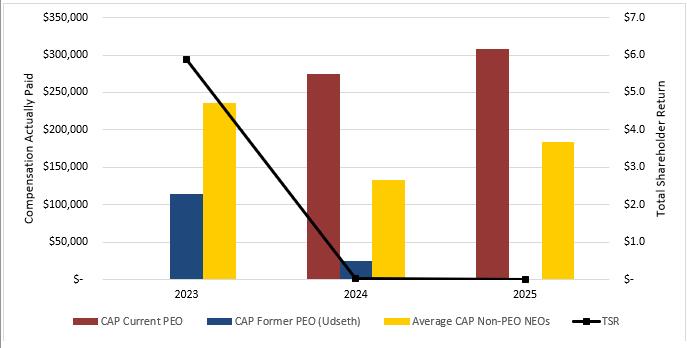
Compensation Actually Paid vs Net Income (Loss)
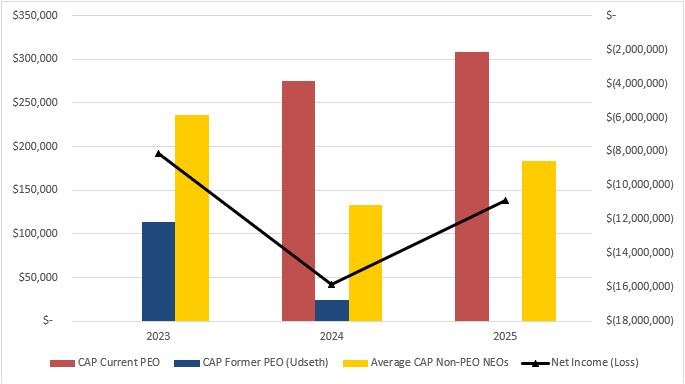
DIRECTOR COMPENSATION
In 2025, the annual compensation payable to non-employee directors of the Board, payable on a quarterly basis on the first day, or as soon as practicable after the first day, of each quarter:
$30,000 cash retainer for all non-employee directors;
$7,500 additional cash retainer to each chair of a committee of the Board;
$5,000 additional cash retainer for service on each committee of the Board, excluding the chair of such committee; and
$15,000 additional cash retainer to the chair of the Board.
While non-employee directors received an annual grant of RSUs in 2022, the RSU grant initially intended for 2023 was not made until early 2024. As a result, our non-employee directors did not receive any equity awards in 2023. During 2024 and 2025, the Company effected three reverse stock splits and the shares available in the 2022 Equity Incentive Plan proportionally decreased as a result. As a result, there were no longer enough available shares to do meaningful equity awards and the Company did not grant any equity awards to directors in 2024 and 2025.
The following table sets forth summary information concerning the compensation earned by our directors for the fiscal year ended December 31, 2025. Compensation paid to or earned by Mr. Maskin, who served as a director and was an NEO during the fiscal year ended December 31, 2025, is set forth in the Summary Compensation Table.
| | |
| Fees Earned or | |
| Paid in Cash | Total |
Name | ($) | ($) |
Spring Hollis | 48,125 | 48,125 |
Henry Howard(1) | 35,625 | 35,625 |
Roger H.D. Lacey | 45,000 | 45,000 |
Kevin O'Connor | 47,500 | 47,500 |
(1)Mr. Howard was a former director of the Board of the Company during the fiscal year ended December 31, 2025, who resigned from the board of directors on August 13, 2025.
ITEM 12. SECURITY OWNERSHIP OF CERTAIN BENEFICIAL OWNERS AND MANAGEMENT AND RELATED STOCKHOLDER MATTERS
Ownership of Certain Beneficial Owners and Management
The following table and accompanying footnotes set forth certain information regarding the beneficial ownership of the Company’s voting stock and Common Stock by (i) each person known by the Company to beneficially own more than 5% of our voting stock or Common Stock, (ii) each current executive officer and director of the Company, (iii) each of the Named Executive Officers of the Company for the fiscal year ended December 31, 2025, and (iv) all current executive officers and directors of the Company as a group, in each case based upon information available to the Company as of December 31, 2025. Percentage ownership is based on 3,406,616 shares of our common stock outstanding as of March 10, 2026. Unless otherwise noted, the address of each person is 171 Remington Boulevard, Ronkonkoma, NY 11779.
Beneficial ownership is determined in accordance with SEC rules. These rules generally attribute beneficial ownership of securities to persons who possess sole or shared voting power or investment power with respect to those securities and include shares of Common Stock issuable upon the exercise of options, warrants, preferred stock, and other securities that are immediately exercisable or convertible, or exercisable or convertible within 60 days of March 10, 2026. Except as otherwise indicated, all persons listed below have sole voting and investment power with respect to the shares beneficially owned by them, subject to applicable community property laws. The information is not necessarily indicative of beneficial ownership for any other purpose.
| | |
Beneficial Owner | Number of Shares Of Common Stock | Percentage of Shares of Common Stock Outstanding |
Roger H.D. Lacey | 11 | * |
Scott Maskin | 24 | * |
Spring Hollis | 14 | * |
Henry Howard (1) | — | * |
Kevin O'Connor | 2 | * |
James Brennan | 15 | * |
Kristin Hlavka | 2 | * |
Andrew Childs | — | * |
All current executive officers and directors as a group (7 persons) | 68 | * |
| | | | | | | |
| | | | | | | |
* | Less than one percent |
(1) | Based on information available to the Company, Mr. Howard was a former director of the Board of the Company during the fiscal year ended December 31, 2025. |
(2) | Based on information available to the Company, Mr. Childs, the Company’s former Interim Chief Financial Officer, was a Named Executive Officer of the Company during the fiscal year ended December 31, 2025. |
| |
ITEM 13. CERTAIN RELATIONSHIPS AND RELATED TRANSACTIONS, AND DIRECTOR INDEPENDENCE
SUNation Acquisition
On November 9, 2022, the Company acquired all of the issued and outstanding equity of SUNation Solar Systems, Inc. and five of its affiliated entities (“SUNation”), directly or indirectly from SUNation’s owners, which included Scott Maskin and James Brennan (with the other two owners, Scott Sousa and Brian Karp, collectively, the “Sellers”). Mr. Maskin was appointed a director of the Company and the Senior Vice President and General Manager, New York Division, of the Company, received 3 shares (513,300 shares prior to the reverse stock splits) of Company common stock as consideration in the transaction and was granted an inducement award of 1 restricted stock unit (69,091 restricted stock units prior to the reverse stock splits) in connection with his employment with the Company. Mr. Brennan was appointed Senior Vice President, Corporate Development, of the Company, received 3 shares (494,007 shares prior to the reverse stock splits) of Company common stock as consideration in the transaction and was granted an inducement award of 3 restricted stock units (65,455 restricted stock units prior to the reverse stock splits) in connection with his employment with the Company.
The terms of Mr. Maskin’s and Mr. Brennan’s current Employment Agreements are set forth above under “Employment Agreements.”
The Company acquired SUNation from the Sellers for an aggregate purchase price of $18,440,533, comprised of (a) $2,390,000 in cash consideration paid at closing, (b) the issuance at closing of a $5,000,000 Short-Term Limited Recourse Secured Promissory Note payable to Messrs. Maskin and Brennan (the “Short-Term Note”), (c) the issuance at closing of a $5,486,000 Long-Term Promissory Note payable to Messrs. Maskin and Brennan (the “Long-Term Note”), with a fair value of $4,830,533 at the acquisition date, and (d) the issuance at closing of an aggregate of 1,480,000 shares of Company common stock. The purchase price also includes potential earn-out payments of up to $5,000,000 in the aggregate based on the percentage of year-over-year EBITDA growth of the SUNation businesses in 2023 and 2024.
The Short-Term Note was paid in full on June 1, 2023. The Long-Term Note was unsecured and initially matured on November 9, 2025. On April 10, 2025, the original Long-Term Note was amended and restated as follows: The principal amount of $5,486,000 previously due and payable under the original Long Term Note, together with all accrued and unpaid interest owing thereunder, shall be due and payable on May 1, 2028 (the “Maturity Date”), and such amended note shall become a senior secured instrument. Principal and interest payments under the amended Long-Term Note shall be payable monthly on the first day of each month commencing with June 1, 2025 for thirty-six (36) consecutive months thereafter pursuant to the terms thereunder. Additionally, pursuant to the terms of that certain Senior Secured Contingent Note Instrument, entered into on April 10, 2025, the unearned 2024 earnout was rescheduled and shall be based on the earnout terms set forth therein pursuant to the financial conditions and terms covering each of fiscal years 2024 and 2025 and, if attained, shall be payable over a period of 24 months beginning in fiscal year 2026, which payment is further conditioned on the continued employment of the note holders at the time of such earnout payment trigger date.
General
The Company’s Board has adopted Governance Guidelines that include provisions with respect to conflicts of interest. These Guidelines describe a “conflict of interest” as a situation in which a director’s personal interest, including an immediate family member interest, is adverse to, or may appear to be adverse to, the interests of the Company. The Guidelines provide that any situation that involves, or may reasonably be expected to involve, a conflict of interest with the Company, must be disclosed promptly to the Chief Executive Officer, the Chairman, and the Company’s primary legal counsel.
If the Company wishes to proceed with a transaction involving a potential conflict of interest, the Board would intend to seek prior approval from the Audit and Finance Committee to ensure the transaction is beneficial to the Company and the terms of the transaction are fair to the Company.
Executive Compensation and Employment Arrangements
Information on compensation arrangements with the Company’s executive officers is described in detail in Part III, Item 11. “Executive Compensation”.
DIRECTOR INDEPENDENCE
Under the Nasdaq listing standards, a majority of the members of a listed company’s board of directors must qualify as “independent,” as affirmatively determined by the board of directors. Our Board of Directors has affirmatively determined that, as currently constructed, all of our directors, except for Mr. Maskin, are independent directors within the meaning of the applicable Nasdaq listing standards.
ITEM 14. PRINCIPAL ACCOUNTING FEES AND SERVICES
Change in Independent Registered Public Accounting Firm
On July 18, 2025, the Audit and Finance Committee of the Board of Directors (the “Audit Committee”) of the Company dismissed UHY LLP (“UHY”) as the Company’s independent registered public accounting firm. During the Company’s two most recent fiscal years ended December 31, 2023 and December 31, 2024 and during the subsequent interim period from January 1, 2025 through July 15, 2025, (i) there were no disagreements with UHY on any matter of accounting principles or practices, financial statement disclosure or auditing scope or procedures that, if not resolved to UHY’s satisfaction, would have caused UHY to make reference to the subject matter of the disagreement in connection with its reports and (ii) there were no “reportable events” as defined in Item 304(a)(1)(v) of Regulation S-K. The audit reports of UHY on the consolidated financial statements of the Company for each of the two most recent fiscal years ended December 31, 2023 and December 31, 2024 did not contain an adverse opinion or a disclaimer of opinion and were not qualified or modified as to uncertainty, audit scope or accounting principles.
On July 18, 2025, the Audit Committee approved the engagement of CBIZ CPAs P.C. (“CBIZ”) as its new independent registered public accounting firm. CBIZ’s appointment is for the Company’s fiscal year ending December 31, 2025, and related interim periods. During the Company’s two most recent fiscal years ended December 31, 2024 and December 31, 2023, and for the subsequent interim period through July 15, 2025, neither the Company nor anyone on its behalf consulted CBIZ regarding (i) the application of accounting principles to a specified transaction, either completed or proposed, or the type of audit opinion that might be rendered on the consolidated financial statements of the Company, in connection with which neither a written report nor oral advice was provided to the Company that CBIZ concluded was an important factor considered by the Company in reaching a decision as to the accounting, auditing or financial reporting issue; or (ii) any matter that was either the subject of a disagreement as defined in Item 304(a)(1)(iv) of Regulation S-K or a reportable event as described in Item 304(a)(1)(v) of Regulation S-K.
Fees of Independent Registered Public Accounting Firm
The following is a summary of the fees billed to the Company by CBIZ for professional services for the year ended December 31, 2025:
| | | | | | |
Fee Category | | | | | | 2025 |
Audit Fees | | | | | $ | 427,500 |
Audit-Related Fees | | | | | | — |
Tax Fees | | | | | | — |
All Other Fees | | | | | | — |
Total Fees | | | | | $ | 427,500 |
The following is a summary of the fees billed to the Company by UHY for professional services for the years ended December 31, 2025 and 2024:
| | | | | | |
Fee Category | | | 2025 | | | 2024 |
Audit Fees | | $ | 357,337 | | $ | 745,850 |
Audit-Related Fees | | | — | | | — |
Tax Fees | | | — | | | — |
All Other Fees | | | — | | | — |
Total Fees | | $ | 357,337 | | $ | 745,850 |
Audit Fees. This category consists of fees billed for professional services rendered for the audit of the Company’s annual financial statements and review of financial statements included in our quarterly reports.
Audit-Related Fees. This category consists of fees billed for assurance and related services, such as the Company’s employee benefit plan audits that are reasonably related to the performance of the audit or review of the Company’s financial statements and are not otherwise reported under “Audit Fees.”
Tax Fees. This category consists of fees billed for professional services for tax compliance, tax advice and tax planning. Assistance regarding federal and state tax compliance and acquisitions are provided to the Company by RSM US LLP.
All Other Fees. All other fees are fees for products and services other than those listed above.
Audit and Finance Committee Pre-Approval Policies and Procedures
In addition to approving the engagement of the independent registered public accounting firm to audit the Company’s consolidated financial statements, the policy of the Audit and Finance Committee is to approve all use of the Company’s independent registered public accounting firm for non-audit services prior to any such engagement. To minimize relationships that could appear to impair the objectivity of the independent registered public accounting firm, the policy of the Committee is to restrict the non-audit services that may be provided to the Company by the Company’s independent registered public accounting firm primarily to tax services, merger and acquisition due diligence and integration services, and any other services that can clearly be designated as “non-audit” services. All of the services described above for 2025 and 2024 were pre-approved by the Audit and Finance Committee before CBIZ and UHY, were engaged to render the services.
PART IV
ITEM 15. EXHIBITS AND FINANCIAL STATEMENT SCHEDULES
(a) (1) Consolidated Financial Statements
The following Consolidated Financial Statements of SUNation Energy, Inc. and subsidiaries appear at pages 40 to 87 herein:
Report of Independent Registered Public Accounting Firm
Report of Independent Registered Public Accounting Firm
Consolidated Balance Sheets as of December 31, 2025 and 2024
Consolidated Statements of Operations and Comprehensive Loss for the years ended December 31, 2025 and 2024
Consolidated Statements of Changes in Stockholders’ Equity for the years ended December 31, 2025 and 2024
Consolidated Statements of Cash Flows for the years ended December 31, 2025 and 2024
Notes to Consolidated Financial Statements
(a) (2)Consolidated Financial Statement Schedules
The schedules are omitted as the required information is inapplicable or the information is presented in the consolidated financial statements or related notes.
(a) (3)Exhibits
| | | |
Regulation S-K | | | |
Reference | | Title of Document | Location |
1.1 | | Form of Placement Agency Agreement, dated February 27, 2025, between the Company and Roth Capital Partners, LLC | Filed as Exhibit 1.1 to Form 8-K filed on February 27, 2025 and incorporated herein by reference. |
3.1 | | Certificate of Incorporation of SUNation Energy, Inc. | Filed as Exhibit 3.1 to the Form 8-K filed on November 19, 2024 and incorporated herein by reference. |
3.2 | | Bylaws SUNation Energy, Inc. | Filed as Exhibit 3.2 to the Form 8-K filed on November 19, 2024 and incorporated herein by reference. |
3.3 | | Certificate of Designation of Series D Preferred Stock | Filed as Exhibit 3.1 to Form 8-K filed on February 27, 2025 and incorporated herein by reference. |
3.4 | | Amended Certificate of Incorporation of SUNation Energy, Inc. | Filed as Exhibit 3.1 to Form 8-K filed on April 4, 2025 and incorporated herein by reference. |
3.5 | | Certificate of Amendment of Certificate of Incorporation of SUNation Energy, Inc. | Filed as Exhibit 3.1 to Form 8-K filed on April 17, 2025 and incorporated herein by reference. |
4.1 | | Description of Registrant’s Securities Registered Pursuant to Section 12 of the Securities Exchange Act of 1934 | Filed herewith. |
4.2 | | Form of Senior Indenture | Filed as Exhibit 4.4 to Registration Statement on Form S-3 filed August 25, 2022 and incorporated herein by reference. |
4.3 | | Form of Subordinated Indenture | Filed as Exhibit 4.5 to Registration Statement on Form S-3 filed August 25, 2022 and incorporated herein by reference. |
4.4 | | Form of Series A Warrant | Filed as Exhibit 4.1 to Form 8-K filed on February 27, 2025 and incorporated herein by reference. |
4.5 | | Form of Series B Warrant | Filed as Exhibit 4.2 to Form 8-K filed on February 27, 2025 and incorporated herein by reference. |
4.6 | | Form of Pre-Funded Warrant | Filed as Exhibit 4.3 to Form 8-K filed on February 27, 2025 and incorporated herein by reference. |
10.1 | * | Pineapple Energy Inc. 2022 Employee Stock Purchase Plan, as amended | Filed as Appendix B to the 2023 Annual Meeting of Shareholders on Schedule 14A filed on November 3, 2023 and incorporated herein by reference. |
10.2 | | Loan and Security Agreement dated as of December 11, 2020 by and between Pineapple Energy LLC as Borrower and Hercules Capital, Inc. as Lender and Agent. | Filed as Exhibit 10.14 to Registration Statement on Form S-4 filed on November 12, 2021 and incorporated herein by reference. |
10.3 | # | Consent and Amendment to Loan and Security Agreement dated as of December 16, 2021 by and between Pineapple Energy LLC as Borrower and Hercules Capital, Inc. as Lender and Agent. | Filed as Exhibit 10.19 to Registration Statement on Form S-4/A filed on January 26, 2022 and incorporated herein by reference. |
10.4 | * | Form of Restricted Stock Unit Award Agreement under the 2022 Equity Incentive Plan | Filed as Exhibit 10.1 to Form 10-Q filed on November 14, 2022 and incorporated herein by reference. |
10.5 | * | Form of Performance Stock Unit Award Agreement under the 2022 Equity Incentive Plan | Filed as Exhibit 10.2 to Form 10-Q filed on November 14, 2022 and incorporated herein by reference. |
10.6 | * | Form of Incentive Stock Option Award Agreement under the 2022 Equity Incentive Plan | Filed as Exhibit 10.3 to Form 10-Q filed on November 14, 2022 and incorporated herein by reference. |
10.7 | * | Form of Non-Qualified Stock Option Award Agreement under the 2022 Equity Incentive Plan | Filed as Exhibit 10.4 to Form 10-Q filed on November 14, 2022 and incorporated herein by reference. |
10.8 | * | Restricted Stock Unit Award Agreement (Inducement Grant) between Scott Maskin and Pineapple Energy Inc., dated as of November 15, 2022. | Filed as Exhibit 10.1 to Registration Statement on Form S-8 filed on November 15, 2022 and incorporated herein by reference. |
10.9 | * | Restricted Stock Unit Award Agreement (Inducement Grant) between James Brennan and Pineapple Energy Inc., dated as of November 15, 2022. | Filed as Exhibit 10.2 to Registration Statement on Form S-8 filed on November 15, 2022 and incorporated herein by reference. |
10.10 | | Form of Consent, Waiver and Amendment among Pineapple Energy Inc. and each of its Series A Preferred Stock and warrant holders. | Filed as Exhibit 10.1 to Form 8-K filed on November 10, 2022 and incorporated herein by reference. |
10.11 | | Contingent Value Rights Agreement dated March 25, 2022 by and among the Company, Equiniti Trust Company, as Rights Agent, and Richard A. Primuth in his capacity as the initial CVR Holders’ Representative. | Filed as Exhibit 10.1 to Form 8-K filed on March 29, 2022 and incorporated herein by reference. |
10.12 | * | Pineapple Energy Inc. 2022 Equity Incentive Plan, as amended through December 7, 2022. | Filed as Exhibit 10.2 to Form 8-K filed on December 9, 2022 and incorporated herein by reference. |
10.13 | | Revenue Loan and Security Agreement dated as of June 1, 2023 by and among Pineapple Energy Inc., the Guarantors party thereto, and Decathlon Specialty Finance, LLC | Filed as Exhibit 10.1 to Form 8-K filed on June 6, 2023 and incorporated herein by reference. |
10.14 | | Consent and Amendment No. 2 to Loan and Security Agreement dated as of May 31, 2023 by and between Pineapple Energy LLC as Borrower and Hercules Capital, Inc. as Lender and Agent | Filed as Exhibit 10.2 to Form 8-K filed on June 6, 2023 and incorporated herein by reference. |
10.15 | | First Amendment to Contingent Value Rights Agreement, dated March 27, 2024, by and among the Company, Equiniti Trust Company, as Rights Agent, and Richard A. Primuth in his capacity as the initial CVR Holders’ Representative. | Filed as Exhibit 10.46 to the Form 10-K filed on April 1, 2024 and incorporated herein by reference. |
10.16 | | Form of Securities Purchase Agreement between Pineapple Energy, Inc. and each purchaser identified therein | Filed as Exhibit 10.1 to Form 8-K filed on February 5, 2024 and incorporated herein by reference. |
10.17 | | Form of Waiver and Amendment | Filed as Exhibit 10.2 to Form 8-K filed on February 5, 2024 and incorporated herein by reference. |
10.18 | | Subscription and Investment Representation Agreement, dated April 23, 2024, by and between Pineapple Energy Inc. and Lake Street Solar, LLC | Filed as Exhibit 10.1 to Form 8-K filed on May 17, 2024 and incorporated herein by reference. |
10.19 | | Form of Limited Waiver and Amendment | Filed as Exhibit 10.1 to Form 8-K filed on May 22, 2024 and incorporated herein by reference. |
10.20 | * | Separation Agreement between Kyle Udseth and Pineapple Energy Inc. dated May 19, 2024 | Filed as Exhibit 10.2 to Form 8-K filed on May 23, 2024 and incorporated herein by reference. |
10.21 | * | Pineapple Energy Inc. 2022 Equity Incentive Plan, as amended through July 19, 2024 | Filed as Exhibit 10.1 to Form 8-K filed on July 25, 2024 and incorporated herein by reference. |
10.22 | | Secured Credit Agreement, dated July 22, 2024, between Pineapple Energy Inc. and Conduit Capital U.S. Holdings LLC | Filed as Exhibit 10.1 to Form 8-K filed on July 26, 2024 and incorporated herein by reference. |
10.23 | | Secured Credit Note, dated July 22, 2024, between Pineapple Energy Inc. and Conduit Capital U.S. Holdings, LLC | Filed as Exhibit 10.2 to Form 8-K filed on July 26, 2024 and incorporated herein by reference. |
10.24 | | Security Agreement, dated July 22, 2024, between Pineapple Energy Inc. and Conduit Capital U.S. Holdings, LLC | Filed as Exhibit 10.3 to Form 8-K filed on July 26, 2024 and incorporated herein by reference. |
10.25 | | Secured Credit Agreement, dated July 22, 2024, between Pineapple Energy Inc. and MBB Energy, LLC | Filed as Exhibit 10.4 to Form 8-K filed on July 26, 2024 and incorporated herein by reference. |
10.26 | | Secured Credit Note, dated July 22, 2024, between Pineapple Energy Inc. and MBB Energy, LLC. Security | Filed as Exhibit 10.5 to Form 8-K filed on July 26, 2024 and incorporated herein by reference. |
10.27 | | Security Agreement, dated July 22, 2024, between Pineapple Energy Inc. and MBB Energy, LLC | Filed as Exhibit 10.6 to Form 8-K filed on July 26, 2024 and incorporated herein by reference. |
10.28 | | First Amendment to Revenue Loan and Security Agreement, dated July 22, 2024, by and among Pineapple Energy Inc., the Guarantors party thereto, and Decathlon Specialty Finance LLC | Filed as Exhibit 10.7 to Form 8-K filed on July 26, 2024 and incorporated herein by reference. |
10.29 | | Amendment and Joinder to Subordination Agreement, dated July 22, 2024 among Pineapple Energy Inc., Decathlon Growth Credit, LLC, Hercules Capital, Inc., and MBB Energy, LLC and Conduit Capital U.S. Holdings, LLC | Filed as Exhibit 10.8 to Form 8-K filed on July 26, 2024 and incorporated herein by reference. |
10.30 | | Consent and Amendment No. 3 to Loan and Security Agreement, dated July 22, 2024 by and among Pineapple Energy LLC, Pineapple Energy Inc. and each other person that has delivered a Joinder Agreement | Filed as Exhibit 10.9 to Form 8-K filed on July 26, 2024 and incorporated herein by reference. |
10.31 | | Offer Letter dated August 28, 2024, between Pineapple Energy Inc. and Andrew Childs | Filed as Exhibit 10.1 to Form 8-K filed on September 4, 2024 and incorporated herein by reference. |
10.32 | | Amended and Restated Convertible Secured Credit Note, dated September 9, 2024, between Pineapple Energy Inc. and Conduit Capital U.S. Holdings, LLC | Filed as Exhibit 10.2 to Form 8-K filed on September 9, 2024 and incorporated herein by reference. |
10.33 | | Form of Securities Exchange Agreement between Pineapple Energy, Inc. and the holder signatory hereto | Filed as Exhibit 10.3 to Form 8-K filed on September 9, 2024 and incorporated herein by reference. |
10.34 | | Second Amended and Restated Convertible Secured Credit Note, dated September 23, 2024, between Pineapple Energy Inc. and Conduit Capital U.S. Holdings, LLC | Filed as Exhibit 10.2 to Form 8-K filed on September 26, 2024 and incorporated herein by reference. |
10.35 | | At The Market Offering Agreement dated as of October 21, 2024, between Pineapple Energy Inc. and Roth Capital Partners, LLC | Filed as Exhibit 10.1 to Form 8-K filed on October 21, 2024 and incorporated herein by reference. |
10.36 | | Second Amendment to Revenue Loan and Security Agreement, dated September 12, 2024, by and among Pineapple Energy Inc., the Guarantors party thereto, and Decathlon Specialty Finance LLC | Filed as Exhibit 10.15 to Form 10-Q filed on November 14, 2024 and incorporated herein by reference. |
10.37 | | Consent and Amendment No. 4 to Loan and Security Agreement, dated September 20, 2024, by and among Pineapple Energy LLC, Pineapple Energy Inc. and each other person that has delivered a Joinder Agreement | Filed as Exhibit 10.16 to Form 10-Q filed on November 14, 2024 and incorporated herein by reference. |
10.38 | | Amendment to Secured Credit Note, dated November 1, 2024, between Pineapple Energy Inc. and MBB Energy, LLC | Filed as Exhibit 10.19 to Form 10-Q filed on November 14, 2024 and incorporated herein by reference. |
10.39 | | Amendment to Second Amended and Restated Convertible Secured Credit Note; and to the Credit Agreement, dated November 1, 2024, between Pineapple Energy Inc. and Conduit Capital U.S. Holdings LLC | Filed as Exhibit 10.20 to Form 10-Q filed on November 14, 2024 and incorporated herein by reference. |
10.40 | * | Employment Agreement, dated December 9, 2024, between SUNation Energy Inc. and Scott Maskin | Filed as Exhibit 10.1 to Form 8-K filed on December 13, 2024 and incorporated herein by reference. |
10.41 | * | Employment Agreement, dated December 9, 2024, between SUNation Energy, Inc. and Jim Brennan | Filed as Exhibit 10.2 to Form 8-K filed on December 13, 2024 and incorporated herein by reference. |
10.42 | | Second Amendment to Contingent Value Rights Agreement dated March 25, 2022 by and among the Company, Equiniti Trust Company, as Rights Agent, and Richard A. Primuth in his capacity as the initial CVR Holders’ Representative, dated December 30, 2024 | Filed as Exhibit 10.1 to Form 8-K filed on January 7, 2025 and incorporated herein by reference. |
10.43 | | Form of Securities Purchase Agreement, dated February 27, 2025, between the Company and purchasers identified therein | Filed as Exhibit 10.1 to Form 8-K filed on February 27, 2025 and incorporated herein by reference. |
10.44 | | Amended and Restated Long-Term Senior Secured Promissory Note, dated April 10, 2025, between SUNation Energy, Inc. and both Scott Maskin and James Brennan | Filed as Exhibit 10.53 to Form 10-K filed on April 15, 2025 and incorporated herein by reference. |
10.45 | | Pledge and Security Agreement, dated April 10, 2025, by and between SUNation Energy, Inc. and Scott Maskin and James Brennan | Filed as Exhibit 10.54 to Form 10-K filed on April 15, 2025 and incorporated herein by reference. |
10.46 | | Senior Secured Contingent Note, dated April 10, 2025, between SUNation Energy, Inc. and both Scott Maskin and James Brennan | Filed as Exhibit 10.55 to Form 10-K filed on April 15, 2025 and incorporated herein by reference. |
10.47 | | Subordination and Intercreditor Agreement among SUNation Energy, Inc., Scott Maskin and James Brennan | Filed as Exhibit 10.56 to Form 10-K filed on April 15, 2025 and incorporated herein by reference. |
10.48 | | Secured Revolving Line of Credit Agreement, Dated April 14, 2025 | Filed as Exhibit 10.1 to Form 8-K filed on April 17, 2025 and incorporated herein by reference. |
10.49 | | Security Agreement, dated April 14, 2025 | Filed as Exhibit 10.2 to Form 8-K filed on April 17, 2025 and incorporated herein by reference. |
10.50 | | ATM Sales Agreement, Dated August 18, 2025, Between SUNation Energy, Inc. and Needham & Company, LLC | Filed as Exhibit 10.1 to Form 8-K on August 18, 2025 and incorporated herein by reference. |
10.51 | * | Employment Agreement between SUNation Energy, Inc. and Kristin Hlavka | Filed herewith. |
21 | | Subsidiaries of the Registrant | Filed herewith. |
23.1 | | Consent of Independent Registered Public Accounting Firm | Filed herewith. |
23.2 | | Consent of Independent Registered Public Accounting Firm | Filed Herewith |
24 | | Power of Attorney | Included on the signature page. |
31.1 | | Certification of Chief Executive Officer | Filed herewith. |
31.2 | | Certification of Chief Financial Officer | Filed herewith. |
32 | | Certification under USC § 1350 | Filed herewith. |
97 | | Pineapple Energy Inc. Compensation Recovery Policy | Filed as Exhibit 97 to Form 10-K filed on April 1, 2024 and incorporated herein by reference. |
101 .INS | | Inline XBRL Instance Document (the instance document does not appear in the Interactive Data File because its XBRL tags are embedded within the Inline XBRL document) |
101 .SCH | | Inline XBRL Taxonomy Extension Schema Document |
101.CAL | | Inline XBRL Taxonomy Extension Calculation Linkbase Document |
101 .DEF | | Inline XBRL Taxonomy Definition Linkbase Document |
101 LAB | | Inline XBRL Taxonomy Extension Label Linkbase Document |
101 .PRE | | Inline XBRL Taxonomy Extension Presentation Linkbase Document |
104 | | Cover Page Interactive Data File (formatted as inline XBRL and contained in Exhibit 101) |
| | | |
# Certain of the exhibits and schedules to this exhibit have been omitted in accordance with Regulation S-K Item 601. SUNation Energy agrees to furnish a copy of all omitted exhibits and schedules to the SEC upon its request.
*Indicates management contract or compensatory plan or arrangement.
ITEM 16. FORM 10-K SUMMARY
Not applicable.
SIGNATURES
Pursuant to the requirements of Section 13 or 15(d) of the Securities Exchange Act of 1934, the Registrant has duly caused this report to be signed on its behalf by the undersigned, thereunto duly authorized.
| | | |
| | SUNation Energy, Inc. |
| | By | /s/ Scott Maskin |
| | | Scott Maskin |
Date: March 20, 2026 | | | Chief Executive Officer |
Pursuant to the requirements of the Securities Exchange Act of 1934, this report has been signed below by the following persons on behalf of the Registrant in the capacities and on the dates indicated:
POWER OF ATTORNEY
Each person whose signature appears below constitutes and appoints Scott Maskin and James Brennan as their true and lawful attorneys-in-fact and agents, each acting alone, with full power of substitution and resubstitution, for them and in their name, place and stead, in any and all capacities, to sign any or all amendments to this Annual Report on Form 10-K and to file the same, with all exhibits thereto, and other documents in connection therewith, with the Securities and Exchange Commission, granting unto said attorneys-in-fact and agents, each acting alone, full power and authority to do and perform each and every act and thing requisite and necessary to be done in and about the premises, as fully to all intents and purposes as they might or could do in person, hereby ratifying and confirming all said attorneys-in-fact and agents, each acting alone, or their substitute or substitutes, may lawfully do or cause to be done by virtue thereof.
| | | | |
Signature | | Title | | Date |
| | | | |
/s/ Scott Maskin | | Chief Executive Officer (Principal Executive Officer), | | March 20, 2026 |
Scott Maskin | | Director | | |
/s/ James Brennan | | Chief Operating Officer and Chief Financial Officer | | March 20, 2026 |
James Brennan | | (Principal Financial Officer) | | |
/s/ Kristin A. Hlavka | | Chief Accounting Officer (Principal Accounting Officer) | | March 20, 2026 |
Kristin A. Hlavka | | | | |
/s/ Spring Hollis | | Director | | March 20, 2026 |
Spring Hollis | | | | |
/s/ Roger H.D. Lacey | | Director | | March 20, 2026 |
Roger H.D. Lacey | | | | |
/s/ Kevin O’Connor | | Director | | March 20, 2026 |
Kevin O’Connor | | | | |